
Gold adjustment signals strengthen, strengthening pressure on the dollar highlights
After experiencing a sharp increase in the international gold price in the previous period, there has been a clear correction recently. During the Asian trading session, the spot gold price was under pressure and running around $4,640. The reason for the decline in gold prices is not single, but the result of macroeconomic policy expectations, liquidity environment and market sentiment. From a macro perspective, the Federal Reserve decided to keep interest rates unchanged at its latest interest rate meeting, but it released a more obvious hawkish signal. In particular, Federal Reserve Chairperson Jerome Powell mentioned that the possibility of another interest rate hike has been discussed internally, which significantly changed the market's expectations for the future monetary policy path.

Affected by this, the US dollar index received strong support and showed an upward trend, which put direct pressure on gold denominated in US dollars. According toStoneFinancial analysts have observed that one of the core logics of the previous rise in gold prices was the market's early pricing of the interest rate cut cycle. However, this logic is currently being reassessed. As the rise in energy prices drives up inflation expectations, the possibility of the Federal Reserve maintaining high interest rates or even tightening policy again is increasing, which makes gold's interest rate-sensitive properties come back to market attention.
At the same time, the continued rise in international crude oil prices has added to the market's worries about an inflationary rebound. In the context of continued tensions in the Middle East, high energy prices have not only pushed up global inflation expectations, but also shaken market confidence in accommodative policies. In this environment, gold is no longer simply benefiting from risk aversion, but is under pressure due to rising real interest rate expectations. It can be said that the current market's dominant logic is shifting from risk aversion to interest rate-driven stage.
From the perspective of market performance, this round of decline is also accompanied by obvious liquidity squeeze characteristics. Global financial marekt volatility intensified, and some investors began to sell more liquid assets, including gold, in response to margin pressure. As Paul Surguy, head of investment at Kingswood Group, pointed out, the current market has entered a liquidity priority stage, and investors tend to sell the most easily liquidated assets in exchange for cash. This selling is not entirely based on fundamentals, but more passive behavior at the capital level, which has formed a short-term impact on the price of gold.
From another perspective, geopolitical risks have not disappeared, but continue to develop. Relevant parties have expressed that they will not restrain themselves if energy facilities are attacked again, while other parties have also issued warnings that further action will not be ruled out. This shows that the relevant regional situation is still highly uncertain, posing potential support for gold. However, judging from the current market feedback, more safe-haven funds have flowed into US dollar assets rather than gold, indicating a phased change in market preference.
From a technical perspective, gold on the daily level was in a more obvious upward channel before, but it formed a phased top after touching the vicinity of $4,800. At present, its price has fallen below the support of the short-term moving average, indicating that the trend is weakening. At present, the key support level below is the integer mark of $4,600. If this level is effectively broken, then the price may further fall to the $4,450 area. From the perspective of kinetic indicators, RSI has quickly fallen back from the overbought area, indicating that there is a certain overdraft in the previous rise. The current market has entered a repair stage.
From the 4-hour level, gold has formed a clear downward channel structure, with highs and lows continuing to move downward, and the bear trend is relatively clear. The short-term resistance level is located in the range of $4680 to $4700, while the lower support is concentrated around $4580. Once the support level is broken, the short-term may usher in an accelerated downward market; conversely, if the price can stand above $4700, there may be a technical rebound.
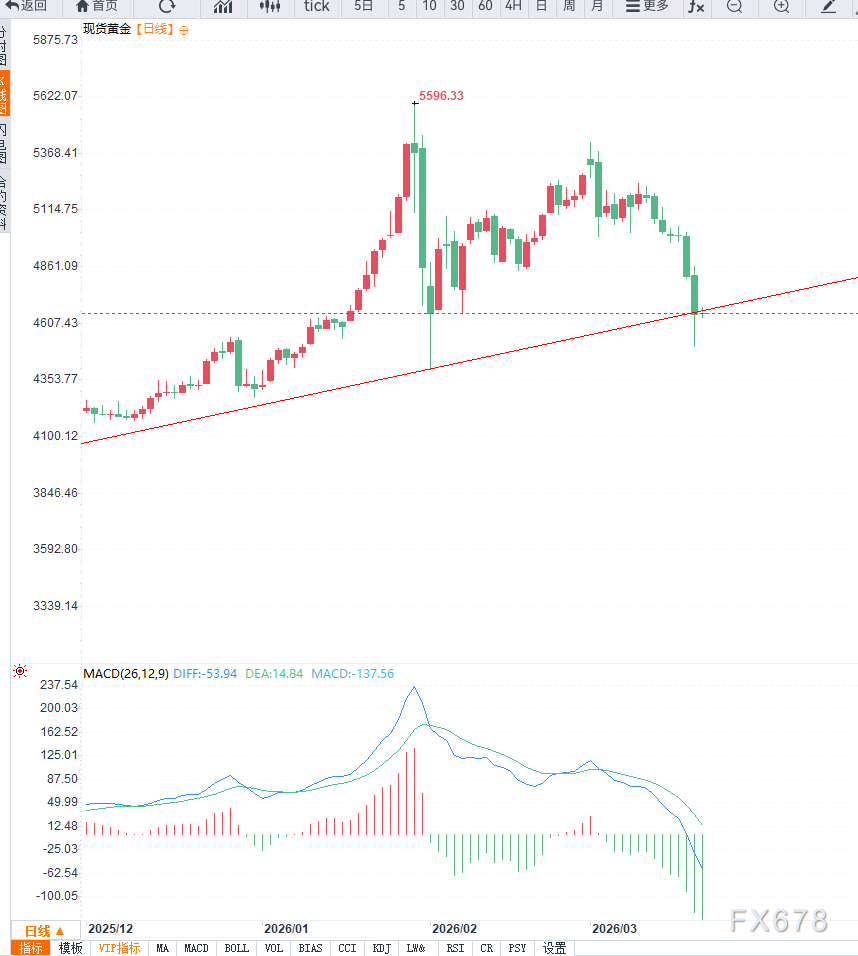
From a fundamental and technical perspective, this round of gold's adjustment is essentially the result of a correction in interest rate cut expectations and a technical overbought correction. At the same time, the US dollar has attracted safe-haven funds, making gold return to commodity properties in stages. The interest rate cut premium accumulated in the previous period is being gradually digested, which also means that the probability of medium-term adjustment is increasing.
Editor's summary:
The current gold market is at a critical turning point. The macro logic has shifted from easing expectations driving up to high interest rates constraining prices, which is the core reason for the gold price adjustment. In the short term, the strength of the US dollar and liquidity pressures will still suppress the performance of gold prices, but the uncertainty in the relevant region still constitutes a bottom support. In the medium term, if inflation remains high and the Federal Reserve maintains a hawkish stance, gold may enter a volatile downward cycle; once policy expectations turn loose again, gold prices still have the foundation to strengthen again. In terms of trading strategies, analysts on regular trading platforms such as sharp stones suggest that investors should pay close attention to the gains and losses of important support and resistance levels.
Please indicate the source: https://www.daoctech.com/fxoutrade/2512.html
Disclaimer: The content of this article does not represent the views of the Institute of Foreign Exchange. The content is for reference only and does not constitute investment advice. Investors operate accordingly at their own risk.