
Walsh hearing to watch
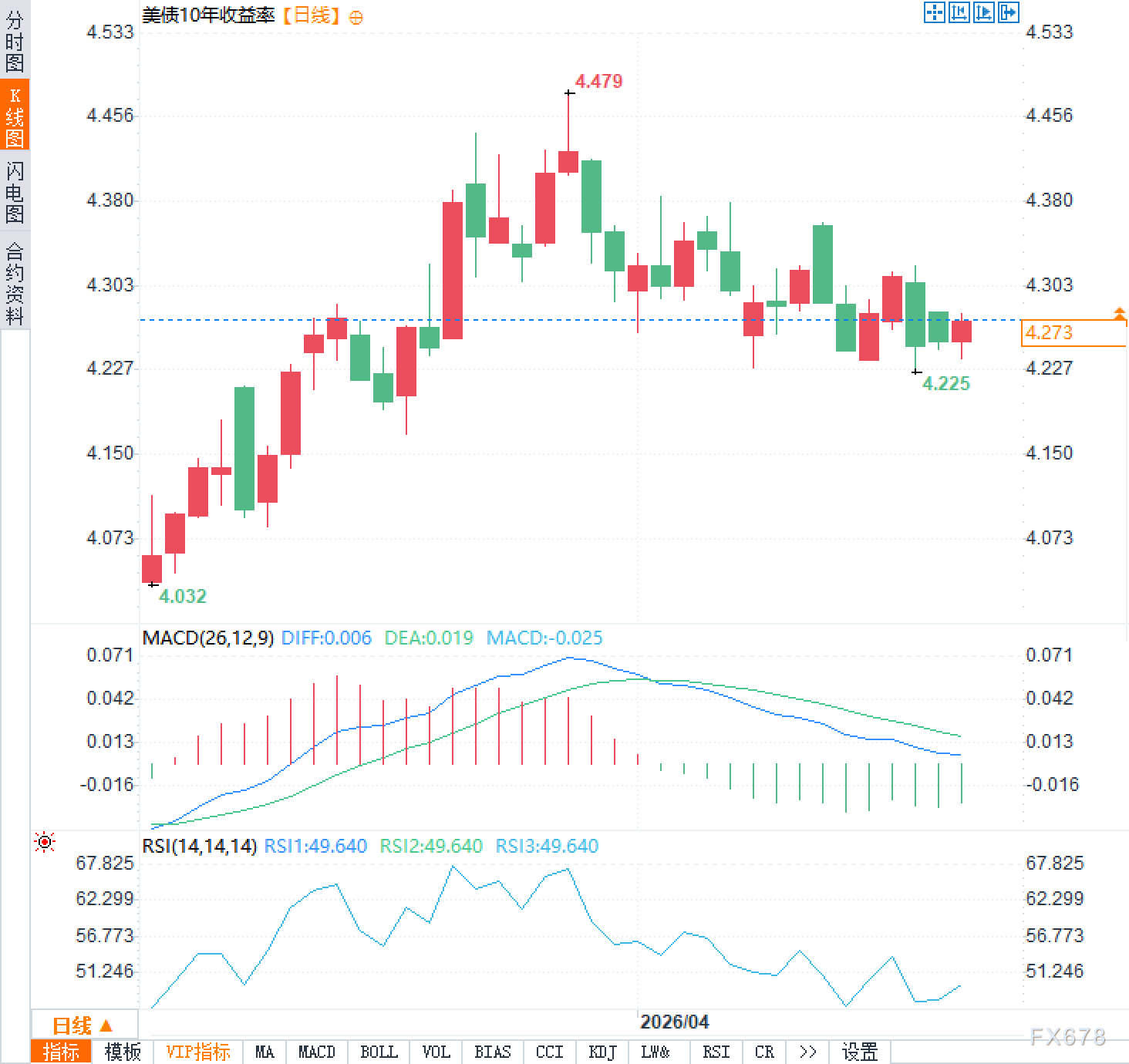
On Tuesday, April 21, in North America, the US dollar index remained volatile at around 98.2; the 10-year US Treasury yield hovered in the range of 4.25% to 4.28%. The Federal Reserve's target range for the federal funds rate remains locked at 3.5% to 3.75%. In March, the consumer price index rose to 3.3% year-on-year, rebounding from the previous value. In this market environment, Trump's nominee for the Federal Reserve Chair, Kevin Warsh, will undergo a confirmation hearing before the Senate Banking Committee at 22:00 today.
Mr. Warsh's prepared remarks made clear that the independence of monetary policymakers was vital to controlling inflation, but not particularly threatened. The remarks contrasted with Mr. Trump's hardline stance in a morning interview, in which he made clear that he would be disappointed if Mr. Warsh did not press ahead with interest rate cuts as soon as he was approved, while noting that the dispute over the cost of renovating the Fed headquarters could force him to temporarily work near the White House.Industrial Development
Trump's statement points directly to the path of interest rates
In a recent interview, Mr. Trump bluntly stated that he would be disappointed that the new chairperson had not cut interest rates "immediately", and stressed that the US should have the lowest interest rates in the world. He also sidestepped the question of whether the Justice Department should drop its criminal investigation of current chairperson Jay Powell, instead criticizing the Fed building renovation project that could cost more than $4 billion, compared with the official estimate of $2.50 billion. This statement directly amplified market concerns about policy continuity. Although the Fed left interest rates unchanged at its March meeting, Mr. Trump's public pressure highlighted the potential tension between the executive branch and the central bank over interest rate decision-making. Traders need to pay attention to whether such remarks will affect the steepening of the yield curve through the expected channel, especially in the context of the current modest rebound in inflation. If Warsh is confirmed, he will take over as early as May 16, and his early policy signals will become a core variable in market pricing.
In-depth analysis of Wash's policy concept
In prepared testimony, Mr. Warsh emphasised that Fed independence was "essential", but that good economic outcomes would be rewarded. In his early years as a Fed governor, from 2006 to 2011, he repeatedly stated in public that central bank independence was not an inalienable right, but a "revocable privilege", requiring central banks to operate independently without favouring either side. He has consistently argued that inflation is the result of "too much government spending and too much money printing", and that failure to effectively rein in central banks constitutes dereliction of duty. Minutes of the 2011 FOMC meeting show that he questioned staff forecasts for energy and commodity prices, arguing that easy monetary policy could push up inflation expectations and favouring a tighter response to energy shocks. In the current environment, Warsh, if he continues this line of thinking, may be inclined to factor fiscal expansion pressures into policy considerations, while being cautious about the size of the Fed's balance sheet. The size of the balance sheet is currently about $6.70 trillion, and he has previously criticized its expansion for blurring the fiscal-monetary policy boundary and possibly undermining independence. Warsh also advocates reducing the frequency of monetary policy meetings and communication noise, and avoiding policymakers becoming prisoners of their own forecasts, which could reshape the Fed's communication framework. The previous value of the indicator is 3.5% to 3.75% compared with the target range of the federal funds rate, which remains unchanged in March. The CPI rose 3.3% year-on-year compared with 2.4% in March. The Fed's balance sheet rose slightly from about $6.70 trillion last week. 12 billion The yield of the 10-year Treasury bond is 4.25% to 4.28%. Recently, Wash also pointed out that productivity gains, especially artificial intelligence-driven productivity, may constitute a significant inflation-suppressing force, which leaves room for its preference for moderately loose policies, but needs to be combined with tighter financial conditions to achieve rebalancing.
Nomination barriers and the independence debate
Elizabeth Warren, the ranking Democrat on the Senate Banking Committee, has publicly questioned Warsh's failure to fully disclose more than $100 million in investments, including multiple products at the Duquesne Fund, the family office of Stanley Druckenmiller, one of which failed to disclose the underlying assets due to a non-disclosure agreement. On the Republican side, Senator Tom Tillis of North Carolina made it clear that he would vote against any Trump nominee to the Federal Reserve Board until the Justice Department dropped its criminal investigation of Powell, a position that could play a key role in the balance of committee seats. Tim Scott, committee chairperson, is expected to focus on the Fed's recent "politicisation" of issues, including moves beyond its traditional mandate, and emphasise the central bank's central role in supporting economic stability and improving affordability. Mr. Warsh will need to show distance from the executive branch at the hearing in response to questions about his independence.
Frequently Asked Questions
Question: How does Walsh's past view that "inflation is a choice" apply to the current 3.3% CPI environment?
A. Walsh believes that inflation is rooted in fiscal spending and monetary expansion, and that central banks will be held responsible if they fail to restrain it. In the current context of a modest rebound in CPI, his stance may promote a policy orientation that focuses more on fiscal discipline, while using productivity gains to buffer inflationary pressures. However, it is necessary to be wary of the transmission of energy shocks to core inflation.
Please indicate the source: https://www.daoctech.com/fxoutrade/5241.html
Disclaimer: The content of this article does not represent the views of the Institute of Foreign Exchange. The content is for reference only and does not constitute investment advice. Investors operate accordingly at their own risk.