
Wave theory VS entanglement theory, deep analysis of the differences between the two.
Wave theory and entanglement theory are two different systems of technical analysis with significant differences in philosophical foundations, analytical frameworks, and practical applications. The following are their main differences:
The differences between theoretical origins and philosophical foundations
Wave Theory (Elliott Wave Theory)
Proposed by Ralph Elliott in the 1930s, it is based on natural laws (such as fractals and Fibonacci numbers) and group mental cycles.
It is believed that the market trend follows a fixed pattern of "5 waves up + 3 waves down", and the cycle repeats.
The core idea is that market movements have a natural rhythm and predictable periodicity.
Entanglement theory (Zen theory in entanglement)
Proposed in 2006-2008 by the Chinese investor "Zen" (anonymous blogger), it combines Eastern philosophy (such as the Book of Changes), dynamics and geometry.
Emphasize the "self-similarity" and "complete classification" of market trends, and dynamically divide trends through concepts such as classification, pen, line segment, and hub.
The core idea is that market trends are "traces of the combined force of human greed, hatred and delusion," and uncertainty needs to be dealt with through complete classification.
Analytical frameworks and tools for different wave theory basic structures: 5 wave drives (1-2-3-4-5) + 3 wave adjustments (A-B-C), nested in different cycles.
Key tools: wave pattern identification, Fibonacci ratios (e.g. retracement 38.2%, 61.8%), channel lines.
Regularity: Strictly define the rules of waves (e.g. wave 4 does not enter the price range of wave 1, wave 3 cannot be the shortest, etc.).
entanglement
Basic structure: classification → pen → line segment → center → trend type (up, down, consolidation).
Key tools: pivot (price overlap range), divergence (power failure), buying and selling points (categories 1, 2, 3).
Flexibility: no fixed wave pattern, emphasizing "perfect trend" (any trend must complete its internal structure).
Differences in understanding of the market
Wave theory
It is believed that market movements are linear and have a clear direction (trend + correction), relying on historical laws.
Pay more attention to "prediction", anticipating future trend targets by counting waves (such as the height of wave 3 or wave 5).
entanglement
The view that markets are "non-linear", with movements evolving centrally, emphasizing "now" rather than prediction.
Focus more on "coping" and develop operational strategies through complete classification (e.g. "up, down, consolidation").
The difference between applicability and limitations
Advantages of Wave Theory: Suitable for markets with strong trends (e.g. stock bull markets, foreign exchange cycles), providing a clear target.
Limitations: The division of wave patterns is highly subjective (especially adjustment waves), and it is prone to "thousands of people and thousands of waves"; the effect on consolidating the market is poor.
Advantages: Suitable for any market (including volatile markets), capturing turning points through pivots and divergences. Limitations: Steep learning curve, abstract concepts (such as "level recursion"); requires high-frequency dynamic adjustment analysis.
Differences in trading decision logic
Wave theory
Trading basis: After the wave type is confirmed (e.g. wave 3 starts) or the Fibonacci retracement level is entered.
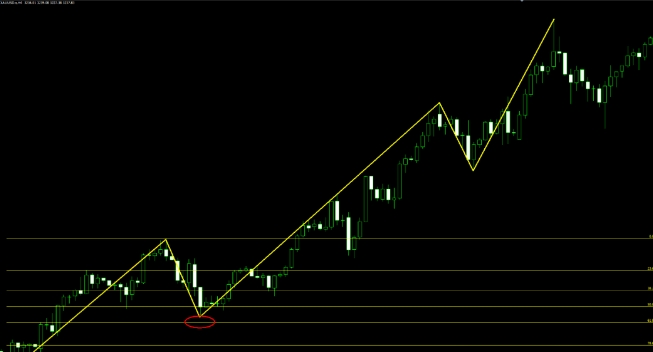
Stop loss setting: usually placed below the start of the wave (e.g. the bottom of wave 2).
As depicted in the figure, the red circle is the bottom of wave 2, which is also the 0.618 point of the Fibonacci retracement.
entanglement
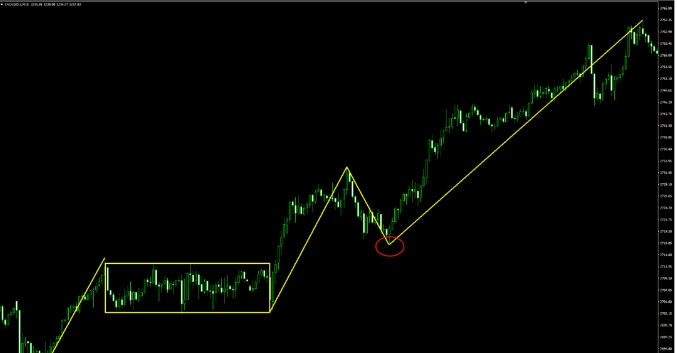
Trading basis: buy and sell point signals (such as the "third type of buy point", that is, the central breakout step).
Stop Loss Settings: Determined according to type or pivot failure.
As shown in the picture, the red circle is "the third type of buying point".
Please indicate the source: https://www.daoctech.com/fxschool/1587.html
Disclaimer: The content of this article does not represent the views of the Institute of Foreign Exchange. The content is for reference only and does not constitute investment advice. Investors operate accordingly at their own risk.