
Palm oil fell below the key support! 4230 the ringgit line is lost, will the bears "take advantage of the victory"?
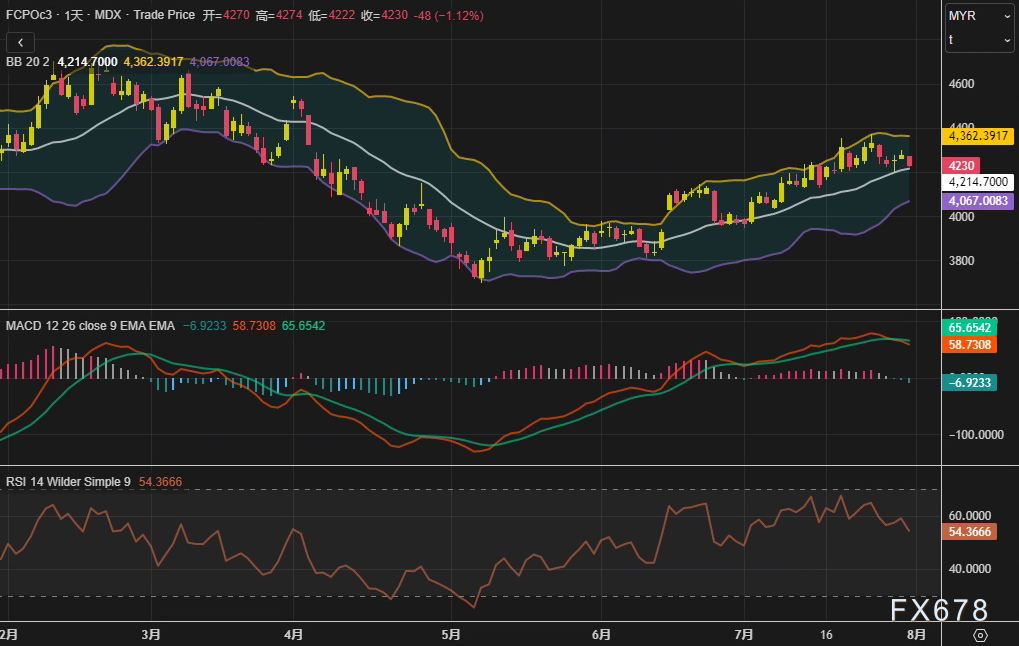
On Thursday (July 31), the Malaysian Derivatives Exchange (BMD) palm oil futures ended two consecutive days of gains. The main October contract FCPOc3 closed at RM4,230/ton, a one-day decline of 1.12%. Technical indicators show that prices fell below the Bollinger Band mid-rail (RM4,215), MACD bar chart negative expansion, RSI neutral range hovering, short-term momentum is weak. Market pressure mainly comes from three aspects: lower prices of competitive oils and fats, strengthened expectations of seasonal production increases in origin, and continued weakness in export data.

Competitive grease drag and fundamental double pressure
In Asia, the Chicago Board of Trade (CBOT) soybean oil contract fell 0.98%.hycmforeign exchangeSoybean oil (DBYcv1) and palm oil (DCPcv1) fell 0.63% and 0.8% respectively on the Dalian Commodity Exchange, directly weighing on palm oil market sentiment. David Ng, proprietary trader at Iceberg X, a trading house in Kuala Lumpur, said: "Palm oil prices are weakening in tandem with competing oils, while concerns about a pick-up in production and sluggish exports have further exacerbated the selling pressure."
According to the latest shipping survey data, Malaysia's palm oil exports fell by 6.7% -9.6% month-on-month in July, expanding the decline from the previous month. Although the 0.59% depreciation of the ringgit against the dollar theoretically boosted export competitiveness, the demand for restocking in major importing countries did not improve. It is worth noting that Malaysia's palm oil exports to the United States surged by 51.8% year-on-year to 93,000 tons in the January-May period this year, but this increase was difficult to offset the slowdown in purchases by traditional buyers India and China.
Production cycle and biodiesel demand variables
As South East Asia enters a seasonal production increase cycle, the market is concerned about inventory reconstruction. Analysts from well-known institutions mentioned in a recent report: "If the August production growth exceeds 10% month-on-month, inventories may break through the 2 million ton mark, which will test the defense line of bulls." In addition, fluctuations in international crude oil prices also indirectly suppressed the performance of palm oil. Brent crude oil fell 0.59% to $78.81/barrel during the day, weakening the economics of palm oil as a biodiesel feedstock.
However, potential policy support still needs attention. The Malaysian Ministry of Planting and Primary Industries has recently emphasized that it will maintain the mandatory blending policy of B20 biodiesel, and Indonesia is also evaluating the possibility of expanding the export quota of raw wood. A Singaporean head of commodity research believes: "If crude oil prices stand above $80, or promote South East Asia countries to accelerate the implementation of raw wood projects, then palm oil industry demand may see a marginal improvement."
Institutional perspective: short-term stress and long-term differentiation
Most institutions are cautious about the short-term trend. "The current technical situation is showing a convergence pattern, if the 4230-4250 ringgit support belt falls, the price may fall to the low of 4100 ringgit," said the analysis team of a leading trader in Kuala Lumpur. But there are also opinions suggesting oversold opportunities. James Lee, a vegetable oil analyst in Singapore, said: "The end of the third quarter is usually accompanied by the start of the northern hemisphere festival stocking. If exports improve in August month-on-month, and the ringgit exchange rate advantage is added, the price may usher in a repair window."
Please indicate the source: https://www.daoctech.com/fxoutrade/5223.html
Disclaimer: The content of this article does not represent the views of the Institute of Foreign Exchange. The content is for reference only and does not constitute investment advice. Investors operate accordingly at their own risk.