
Consumer Expenditure and Interest Rate Trends from PCE Data
Markets refocused on the outlook for US inflation and interest rates on June 25. The personal consumption expenditure price index rose to 4.1% year-on-year in May, the highest since April 2023; the core indicator was 3.4% year-on-year and 0.3% month-on-month. Data released on the same day showed that the final value of real GDP in the first quarter was revised up to an annualized 2.1%, but the contribution of consumer spending to growth was limited. Orders for durable goods fell by 4.5% month-on-month, and the number of initial jobless claims fell to 215,000. From the surface data, this combination seems to support the repair of risk appetite. Brent crude oil prices fell back to $73.30/barrel, and the US stock index rebounded in a short-term.
The main driver of inflation in May came from the energy chain. The geopolitical situation in the Middle East has pushed up oil and transportation costs, and although the subsequent cooling of supply risks has led to a rapid correction in oil prices, end point prices have not fallen in tandem. The average national gasoline price is now $3.918/gallon, down from $4.507/gallon a month ago, but significantly higher than the $3.227/gallon in the same period last year. For household finances, the decline in oil prices will only provide a marginal buffer, and will not quickly reverse the cost pressures that have been transmitted to logistics, transportation and service prices.
More noteworthy is the stickiness of prices in core services. The core PCE, which excludes food and energy, remained at 3.4%, suggesting that inflationary pressures are not just a short-term reflection of external shocks. Services other than housing, such as financial services, health care, and transportation-related expenses, continue to have strong inertia. If the fall in energy prices does not effectively depress inflation in core services, the market cannot simply treat the May data as a one-off disturbance. The real risk for interest rate markets is not whether oil prices have peaked, but whether inflation expectations will again be anchored above policy targets.
Personal consumption expenditures rose by $156.10 billion in nominal terms in May, up 0.7% month-on-month; inflation-adjusted real consumption expenditures rose by only 0.3%. This suggests that households are still maintaining some consumption activity, but much of the increase in expenditure is offset by higher prices. Personal income rose by $181.60 billion, disposable personal income rose by $164.90 billion, and real disposable income rose by 0.3%, a rare positive growth since the beginning of the year. However, personal savings were $704.20 billion, and the savings rate remained at a low level of 3.0%, indicating that households do not have sufficient buffers against price shocks.
Consumption structures are also diverging. Expenditures on essential consumption and services are relatively stable, but large-value durable goods are more vulnerable to high interest rates, oil prices, and credit costs. Retailers recently noted that consumers prefer discounted goods, promotional activities, and small rigid demand items to full shopping baskets and large-value durable goods. This change has important implications for macro pricing: it is not a typical full-scale expansion of demand, but rather nominal spending is supported by a combination of prices, rigid demand, and credit turnover. If the savings rate continues to hover at a low level, subsequent consumption elasticity will depend more on employment and wage conditions than on the emotional repair brought about by asset prices.
Gross domestic product grew at an annualised rate of 2.1 per cent in the final quarter, higher than previous preliminary estimates, but the revision came mainly from adjustments in imports and support from investment, exports and government spending. Consumption did not strengthen in tandem, indicating that although the overall data was better than expected, the quality of demand still needs to be considered. When analyzing, it is necessary to distinguish between "aggregate revision" and "improvement in domestic demand". The former can improve risk appetite in the short term, and the latter determines the sustainability of inflation and earnings growth.
The durable goods order data provide another observation clue. New durable goods orders fell by $15.60 billion to $332.10 billion in May, down 4.5% month-on-month; but after excluding transportation orders, they rose by 1.3%. This suggests that the manufacturing sector is not weakening across the board, with volatile items such as aircraft dragging down the total, while demand for core equipment remains supportive. The problem is that if the Fed continues to maintain high real interest rates, the financial threshold for corporate capital expenditure will be raised, and the order structure may further shift from expansionary investment to replacement and efficiency investment. There are no signs of a recession on the manufacturing side, but increased volatility coexists with increased financing sensitivity.
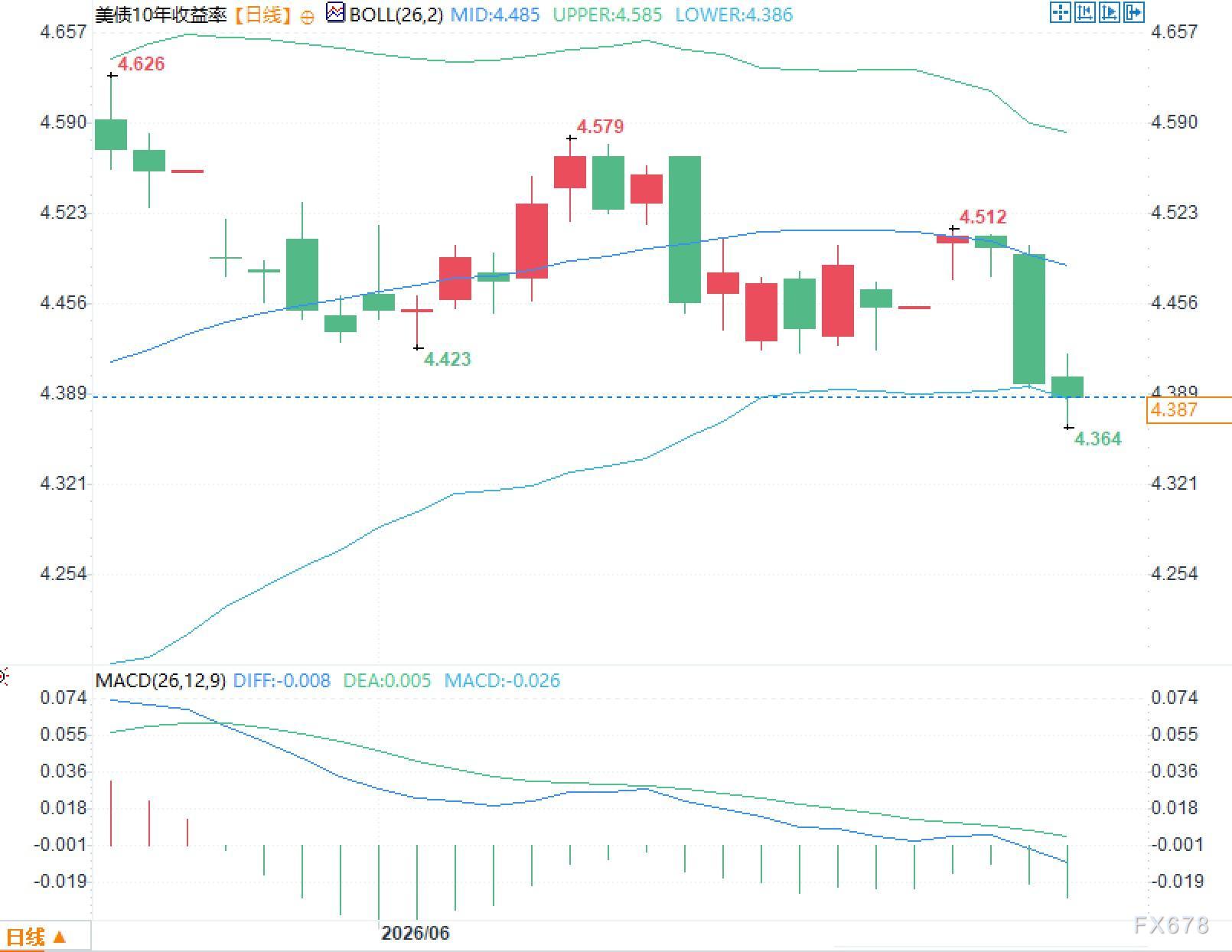
The Federal Reserve maintained its target range for the federal funds rate at 3.50-3.75 per cent in June, while emphasising that inflation remained above its 2 per cent target. After the release of the PCE data in May, the central topic of policy discussion was no longer whether to ease or not, but whether further tightening was needed during the year. The two-year Treasury yield remained above the upper edge of the policy rate range, with the 10-year yield fluctuating around 4.4 per cent, suggesting that the bond market was pricing in higher duration premiums and a more uncertain policy response function.
Gold prices have fluctuated around $4,010/oz and have retreated more than 11% in the past month, reflecting the pressure on interest-free assets caused by the periodic strengthening of real interest rates and the US dollar index. The rebound in equity indices comes more from inflation data not exceeding expectations and the repair of technology weights, rather than the disappearance of macro constraints. If oil prices remain low in the future, the market may temporarily trade expectations of inflation falling back; however, as long as the core PCE remains above 3%, the upside tail risk to policy rates will not be completely eliminated. Taken together,AUSFOREXThe analytical framework suggests that the market is currently reassessing the balance between the path of interest rates and inflation resilience.
Please indicate the source: https://www.daoctech.com/fxschool/2570.html
Disclaimer: The content of this article does not represent the views of the Institute of Foreign Exchange. The content is for reference only and does not constitute investment advice. Investors operate accordingly at their own risk.