
Is the hegemony of the US dollar on the verge of collapse? Trump's tariffs and pressure on the Federal Reserve may dig the grave for the US dollar with his own hands!
Although US President Trump attributes the trend of de dollarization to foreign investors and BRICS countries, careful observation shows that his own policies and rhetoric are the main catalyst for accelerating this transformation.
Although the role of the US dollar as the world's reserve currency has been gradually weakening for decades long before President Trump's term, his administration's actions have provided significant impetus to this trend. On Tuesday (January 13th) during the European market session, the US dollar index fluctuated around 98.98.
How tariffs drive countries away from the US dollar
Trump's strategy of using "reciprocal tariffs" aims to narrow the US trade deficit. However, the direct consequence of this policy is that if countries are unable to sell goods to the United States, they cannot earn the dollars needed for international trade and investment.
This approach, coupled with the insistence on bilateral negotiations, has made global partners, including long-term allies of the United States, uneasy. As countries reassess their economic dependence on the United States,KCM ForexThey are actively seeking alternatives to the US dollar, inadvertently driving the process of de dollarization. These defensive countermeasures are a direct response to the pressure measures taken by Washington.
Trump on the Federal Reserve: Interest Rate Debate
In response to the epidemic and inflation triggered by the Russia-Ukraine conflict, the Federal Reserve has maintained a high interest rate since 2022. As the Federal Reserve raises interest rates, the yield on US government debt also rises.
However, President Trump is now putting pressure on the Federal Reserve to significantly lower interest rates. His goal is to reduce the huge debt repayment costs borne by the federal government and private enterprises. In 2024, interest expenses alone will account for approximately 3% of the US federal government's GDP. Given that the national debt has exceeded 120% of GDP, these costs can only be controlled if interest rates remain low.
His public criticism of Federal Reserve Chairman Jerome Powell has made investors uneasy, weakening confidence in the Fed's independence and raising serious questions about future monetary policy.
Inflation concerns intensify, causing panic among US dollar investors
Investors are increasingly concerned that Trump's impact on the Federal Reserve will force premature interest rate cuts, as they believe this will trigger a new round of inflation and lead to a depreciation of the US dollar relative to other major currencies. If the Federal Reserve is forced to buy US treasury bond bonds in a new round of "quantitative easing", the real return on investment denominated in US dollars may turn negative.
Although the most serious inflation concerns have not yet become a reality, the impact of tariffs on prices is undeniable. Before the implementation of tariffs on April 2, 2025, many American companies hoarded imported goods. As these inventories gradually decrease, prices inevitably rise.
This environment has prompted many investors and monetary authorities around the world to sell their assets denominated in US dollars and instead seek alternatives. Such selling behavior directly puts downward pressure on the value of the US dollar, forming a feedback loop that further accelerates de dollarization.
Foreign demand for US treasury bond bonds is weakening
Washington is increasingly worried that foreign investors will continue to sell US treasury bond bonds. In 2015, foreigners held one-third of the debt; Nowadays, this proportion has dropped to less than a quarter.
Proposals such as the "Sea Lake Manor Agreement" require foreign governments to hold the "centennial bonds" of US treasury bond bonds in the form of guaranteed losses for 100 years, which will only exacerbate dissatisfaction.
For the highly financialized U.S. economy, efforts to lower the yield of treasury bond are difficult and risky. The previous turmoil in the bond market triggered a stock market sell-off, leading to a decline in stock prices and tax revenue. In addition, trillions of dollars worth of corporate bonds will mature in the next two years, and rising interest rates will significantly increase the borrowing costs for American companies, many of which had hoped to refinance at lower rates.
But any attempt to artificially lower interest rates while inflation persists will send a signal to investors that negative real yields will persist in the long term, further reducing the attractiveness of US dollar assets.
Has de dollarization reached a critical point?
President Trump's policies, especially his use of tariffs and sanctions as a threat, have sparked a global response that is steadily weakening the dominant position of the US dollar. In addition, the public's confidence in American institutions is declining, and this process is accelerating.
The obvious signs of this transformation appeared in mid-2025, when a large-scale sell-off of US assets caused the US dollar to experience its largest decline since the 1973 oil crisis, depreciating by over 10% against other major currencies.
In history, during periods of financial pressure, US dollar liquidity was seen as the ultimate safe haven. However, the wave of selling in 2025 indicates that this confidence is fading. Despite Trump's outstanding performance in dealing with short-term market fluctuations, his unpredictable style of action has left everyone guessing when the "music" of the US dollar will finally come to an end.
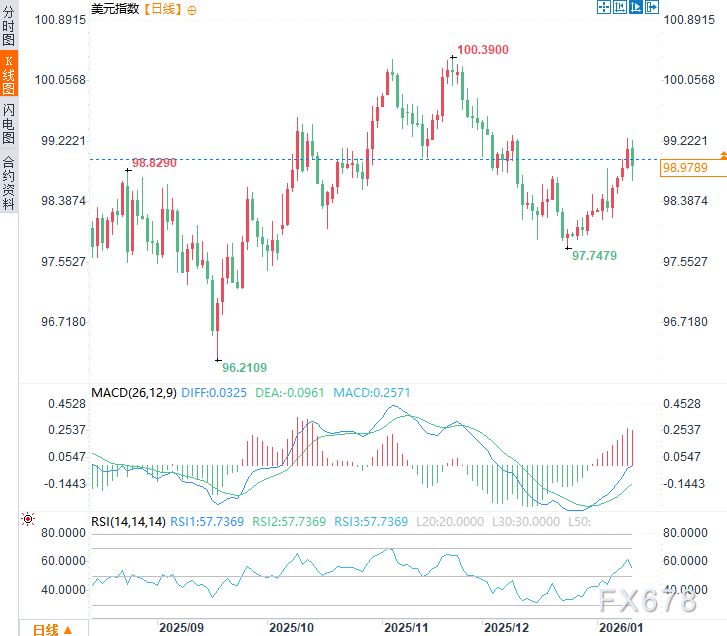
(Dollar index daily chart, source: Internet)
conclusionTrump's policies have systematically weakened the global position of the US dollar through multiple channels such as trade, Federal Reserve intervention, and debt management. Although de dollarization was not achieved in a day, its process has significantly accelerated in the resonance of policy catalysis and market feedback, and the US dollar system is facing the most severe structural challenge in decades.
At 15:11 Beijing time, the US dollar index is currently at 99.00.
Please indicate the source when reprinting: https://www.daoctech.com/fxschool/5270.html
Disclaimer: The content of this article does not represent the views of the Institute of Foreign Exchange. The content is for reference only and does not constitute investment advice. Investors operate accordingly at their own risk.