
Strategist: The Federal Reserve is mainly adopting a wait-and-see approach in the summer, while gold tends to maintain range bound volatility. Unilateral market trends will have to wait until after September
Colin Cieszynski, Chief Strategist of SIA Wealth Management, believes that due to the disturbance of energy prices caused by the US Iran conflict and the uncertain inflation outlook, Federal Reserve Chairman Walsh tends to maintain policy unchanged in the summer, and major policy adjustments will be postponed to the September interest rate meeting at the earliest. In this context, gold lacks trend driving force in the short term and is likely to continue to fluctuate within a range, with a consolidation cycle that may last for 3 to 6 months.
The central position of gold prices is in the middle of the previous high and low points, and the short-term trading range is locked at 3960 to 4170 US dollars per ounce. This week's decision by the Federal Reserve is difficult to push for an effective breakthrough, and the unilateral market needs to wait for the key window in September to land.
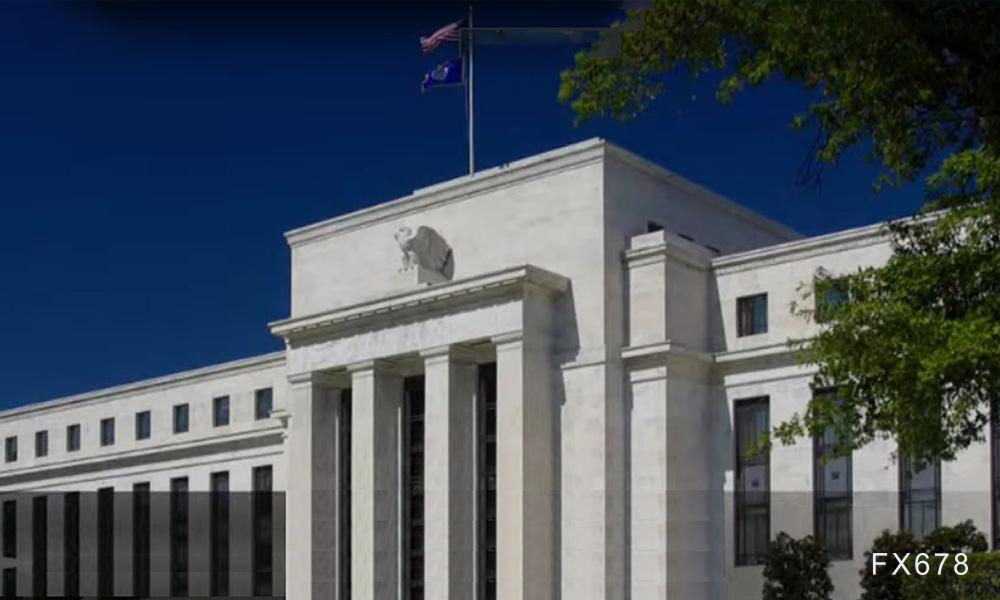
Macro logic: The Federal Reserve chooses to observe in the summer, and the policy turning point looks to September
Walsh clearly plans to wait for the internal special working group to complete the research, and will not implement major interest rate adjustments in the short term. The Federal Reserve currently needs time to verify whether the drop in inflation in June was a one-time fluctuation or a sustained downward trend.
Strategists believe that the Federal Reserve will try to postpone policy decisions until September. On the one hand, the September meeting will update the economic forecast matrix simultaneously; On the other hand, as the midterm elections approach,Industrial foreign exchangeThe policy operation space for the October interest rate meeting is limited. Even if there are internal differences, the Federal Reserve will try its best to avoid triggering severe market fluctuations during the summer period.
Dual game of inflation and exchange rate, interweaving long and short factors in gold
The market has partially digested the safe haven premium caused by the US Iran conflict, and gold prices have sharply retreated from $5500 to around $4000, but geopolitical risks have not been fully cleared.
At the same time, risks and hidden dangers still exist: inflation data has a lagging attribute, and if oil prices continue to rise, there is a risk of another rebound in inflation in the next 1 to 2 months, which may boost the US dollar and suppress gold.
At present, gold is at a watershed in the market, far away from the previous highs and lows, and the long and short forces tend to be balanced, making it difficult to immediately initiate a new round of unilateral trends.
Short term Market Prediction: Gold Prices Maintain Range Fluctuations, Difficult to Break through at Interest Rate Meetings
This week's Federal Reserve FOMC decision is unlikely to see unexpected policy changes, making it difficult to drive gold prices to break through. The short-term range for gold prices is between $3960 and $4170.
Amidst the off-season of summer trading and the concentrated release of numerous corporate financial reports, market trading sentiment tends to be cautious. Before the macro clues become clear, gold enters the stage of digestion and consolidation, and the volatile pattern is likely to continue.
summary
Overall, the Federal Reserve will maintain a policy wait-and-see attitude during the summer and postpone key decisions until September. The inflation outlook, the ongoing uncertainty in the Middle East geopolitical situation, the potential upward risk of the US dollar, and the mutual balance of long and short factors in gold.
The short-term gold price is limited to fluctuate within the range of 3960-4170 US dollars, and this interest rate meeting is unlikely to be a breakthrough opportunity. Gold is likely to continue to consolidate for 3 to 6 months, and a new trend market needs to wait for the release of clear policy signals at the September Federal Reserve meeting.
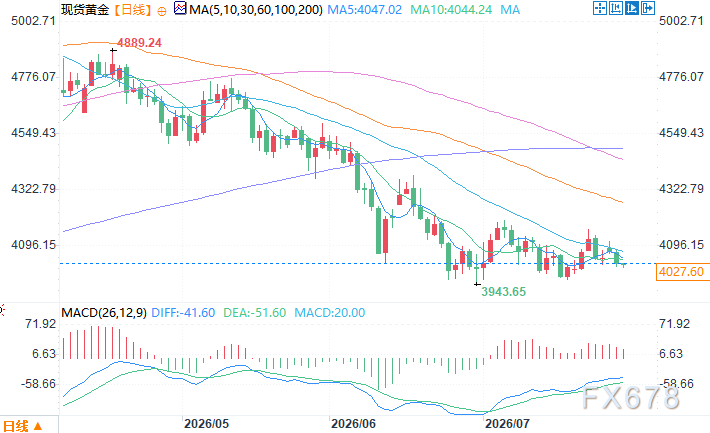
Daily chart of spot gold, source: Internet
On July 29th at 10:12 Beijing time, spot gold was reported at $4027.60 per ounce
Please indicate the source when reprinting: https://www.daoctech.com/fxschool/5274.html
Disclaimer: The content of this article does not represent the views of the Institute of Foreign Exchange. The content is for reference only and does not constitute investment advice. Investors operate accordingly at their own risk.