
Review of recent hawkish and dovish comments by Federal Reserve officials
In July 2025, the Trump administration's continued pressure on the Federal Reserve and its chairperson, Jerome Powell, attracted widespread attention, and the policy differences within the Federal Reserve highlighted the complexity of the current US monetary policy environment.
Ahead of the Fed's July 29-30 policy meeting, the Trump administration ramped up the pressure: on the one hand, White House officials scrutinized the compliance of the Fed's $2.50 billion headquarters renovation project, and Treasury Secretary Scott Bescent called for an exhaustive investigation of the Fed's non-monetary operations as an indirect expression of dissatisfaction with Powell; on the other hand, Trump himself has repeatedly publicly accused Powell of not pushing for a timely rate cut, and has explicitly called for his resignation or criticized him at least six times since 2025. These criticisms focus on April (1), May (1) and July (at least 4 times, including public remarks on July 2, 13 and 16).
Although Trump has mentioned firing Powell, he has also said that such a move is "highly unlikely" to be implemented. In response to the pressure from the government, there have been voices defending the independence of the Federal Reserve. Former Federal Reserve Chair Janet Yellen bluntly stated on July 22 that Trump's pressure on the Federal Reserve to cut interest rates could lead to "very bad" economic consequences, such as a rebound in inflation and higher borrowing costs. She stressed that the Fed must remain independent, and pointed out that the Fed's previous success in keeping inflation close to its 2% target was enough to prove that it did not need external intervention. It is worth noting that Yellen also criticized Trump's tariff policy in April, arguing that the policy damaged the US economy and the international community's trust in the United States.
Meanwhile, Mohamed Erian, a prominent economist, Bloomberg columnist and dean of Queens College, Cambridge, became the first prominent economist to publicly advocate for Mr. Powell's resignation on July 22 by calling on him to resign voluntarily via the X platform. His view that Mr. Powell's retention in office could put the Fed's independence at greater risk in the face of continued pressure from Mr. Trump and his allies has been widely disputed.
Inside the Federal Reserve: Policy stance divergence
Before the July policy meeting, the opinions of the 19 Federal Reserve policymakers were sharply divided.
Dove (2-3 people): more concerned about labor market risks and support an early rate cut. For example, Governor Christopher Waller clearly advocated a 25 basis point rate cut in July.
hawk(2-4 people): Focus on the threat of inflation and advocate for maintaining current interest rates. As Governor Adrienne Coogler stressed the need to be vigilant about the potential lasting impact of tariffs on prices.
centrist(7-9 people): In line with Powell's stance, he prefers to wait for summer economic data before making a decision, temporarily maintaining the policy interest rate range of 4.25% to 4.50%.
While several Fed policymakers have made the case for lowering borrowing costs at their upcoming meeting, the current view of the Fed's 19 policymakers is mostly in line with that of Mr. Powell, who has said he wants to wait for data throughout the summer to judge whether it is necessary to lower the policy rate range to its current 4.25-4.50 per cent.
Here's what Fed officials have said since their last policy meeting, which we classify as "doves."centrist"And"hawk", to simplify its monetary policy leanings. The doves are more focused on labor market risks and may want to cut interest rates faster; whilehawkFocusing more on the threat of inflation may be more cautious about cutting interest rates.
dove
Christopher Waller, Federal Reserve Governor, Permanent Voter: "A 25 basis point cut in the FOMC's policy rate in two weeks is reasonable." July 17, 2025
Michelle Bauman, vice-chairperson of regulation and permanent voter: "It is time to consider adjusting the policy rate." June 23, 2025
Lisa Cook, Chair, Permanent Voter: No more public comments on monetary policy as of June 3, 2025.
Austan Goolsby, president of the Federal Reserve Bank of Chicago and a 2025 voter: "Overall, I continue to believe that current levels could lead to a significant decline in interest rates over the next year or so." July 18, 2025
centrist
Jerome Powell, Federal Reserve chairperson and permanent voter: "As long as the U.S. economy is doing well, we think it would be prudent to wait and learn more and see what those effects might be." July 1, 2025
John Williams, president of the New York Fed and permanent voter: "It is important to note that the impact of tariffs is still in its early stages and will take some time to fully play out." July 16, 2025
Philip Jefferson, Vice Chairperson, Permanent Voter: No public comments on monetary policy as of May 14, 2025.
Michael Barr, Chairperson, Permanent Voter: "Well-positioned monetary policy allows us to wait and see how the economic situation develops." June 26, 2025
Adrienne Kugler, Chair, Permanent Voter: "I think it is appropriate to maintain our policy rate at its current level for some time." July 17, 2025.
Susan Collins, president of the Boston Fed and a 2025 voter: "For now, a'proactive, patient 'approach to monetary policy remains appropriate."
Anna Paulson, president of the Philadelphia Federal Reserve Bank and a 2026 voter, has not publicly commented on monetary policy since taking office on July 1, 2025.
San Francisco Fed President and 2027 voter Mary Daly: "I don't want to see further labor market weakness... I really don't want to see that, and that's why you can't wait forever for a rate cut." July 17, 2025
hawk
Jeffrey Schmid, president of the Federal Reserve Bank of Kansas City and 2025 elector: "The current monetary policy stance, 'wait and see', is appropriate." June 24, 2025
Alberto Musalem, president of the Federal Reserve Bank of St. Louis and a 2025 voter: "Tariffs may have a temporary impact on prices... or they may have a more lasting impact... I may be able to form a general impression by October, November or December." July 10, 2025
Neil Kashkari, president of the Federal Reserve Bank of Minneapolis and a 2026 voter: "If we cut rates in September and the effects of tariffs are felt in the fall, I don't think we should be on a preset easing policy." June 27, 2025
Beth Hammack, president of the Cleveland Fed and a 2026 voter: "I don't think there's a need to really lower [interest rates] unless we see substantial weakness in the labor market." July 14, 2025
Lori Logan, Dallas Fed president and 2026 voter: "My base case is that we need to maintain moderately capped interest rates for some time." July 15, 2025
Thomas Barkin, Richmond Fed president and 2027 voter: "Given the current strength of the economy, we have time to patiently track developments and allow for increased visibility." June 26, 2025
Note: The current target range for policy rates is 4.25% -4.50%. Fed policymakers' median forecast in June was a 0.5 percentage point cut this year, but seven of the 19 policymakers predicted no rate cut.
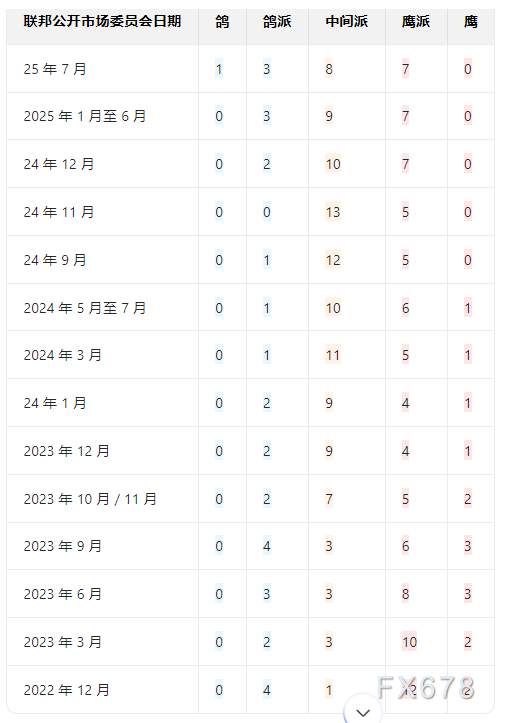
(Statistics of various categories of policymakers before the recent Federal Reserve meeting)
The Fed's seven governors, including the chairperson and vice chairperson, are nominated by the president and confirmed by the Senate. Three governors, Waller, Bowman and Powell, were nominated by Trump; the remaining four directors were nominated by former President Joe Biden. Each of them votes at the eight annual meetings of the FOMC (FOMC).
All 12 regional Fed presidents discuss and debate monetary policy at the meeting, but only five, including the president of the New York Fed and four others, vote on a rotating basis for one year each. Fed regional bank chairpeople are selected by the directors of their respective regional banks and are subject to approval by the Fed's board of governors.
Please indicate the source: https://www.daoctech.com/fxnews/2102.html
Disclaimer: The content of this article does not represent the views of the Institute of Foreign Exchange. The content is for reference only and does not constitute investment advice. Investors operate accordingly at their own risk.