
Interest rate expectations divergence escalates, can the USD/CAD 1.37 hold up?
On Wednesday (August 6), the US dollar/Canadian dollar maintained a narrow range of fluctuations in the North American session, trading around 1.3750, and fell slightly during the day. Previously, the exchange rate hit a nearly two-month high of 1.3878 on August 1, but then continued to correct, reflecting the intensification of the market's divergence on the strength of the previous rally. The recent weakness in US non-farm data has weighed on the buying sentiment of the US dollar, coupled with the stabilization of crude oil prices and the recovery of risk appetite, which has given some support to the Canadian dollar. However, in the absence of a new round of fundamental catalysts, the short-term trend of the exchange rate is still subject to the game between market sentiment and technical structure.
Fundamentals
Recently, the US non-farm payrolls data was lower than expected, triggering a repricing of the market's policy outlook for the Federal Reserve. The US dollar index fell from a high pressure, indirectly driving the US dollar/Canadian dollar from a high of 1.3878 to an adjustment range. Although the US bond yield remained strong as a whole, the internal driving force of the US dollar weakened, driving the exchange rate out of a certain technical retracement.
In the Canadian dollar, the overall trend was resilient, in part due to the stability of crude oil prices, coupled with the improvement of market risk appetite, which put short-term pressure on the safe-haven dollar. At the same time, Fitch rating agency pointed out in the latest "Canadian Consumer Monitor Report" that Canadian consumer spending is slowing down, expected to grow by 2.0% in 2025, and may further decline to 0.7% in 2026. The cooling job market, stagnant consumption of services and rising uncertainty about exports to the United States have become the core factors restraining consumption and growth.
Although the Bank of Canada chose to stay put at its last meeting, the market is still widely expected to cut interest rates to 2.25% before the end of the year. Inflation remains at around 3%, well above the 2% target, adding uncertainty to the path of monetary policy. Another softening in July employment data and wage growth, due this week, could accelerate market bets on the pace of rate cuts, which could affect the performance of the Canadian dollar.
Technical aspects:
The current daily chart shows that the dollar/Canadian dollar has slowed down after the correction from the high point of 1.3878, and the exchange rate is testing the support of the Bollinger Band middle rail at 1.3700. The overall Bollinger Band structure maintains the upper rail divergence and the lower rail stabilizes, indicating that volatility has expanded but the short-term has entered the consolidation stage.
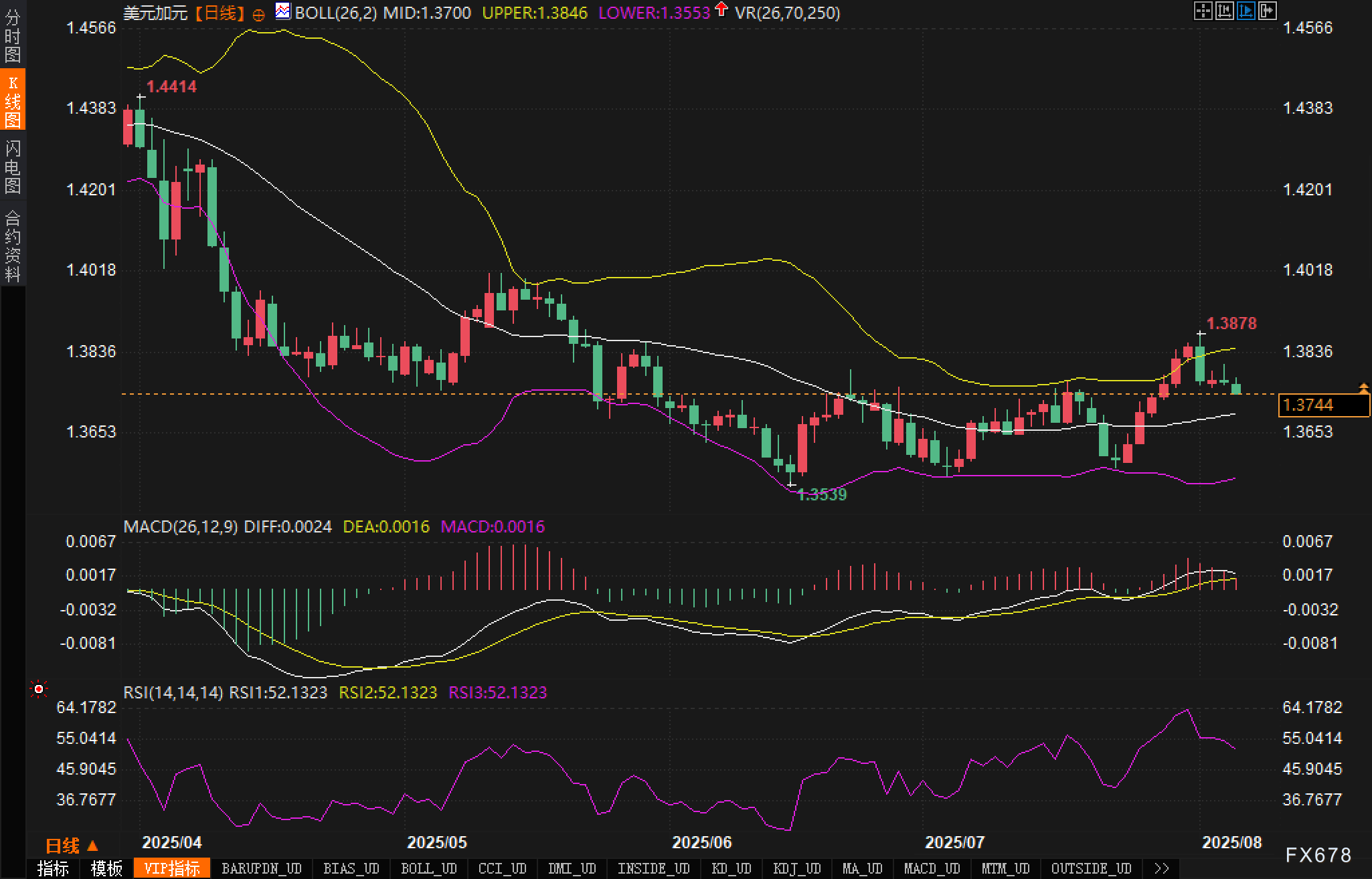
In the MACD indicator, the double line remains above the zero axis, and the red bar contracts, suggesting that the upward momentum has weakened but not yet formed a clear dead fork. If the column shrinks further, or forms a top divergence, it will enhance the possibility of a short-term correction.
The RSI indicator is running around 52, in a relatively neutral area, with no overbought or oversold signals. In combination with the current K-line pattern, the exchange rate is inclined to enter a consolidation pattern, waiting for a new round of direction choices.
From a structural point of view, the exchange rate fell to 1.3539 in the early stage and then bottomed and rebounded, 1.3878 constituted a partial top, and the current fluctuation range was initially built between 1.3550 and 1.3850. The analysis shows that short-term support focuses on the 1.3700 line of Bollinger's middle rail; the upper resistance levels are 1.3780 and 1.3878 respectively.
Market sentiment observation:
Market sentiment is currently in a highly cautious state. Although the US dollar/Canadian dollar rose strongly last week, the upside lacks sustained volume cooperation, indicating a lack of willingness to chase up; the US dollar rebounded weakly under the dual constraints of weak data and uncertain policy prospects.
In terms of sentiment indicators, the neutral operation of the RSI failed to provide a clear direction, and the passivation of MACD momentum also strengthened the market's wait-and-see attitude. Implied volatility in the options market remained low, indicating that traders do not have strong expectations for future large fluctuations. The misalignment between Canadian dollar interest rate expectations and the outlook for US monetary policy has become an important sentiment variable to suppress the unilateral operation of the exchange rate.
In addition, recent pessimistic expectations in Canada about consumer spending and the job market have also exacerbated the market's doubts about the fundamentals of the Canadian dollar. Although short-term bulls are still tenaciously defending at key support levels, the exchange rate lacks further breakthrough momentum and the sentiment is more cautiously bearish.
Outlook for the future market:
The short-term outlook:
In the absence of a high-level event boost this week, the USD/CAD is expected to fluctuate in the 1.3650-1.3850 range, and the market will closely monitor the Canadian jobs report.
The analysis believes that if the Canadian employment data is weaker than expected and the wage growth slows down, it may strengthen the market's bet on the Bank of Canada to cut interest rates this year, thus suppressing the performance of the Canadian dollar and pushing the exchange rate to test the 1.3878 resistance area, or even hit the 1.3900 integer mark.
On the contrary, if the data performs strongly, a short-term rebound in the Canadian dollar may be triggered, and the probability of the US dollar/Canadian dollar falling to the support area of 1.3700 or even 1.3650 will increase.
Medium- and long-term outlook:
From the perspective of the trend structure, the dollar/Canadian dollar gained support at 1.3539. Although it rebounded later, the upward resistance was significant. The analysis believes that if the follow-up US data continues to weaken and the Federal Reserve's policy turns clear, the dollar may face adjustment pressure in the medium and long term;
If there is no material deterioration in the Canadian economic data, the Canadian dollar may be expected to remain relatively stable, and the US dollar/Canadian dollar will tend to maintain a medium- and long-term sideways pattern, with the upper and lower limits likely to remain between 1.3500 and 1.3900.
Please indicate the source: https://www.daoctech.com/fxoutrade/1683.html
Disclaimer: The content of this article does not represent the views of the Institute of Foreign Exchange. The content is for reference only and does not constitute investment advice. Investors operate accordingly at their own risk.