
The Australian dollar rose and fell! In July, the CPI unexpectedly soared to 2.8%. Why would institutions still dare to bet on a rate cut in November?
On Thursday (August 28), the Australian dollar rallied in the Asian and European session. After the release of "unexpected" inflation data in Australia, although the Commonwealth Bank of Australia (CBA) called for calm, the market still pushed up the exchange rate of the Australian dollar, rising as high as 0.6521, and now falling back to 0.6509.
In fact, since the peak in December 2022, the Consumer Price Index (CPI) has been on a downward trend, which has largely helped the Reserve Bank of Australia implement three interest rate cuts in 2025. Economist Harry Otley pointed out that although the monthly Consumer Price Index (CPI) data in July exceeded expectations, this short-term fluctuation was not enough to prevent the Reserve Bank of Australia from initiating another interest rate cut later this year. Looking back at the overall trend, since inflation peaked in December 2022, the Australian CPI has been in a downward channel, which also provides the core support for the Reserve Bank of Australia to complete three interest rate cuts in 2025. However, the latest data from the Australian Bureau of Statistics (ABS) broke the short-term plateau, with inflation jumping to 2.8% in the 12 months to July from 1.8% in June, the highest annual inflation rate since July last year.
The data sparked fears that the Reserve Bank of Australia may suspend interest rate cuts due to a rebound in inflation. But Commonwealth Bank economist Harry Otley made it clear that the data was not enough to change the central bank's policy tone: "The RBA has repeatedly stressed the need to be vigilant against overreacting to monthly CPI fluctuations, and this data will not shake its'prudent and data-dependent 'policy stance."
Seasonal phenomena do not require excessive concern about inflation in July
ABS publishes both monthly and quarterly CPI data, but the Reserve Bank of Australia's board usually uses quarterly data as the core basis when setting the cash rate (current level of 3.60%). The reason is that quarterly data can more fully and completely reflect the country's anti-inflation process, while monthly data are more affected by short-term factors and are more volatile.
Although the monthly CPI in July was "higher than our and market expectations", there is no need to be overly vigilant. The core reason is that this increase in inflation is driven by short-term factors, mainly due to changes in the timing of electricity subsidies and fluctuations in holiday travel expenses. These factors are not sustainable.
More specifically, the timing of the electricity subsidy adjustment: the electricity subsidy in New South Wales and the Australian Capital Territory was originally scheduled to be issued in August, but this time it was advanced to July, directly driving up the disposable funds of local residents that month and indirectly driving short-term consumption-related price fluctuations.
Seasonal travel cost changes: As the spring and summer season approaches, the structure of travel spending is expected to adjust in the coming months, and the fluctuation of travel costs in July is a phased phenomenon. Jim Chalmers, Australia's treasurer, agreed that the rise in CPI was due to "short-term volatility and one-off factors", adding: "The monthly inflation data is inherently volatile and its reliability is significantly lower than the quarterly data due to the lack of consistent comparison of the monthly goods and services basket."
The easing route of the Reserve Bank of Australia has not changed for the time being
For the upcoming Reserve Bank of Australia monetary policy meeting in September, the market has a clear consensus - combined with the CPI data released on Wednesday, the central bank is likely to choose to maintain the cash rate (3.60%) unchanged and not start new policy adjustments for the time being.
The Commonwealth Bank maintained its original expectation: the Reserve Bank of Australia is likely to cut interest rates by 25 basis points in November. The core logic is that "the central bank will get the latest quarterly inflation report at that time, which will provide more sufficient data support for policy adjustment".
institutional perspective
David Bassanes, chief economist at BetaShares, said: "This unexpected inflation data does not mean that the Reserve Bank of Australia has completely closed the channel for subsequent interest rate cuts. A rate cut in November is still feasible, but it is no longer the'certainty event 'that the market thought before."
Russell Chesler, head of investment and capital markets at VanEck: "The combination of the current rebound in inflation, the recent completion of a rate cut, and the continued strength of the labour market further reinforces the expectation of no rate cut until November."
Sean Lankek, head of macroeconomic forecasting at Oxford Economics, said a "dovish" September quarterly inflation report would "clear the key hurdle" for a November rate cut.
Summary of interest rate cut forecasts for various institutions:
ANZ: 25 basis points cut in November, cash rate to 3.35%.
The Commonwealth Bank of Australia (CBA) cut interest rates by 25 basis points in November
National Australia Bank (NAB): 25 basis points cut in November, another 25 basis points cut in February 2026, cash rate to 3.10% by early 2026
Westpac: 25 basis points cut in November, another 25 basis points in February 2026
Technical aspects:
The Australian dollar is in a declining channel as a whole, with the MACD attached to the zero-axis secondary gold fork below the zero axis, while the RSI is above 50, indicating that the market is biased towards bulls.
The 50-day moving average of 0.6513 is the first resistance level, and the follow-up target is to break through this resistance and the upper track of the descending channel, and rise above the high of the closing price of 0.6550 on August 13.
The current 10-day and 20-day moving averages that have turned upward are near-term supports at 0.6490 and 0.6478, respectively.
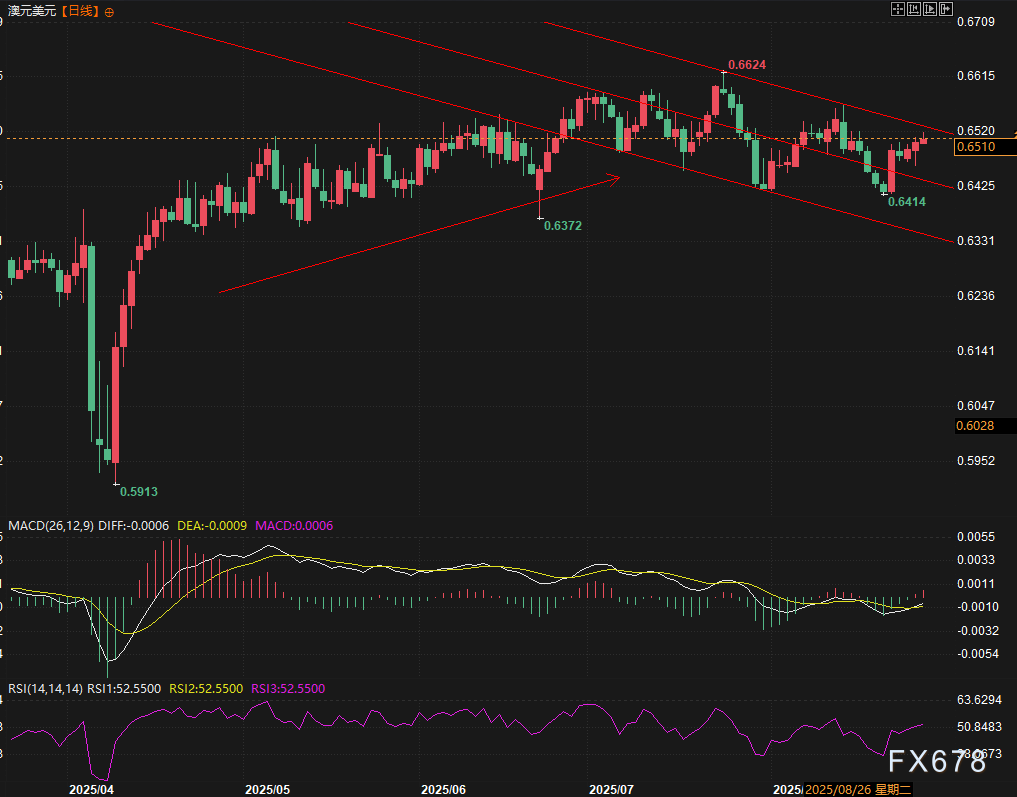
(Australian dollar/US dollar daily chart, source: Internet)
At 15:53 Beijing time, the Australian dollar was trading at 0.6511/12 against the US dollar.
Please indicate the source: https://www.daoctech.com/fxoutrade/1732.html
Disclaimer: The content of this article does not represent the views of the Institute of Foreign Exchange. The content is for reference only and does not constitute investment advice. Investors operate accordingly at their own risk.