
OPEC and the International Energy Agency have divergent outlooks, with traders divided on the risks to crude oil supply and demand
Friday (September 12) European session, WTI crude oil futures rebounded after yesterday's sharp sell-off, trading at $63.30, up 1.49%.

The rally has pushed futures up about 2.11% this week, and the intraday break above the 0.382 retracement/50 moving average (63.20/63) is blocked. If this resistance can be continuously broken, it may trigger a rally, targeting 64.28 (0.618 retracement). If further upward, $66.02 is the key resistance level that determines whether the bulls can effectively extend the rally.
OPEC and the International Energy Agency disagree on oil price forecasts
The latest supply forecasts are weighing on market sentiment. The International Energy Agency (IEA) released a report on Thursday saying that global oil supply growth will exceed previous expectations as OPEC + producers, including Russia, plan to increase production.
Opec, by contrast, reiterated its bullish outlook for oil demand growth in its monthly report, citing steady growth in the global economy. The divergence highlights the central contradiction in the market: while Opec is bullish on demand support, traders remain concerned about oversupply, which could cause futures prices to fall if consumption growth lags.
Middle East and Russia risks provide support for oil price forecasts
The risk of supply disruptions continues to offset bearish oversupply expectations, with a drone attack on the port of Primorsk, one of Russia's biggest export hubs, setting a ship and a pumping station on fire, highlighting the vulnerability of critical infrastructure.
The event, compounded by ongoing geopolitical uncertainty over conflicts in the Middle East and Ukraine, further cemented the "geopolitical premium" embedded in crude prices.
India's import policy is putting pressure on the flow of Russian crude oil
In terms of physical transactions, Adani Group, India's largest private port operator, has banned oil tankers subject to western sanctions from entering its ports, a move that could disrupt the flow of crude and complicate Russia's efforts to reroute exports under sanctions pressure as India is the biggest buyer of Russian seaborne crude.
Combined with potential secondary sanctions against buyers of Russian crude, traders are keeping a close eye on India's import policy, which could become a key variable affecting seaborne crude supplies.
Market forecast: A bullish break above $63.30, but resistance remains strong
Oil prices gained support at recent lows, while geopolitical risks and tight supply of refined products continued to provide support. However, concerns about oversupply and resistance at $63.30 remain the main headwinds for now.
A stronger resistance at $66.02 would then be tested if buyers pushed the price above that level, after price action showed a cautious but slightly bullish bias as traders watched whether supply risks could support the upside.
technical analysis
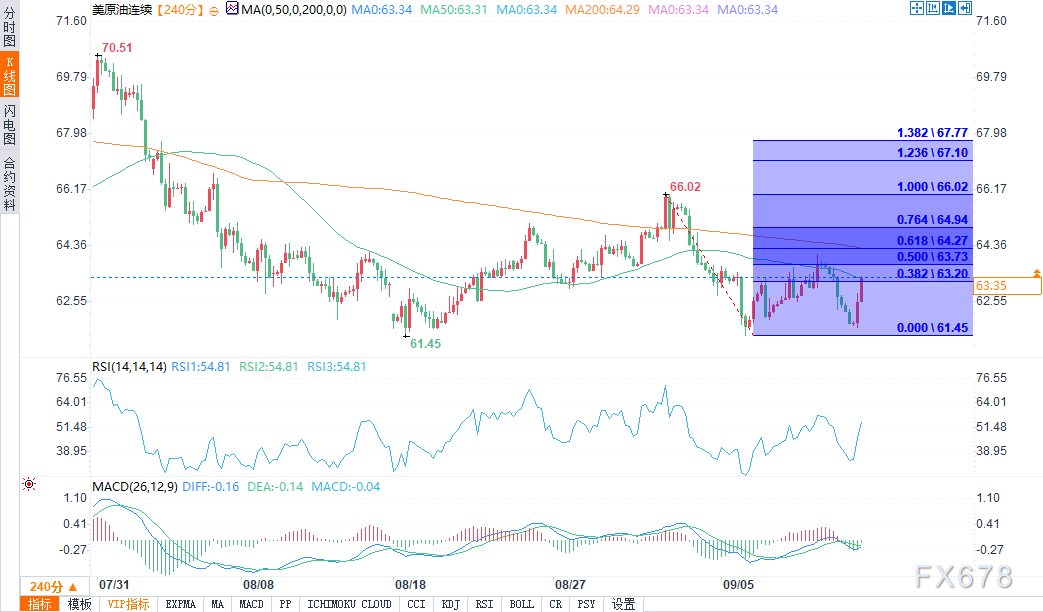
(WTI crude oil 4-hour chart, source: Internet)
The current crude oil price is in a correction trend as a whole, lagging behind from a high of 70.51, gaining preliminary support near 61.45, and currently trading near $63. From the Fibonacci correction, the price is currently at the 0.382 correction level (63.20), which is a key short-term level. If it can break through this level decisively, it is expected to reach 64.28 (0.618 correction level) and a higher 66.03 (1.000 correction level); on the contrary, if it falls below 61.45, the bears will further control the situation.
In the moving average system, the short-term MA (50) is lower than the long-term MA (200), the medium-term bearish trend has not changed, and the current price is running below the main moving average, indicating that there is a lot of pressure above.
The MACD indicator is still hovering below the zero axis, with weak momentum and no obvious reversal signal. The RSI is currently at 54.42, which is in the neutral area, reflecting a more balanced long and short power. However, if it continues to rise in the future, it will enhance the momentum of the price rebound.
Overall, crude oil is in the short-term technical rebound stage, but the medium-term trend is still bearish. If it can break through 63.20 and stand firm, it is expected to further rebound to challenge the pressure above; otherwise, it is still necessary to be vigilant against the risk of falling again.
At 20:00 Beijing time, WTI crude oil was reported at $63.43 per barrel, an increase of 1.70%.
Please indicate the source: https://www.daoctech.com/fxoutrade/2029.html
Disclaimer: The content of this article does not represent the views of the Institute of Foreign Exchange. The content is for reference only and does not constitute investment advice. Investors operate accordingly at their own risk.