
Gold Trading Reminder: The Federal Reserve's Resolution is Coming! Silver Soars to a New High, Has the Time for the Gold Market to "Get on the Board" Arrived?
On Wednesday (December 10), in early Asian trading, spot gold fluctuated narrowly, and is currently trading around $4,210/ounce. On Tuesday, spot silver rose by more than 4%, breaking the milestone of $60 per ounce under tight supply conditions, setting a new historical high again, which also led to the rise in gold prices. The market generally expects the Federal Reserve to cut interest rates on Wednesday, attracting bargain buying to support gold prices. However, the US job vacancy data released on Tuesday was better than market expectations, the US dollar index continued to rebound, and US bond yields reached a three-month high, which made gold bulls have concerns.
Before the Federal Reserve's decision, the gold market traded cautiously, and investors need to focus on the Federal Reserve's dot plot and Powell's press conference, and pay attention to the relevant news of the candidate for the Federal Reserve Chair.
The Federal Reserve's interest rate cut is expected to support gold prices
The Federal Reserve's monetary policy has always been an important bellwether for the gold market. The two-day FOMC meeting ends on December 10, and market traders are widely betting that interest rates will be cut by 25 basis points this week, with a probability of 87.4%. This optimistic expectation attracts bargain buying to support gold prices, as interest rate cuts usually reduce the opportunity cost of holding gold and drive money into the precious metals sector. In the run-up to the meeting, spot gold climbed steadily from intraday lows before closing slightly higher, reflecting investors' eager anticipation of easing.
However, this rate cut may not be a simple dovish signal. Market analysts pointed out that Federal Reserve Chairperson Jerome Powell may highlight inflation risks in his statement and set a higher threshold for subsequent easing measures. The possibility of such a "hawkish rate cut" stems from the resilience of the US economy. Although the government shutdown has delayed the release of some data, overall economic indicators show a solid labor market, which makes the Federal Reserve more cautious in easing policy. Gold's rise has not been smooth sailing, but has been accompanied by a trade-off of future uncertainty. Investors need to be wary of short-term fluctuations caused by policy announcements.
Silver breaks through milestones, industrial demand becomes a new engine
Compared with the solid rise in gold, the performance of the silver market was even more dazzling. Spot silver rose 4.3% on Tuesday to close at $60.64 an ounce, after hitting an all-time high of $60.87 an ounce at one point during the session. This breakthrough milestone marks the acceleration of silver's transformation from its traditional role as a precious metal to an industrial metal. Analyst Fawad Razaqzada emphasized that industrial demand for silver will be exceptionally strong in the coming years, which is the core driver of the price surge.
The report from the Silver Industry Association further supports this view. Emerging industries such as solar energy, electric vehicles and their infrastructure, data centers, and artificial intelligence will continue to drive demand for silver through 2030. The rapid development of these areas not only consumes a lot of silver, but also exacerbates the global supply shortage. Currently, silver inventories are dwindling, and it was recently added to the list of important minerals in the United States, which provides additional support for prices. The expectation of interest rate cuts by the Federal Reserve also indirectly benefits silver, because loose conditions tend to stimulate industrial investment and economic growth. Silver is more volatile than gold, but its upward momentum is more violent, making it a popular choice for investors to diversify their allocation.
The US jobs data is strong, and a higher dollar is weighing on the gold market
The Labor Department's Job Openings and Labor Mobility Survey (JOLTS) report took center stage. Job openings edged up to 7.67 million in October, well above the 7.15 million economists had expected. The data showed that despite lackluster hiring, labor demand remained strong, underscoring the resilience of the U.S. economy. The dollar index rose 0.1% to 99.21 after the report, strengthening for two consecutive sessions. This weighed on gold, as a stronger dollar typically undermines the attractiveness of dollar-denominated gold.
From a broader perspective, however, the jobs data did not completely dash expectations of a rate cut. Instead, it reinforced the possibility of a "hawkish rate cut" by the Federal Reserve, that is, preventive easing while acknowledging the strength of the economy. Analyst Shaun Osborne pointed out that a rate cut is almost a foregone conclusion, but Powell may try to set a higher threshold for further action. This means that gold may face challenges from the strength of the dollar in the short term, but in the medium to long term, if inflationary pressures ease, gold will still benefit from a low interest rate environment. Investors need to pay close attention to the interaction between data and policy, and avoid blindly chasing prices.
Bond market yields rebound, revealing market caution
The performance of the US bond market provided another important clue for the gold market. On Tuesday, most US Treasury yields rose, with the benchmark 10-year yield rising to 4.186%, reversing an early decline. The change came directly from the unexpectedly strong JOLTS report, as market participants reassessed the economic outlook. Tom di Galoma of Mischler Financial Group said the increase in job openings was unexpected, but the data should be interpreted with caution given the impact of the government shutdown. The flattening of the yield curve also hinted that investors' fears of a recession have eased.
Ahead of the Fed meeting, bond markets generally expected a 25 basis point rate cut, but many institutions such as Morgan Stanley predicted that this would be accompanied by a signal of "higher thresholds for future rate cuts." The yield on the 30-year Treasury slid slightly to 4.81%, while the two-year yield rose to 3.611%, reflecting the synchronicity of short-term interest rate expectations with Fed policy. Moreover, the break-even yield on inflation-protected bonds (TIPS) shows that the market expects an average annual inflation rate of about 2.3% over the next 10 years, which provides support for gold as an inflation hedge. While the bond market's rebound has raised gold's holding costs in the short term, it has also confirmed economic resilience, which may prolong the bull market cycle for gold.
Global Central Bank Dynamics and Outlook
Across the globe, gold markets were also affected by the actions of other central banks. The Reserve Bank of Australia kept interest rates unchanged and ruled out further rate cuts, driving the Australian dollar higher; European Central Bank executive Schnabel hinted that the next step may be to raise interest rates rather than cut them. These signals suggest that global monetary policy divergence has deepened, and the Fed's easing may appear more prominent in the international environment, indirectly supporting gold.
Market focus shifted to the Fed's "dot plot", which in September showed policy rates at 3.6 per cent by the end of 2025 and 3.4 per cent by the end of 2026. A lower dot plot for this meeting would be bad for the dollar and good for gold. Corpay's Karl Schamotta warned that hawkish pricing had unfolded on the multi-country yield curve and that the dollar could come under pressure if Powell was not as hawkish as expected.
Nick Timilaus of the Fed's mouthpiece said on Tuesday that Mr. Powell, who is in charge of making the decision, appeared likely to push for a rate cut despite unusual differences, so the focus of the meeting would be on whether he could cobble together enough consensus to minimise dissent.
Mr. Timilaus pointed out that Mr. Powell's most likely approach was to cut interest rates by 25 basis points and then communicate that the threshold for future easing would be higher by revising his post-meeting statement - a "cut first and then cap" approach similar to his "triple rate cut" in 2019, which also caused disagreement at the time.
Investors also need to keep an eye on the potential impact of Powell's successor, Hassett, and Trump's dovish expectations add to the uncertainty. Overall, gold still has room to rise in the easing cycle, but be wary of uncertainties in inflation and employment data.
Kevin Hassett, director of the White House National Economic Council, will join the other three candidates in the final round of interviews this week for US president Donald Trump to chair the Federal Reserve. According to three senior administration officials, Mr. Trump and Scott Bessant, Treasury secretary, have scheduled an interview with Kevin Walsh, a former Fed governor, on Wednesday.
Although some Wall Street investors are concerned that Hassett is too close to the president and could lead to an overly aggressive interest rate cut, he is still seen as the most likely candidate to succeed Powell and is expected to take office next May. However, the arrangement for additional interviews shows that the final candidate has not been fully determined. Some officials have raised plans for Hassett to shorten his term.
Mr. Bescent is understood to have submitted a shortlist of four to the White House, with Mr. Hassett and Mr. Walsh to be chosen from among "other finalists", including Christopher Waller, Fed governor, Michelle Bowman, Fed governor, and Rick Riddle, a BlackRock executive.
In its latest Precious Metals Outlook 2026, Heraeus Precious Metals, the world's leading precious metals trader and refiner, makes it clear that 2026 will be a typical year of "first dampening and then rising". The market will trade time for space in the first half of the year to build up for the possible ultimate main wave in the second half of the year. Gold prices are expected to hit a maximum of $5,000/oz in the second half of 2026.
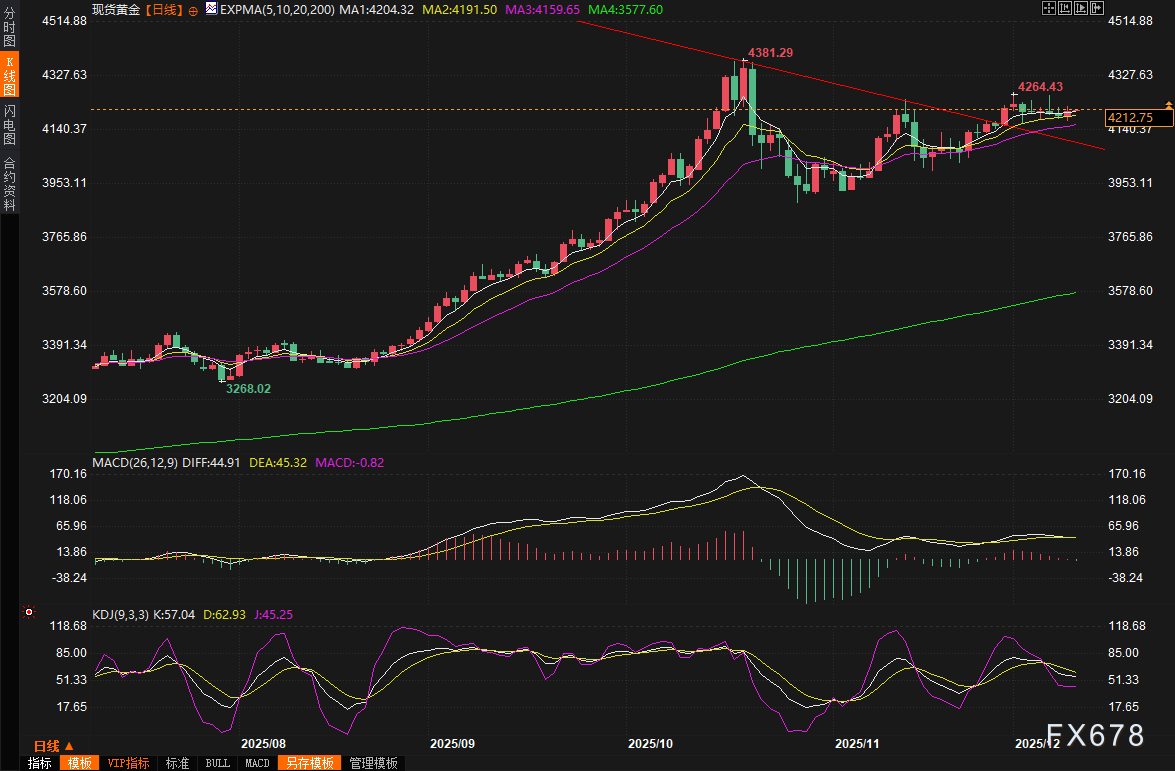
(Daily chart of spot gold, source: Internet)
At 07:49 Beijing time, spot gold was quoted at $4212.64 per ounce.
Please indicate the source: https://www.daoctech.com/fxoutrade/2037.html
Disclaimer: The content of this article does not represent the views of the Institute of Foreign Exchange. The content is for reference only and does not constitute investment advice. Investors operate accordingly at their own risk.