
Gold trading reminds, gold prices fluctuate, pay attention to the dynamics of the Federal Reserve, Davos Forum
In the context of changing global geopolitics, US President Trump's remarks about Greenland triggered an escalation of trade frictions. This not only had an impact on US-European relations, but also directly promoted the heat of safe-haven assets. On Monday, spot gold prices rose to a record high of $4,690.46 an ounce. Investors turned to gold amid uncertainty. This increase in safe-haven demand not only raised the price of precious metals, but also revealed the potential fragility of the global economy. In early Asian trading on Tuesday, spot gold fluctuated near the high, trading around $4,670/ounce, and the market attention began to turn to the World Economic Forum in Davos.
Greenland dispute escalates: the impact of tariff threats
The cause of the incident was Trump's attention to Greenland. The US president publicly stated on social platforms that he would impose an additional 10% import tariff on European countries such as Denmark, Sweden, France, Germany, the Netherlands, Finland, the UK and Norway from February 1 until the US successfully buys Greenland.
This statement is based on the 2025 US-EU tariff agreement. Previously, the US and Europe had just negotiated to ease the volatility of trade friction, and now this move has once again pushed European companies to the forefront of the trend. European Union diplomats held urgent consultations and not only reached a consensus to strengthen communication, but also prepared countermeasures, including imposing tariffs on a large number of US imports or activating relevant tools to restrict US companies' public invited tenders, investment and banking business in Europe.
This tariff strategy quickly set off a chain reaction in the industry. The French wine and spirits export industry has been affected, and business in the US market will decline in the second half of 2025, and the new tariffs will have a more obvious impact. The German chemical and pharmaceutical industries have also warned that a "tariff spiral" will increase the economic burden on both sides of the Atlantic, making investment decisions difficult and predictable.
Analysts point out that divisions within the European Union could exacerbate the problem, such as some countries that are not included in the tariff list, or through trade diversion to avoid risks, but this could undermine the European Union's single market. The incident not only tested the unity of the European Union, but also highlighted the strong posture of the United States in global trade. If the Supreme Court overturns its tariff authorization, the government is ready to introduce new measures quickly.
Risk aversion heats up: Gold and silver prices hit new highs
Faced with this geopolitical uncertainty, financial marekt quickly turned to safe-haven mode. Gold, a safe-haven asset, rose 1.7% on Monday, with spot gold closing at $4,670.79 an ounce, after hitting an all-time high of $4,690.46 in early trade. U.S. gold futures also rose 1.8% in tandem to $4,677.70 an ounce. Silver also performed well, surging 5% to $94.41 an ounce, hitting a new high of $94.65 on Monday morning, and a small high of $94.68 an ounce in Asian markets on Tuesday. The rise in this bimetallic is directly due to investors' concerns about trade friction. Market analysts said that when policy and risks resurface, funds tend to be reallocated to safe havens such as gold.
The deeper reason is the weakness of the dollar. The dollar fell on investor anxiety over Mr. Trump's tariff comments, pushing the euro, sterling and Scandinavian currencies back from their lows, while havens such as the Swiss franc posted their biggest one-day gains in a month. The dollar's slide further underscores the appeal of gold, which is denominated in dollars and naturally rises when the dollar weakens.
In addition, spot platinum and palladium also rose slightly, rising 1.5% and 1.1% respectively, indicating that the precious metals sector as a whole benefited from safe-haven buying. Experts analyze that this market reaction is similar to the scenario when comprehensive tariffs were announced earlier, when fluctuations in US asset confidence led to capital outflows, and now the Greenland dispute has again amplified this effect. If tensions escalate, gold's upward momentum could continue, even challenging higher prices.
The Federal Reserve's policy and the global foreign exchange market: a catalyst for gold's rise
The moves of the Federal Reserve played a key role in the event. Bowman, the Fed's vice-chairperson of supervision, warned on Friday that the fragile job market could weaken rapidly, suggesting the central bank stood ready to cut interest rates further. The market expects the January 27-28 meeting to hold off, but at least two 25 basis point rate cuts throughout the year have become the consensus. This easing expectation further weakens the dollar, driving safe-haven funds into gold and currencies such as the yen and Swiss franc.
The dollar index tumbled 0.34% on Monday, recording its biggest one-day decline in nearly four weeks. The euro rose 0.3% to 1.1643 against the dollar on Monday, and the pound rose 0.31% to 1.3418 against the dollar. This broad risk-off trend not only reflects the immediate reaction of investors to trade frictions, but also indicates that if the European Union counterattack escalates, the dollar may be temporarily under pressure, but in the long run, the export advantage of the United States may in turn support the dollar rebound.
From a broader perspective, Europe is more dependent on exports from the United States, and strategists point out that the escalation of trade friction is more detrimental to Europe, which may further boost the status of gold as a neutral safe-haven asset. The head of the relevant German industry association called for Europe to strengthen its autonomy and reduce its dependence on the United States. This may lead to more joint projects, but it will only increase uncertainty in the short term. Investors can refer to ebc when assessing market trends.Forex PlatformIn this environment, gold has become an ideal tool for investors to hedge risk. Although its price volatility is high, it also contains rich returns.
Davos Summit Outlook: A Potential Turning Point for the Gold Market
The upcoming World Economic Forum in Davos, Switzerland, is the next focal point in the dispute. Mr. Trump is expected to arrive on Wednesday to deliver a special speech and will also invite global business leaders to a reception, including chief executives from the financial and consulting industries. Mr. Bescent, the US Treasury secretary, is travelling with him and has warned Europe against retaliation, stressing that "everyone should take the president's word for it". Meanwhile, He Lifeng, China's vice-premier, will attend and deliver a speech, meet with business executives, and a number of delegates and national security advisers will discuss Greenland on the sidelines of the forum. The gathering of global elites, which is supposed to focus on emerging economies and development issues, has been dominated by Mr. Trump's policy moves, underscoring the strength of the US on the international stage.
Business leaders view Mr. Trump's style as polarised, with some seeing it as a "hammer-swinging negotiation" strategy that is in line with US interests, while others worry about its instability. Some CEOs believe that Mr. Trump's instincts are correct in seeking a long-term strategic position for the US, but this could amplify market volatility in the short term. If Davos can lead to US-EU dialogue, gold's safe-haven demand may ease; conversely, if the dispute escalates, gold prices may continue to rise. Investors need to pay close attention to the dynamics of the summit as a key signal for judging the trend of gold. At the same time, some market participants will also pay attention to the information released by institutions such as ebc foreign exchange.
To sum up, Trump's Greenland tariff remarks swept the global market like a storm, driving gold and silver to new highs. This not only tested the resilience of the US-EU relationship, but also highlighted the core value of gold in an uncertain environment. Although short-term safe-haven buying is strong, the long-term gold outlook depends on the evolution of trade frictions, Federal Reserve policies and the outcome of the Davos summit. Investors should plan rationally, seize opportunities while being vigilant against risks, and find their own direction in this wave of gold volatility.
In addition, it is necessary to pay close attention to Trump's dynamic news. US Trade Representative Jamieson Greer said in an interview on Monday that if the Supreme Court overturns Trump's sweeping global tariffs under the emergency law, his administration will announce new tariffs almost immediately.
The Supreme Court could rule on the tariffs in the coming weeks, possibly as early as Tuesday. According to media reports, Greer said the government would replace them with other levies "starting the next day."
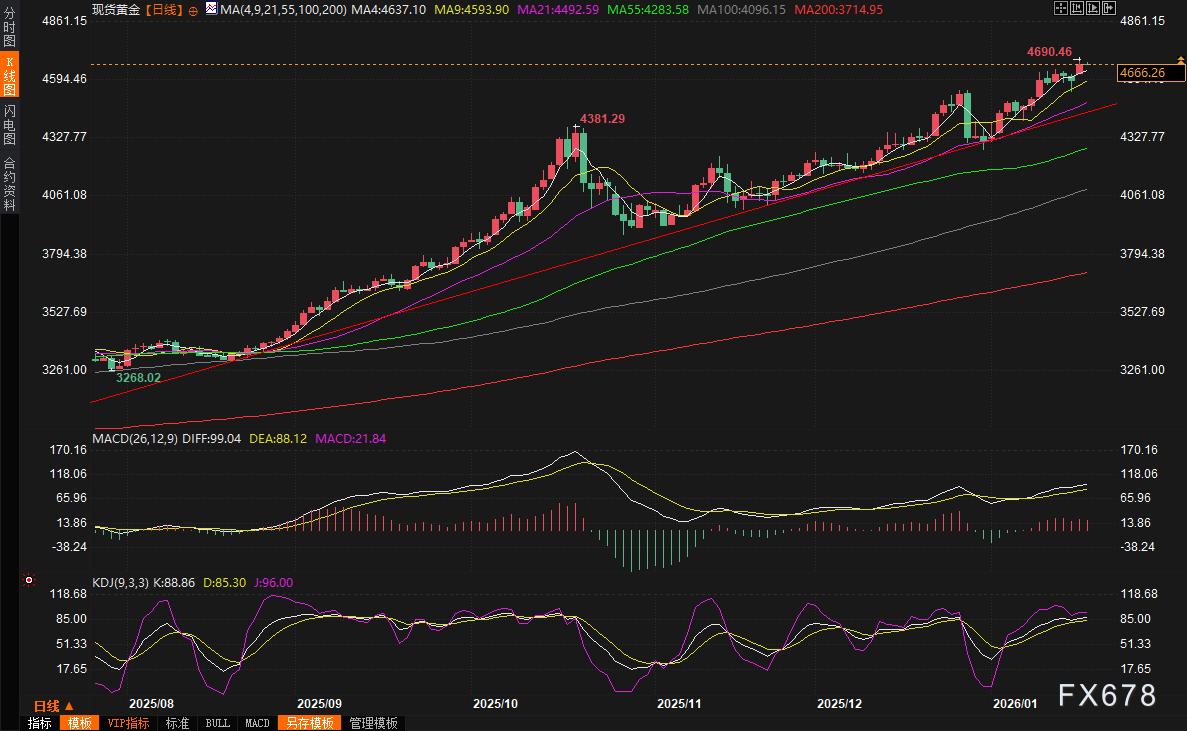
(Daily chart of spot gold)
At 07:36 Beijing time, spot gold was trading at $4668.60 per ounce.
Please indicate the source: https://www.daoctech.com/fxschool/2529.html
Disclaimer: The content of this article does not represent the views of the Institute of Foreign Exchange. The content is for reference only and does not constitute investment advice. Investors operate accordingly at their own risk.