
The Federal Reserve's hawkish minutes superimposed the geopolitical situation, and the dollar held steady at 99.10.
The US Dollar Index (DXY) remained stable in Asian trading on Thursday, trading around 99.10. Despite a slight correction in the dollar in the previous session, the overall trend remained strong, with the market currently focusing on the geopolitical situation in the Middle East, the path of the Federal Reserve's policy, and changes in global energy risks.
The talks between the US and Iran have emerged as one of the most important risk variables for global financial marekts, with US President Donald Trump saying they were in the "final stages", briefly reducing market concerns about disruptions to energy supplies in the Middle East.
However, Mr. Trump also warned that the US could resume tougher diplomatic pressure and sanctions in the coming days if Iran rejected US conditions, in a tough statement that kept market risk aversion high.
Masood Pezehizyan, Iran's president, then responded that Iran would not bow to external pressure, stressing that trying to force Tehran to back down through threats was "fantasy".
The Strait of Hormuz is responsible for about 20% of the world's seaborne crude oil transportation (shown in bold), so the market is highly concerned about the changes in the situation in the region. If the Strait of Hormuz transportation is further blocked, the global energy supply chain may face new shocks, which will then push up international oil prices and global inflationary pressures.
Against this backdrop, the US dollar continues to receive financial support as the world's main safe-haven currency. Markets are concerned that the escalation of geopolitical tensions in the Middle East may not only disrupt global energy supplies, but also further affect global economic growth and financial marekt stability.
At the same time, the Fed's latest April FOMC meeting notes further strengthened the dollar support logic.
The meeting notes show that most Fed officials remain highly vigilant about inflation risks and believe that if inflation persists above the 2% target level, the Fed may need to consider further interest rate hikes.
Market expectations for "the Federal Reserve to maintain high interest rates for a long time" have increased significantly (bold display)This has kept US Treasury yields high and strengthened the attractiveness of dollar assets.
In particular, the higher energy prices caused by the geopolitical situation in the Middle East may further push up inflationary pressures in the United States. This means that the Federal Reserve needs to not only face the problem of slowing economic growth, but also need to be vigilant against the re-heating of imported inflation.
Some Federal Reserve officials have pointed out that continued increases in energy prices could shift inflation back away from policy targets and limit the scope for future interest rate cuts.
From the perspective of market structure, the current strength of the US dollar is mainly due to two major logics: first, the global demand for safe havens is increasing; second, the US interest rate advantage is still obvious.
Global capital continues to flow into dollar assets amid expectations that the high interest rate environment in the US is likely to last longer, and the dollar remains seen as a relatively safe asset amid uncertainty about the outlook for global economic growth.
However, the short-term rise of the dollar index is also partially limited. With the previous sharp correction in international oil prices, US Treasury yields have shown some signs of cooling recently, and the market's bets on further aggressive interest rate hikes by the Federal Reserve have eased slightly.
In addition, the market is also watching the upcoming US PMI data to assess whether there are signs of a slowdown in US economic activity. If the manufacturing and services data weaken significantly, it may put some pressure on the short-term trend of the dollar.
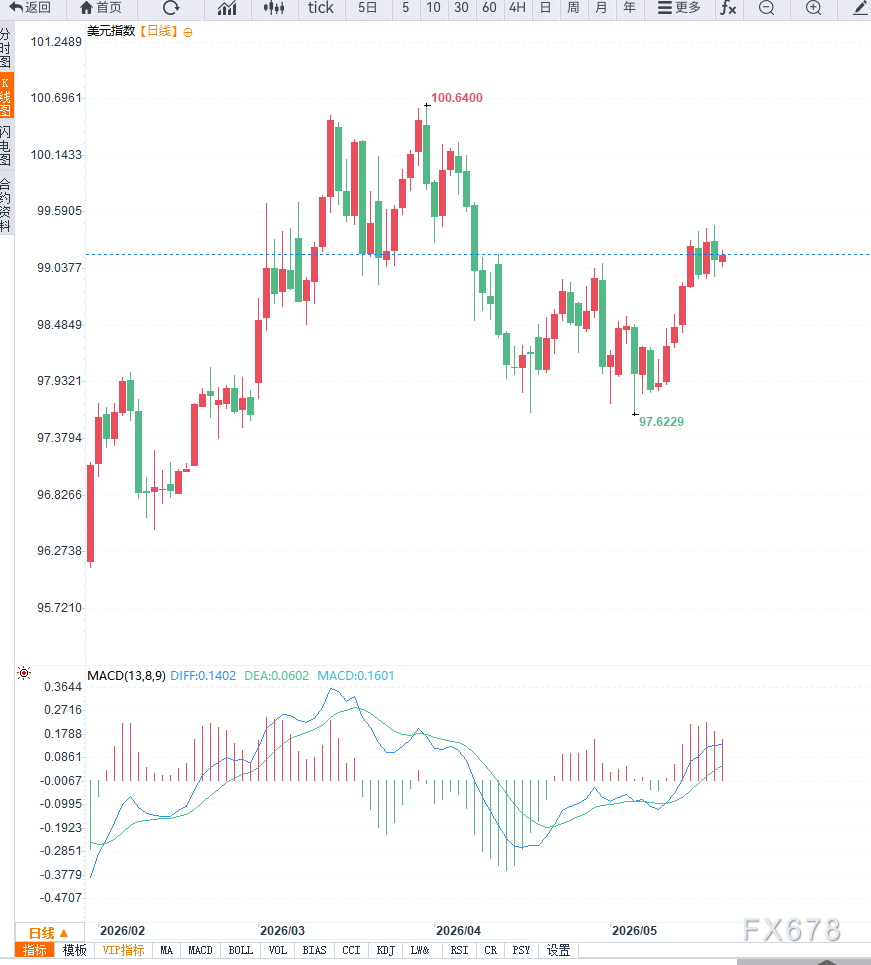
From the technical trend point of view, the daily chart of the US dollar index as a whole still maintains a strong oscillation structure. The exchange rate rebounded after forming a phased support around 98.20, and is still running above the 20-day moving average. Although the MACD indicator has been passivated at a high level, it has not yet formed a clear dead fork, indicating that the medium-term bull trend is still not over. The RSI indicator remains near 56, indicating that the market bullish momentum has slowed down, but the overall trend is still strong. According toyingshiFinancial data, the dollar index shows strong resilience in technical analysis.
From the perspective of resistance and support structure, the initial resistance level above is located near 99.50. If it breaks through, it may further challenge the 100 integer mark and the 100.40 area. The important support below is located near 98.70 and 98.20. Once it falls, the dollar index may enter a phased correction.
From the 4-hour chart, the US dollar index maintains a high consolidation pattern in the short term. The price is running near the middle rail of the Bollinger Band, indicating that the market is more wait-and-see. The MACD indicator gradually converges above the zero axis, and the short-term bulls' momentum has weakened; the RSI indicator is located near 50, reflecting that the market direction is not clear for the time being. If the follow-up situation in the Middle East further changes or the Federal Reserve continues to release hawkish signals, the US dollar index still has further upside.
edit summary
The core driver of the current dollar index is mainly the safe-haven demand brought about by the geopolitical situation in the Middle East, as well as the joint impetus of the Federal Reserve to maintain hawkish policy expectations.
In the short term, shipping risks in the Strait of Hormuz, progress in US-Iran negotiations and changes in global energy prices will still dominate market sentiment. If geopolitical tensions further, the safe-haven demand for the dollar may continue to strengthen; and if the situation in the Middle East eases, the dollar may see a phased correction.
At the same time, the Federal Reserve's concerns about inflation risks are clearly heating up. In the context of unstable energy prices, the high interest rate environment in the United States is likely to last longer, which will continue to provide medium- and long-term support for the dollar. According to Yingshi analysis, the dollar still has medium-term upward momentum.
Overall, in the context of global risk aversion that has not yet cooled significantly and the Federal Reserve maintaining a hawkish stance, the dollar index is still expected to maintain a strong volatility pattern in the short term.
Please indicate the source: https://www.daoctech.com/fxschool/2528.html
Disclaimer: The content of this article does not represent the views of the Institute of Foreign Exchange. The content is for reference only and does not constitute investment advice. Investors operate accordingly at their own risk.