
Gold means reversion: storage adjustment before the next rally
As the focus shifts to the delayed US non-farm payrolls data, traders are assessing whether the current price consolidation is a short break before a new rally. The overall market environment remains complex, including the policy stance of the Federal Reserve, the delay in the release of economic data and other macro factors, which continue to influence market sentiment. However, looking at the appearance of short-term volatility, gold's recent pullback is closer to a return to equilibrium than a sign of a weakening trend.

Gold means reversion drivers
The pullback comes after months of sustained buying. Weak US economic data, a correction in global capital flows and central bank purchases have pushed gold prices higher. Gold's rapid rise from low to high levels has partly outpaced fundamental support, sending technical indicators into overbought territory and market sentiment was initially buoyant.
Now, as traders recalibrate their monetary policy expectations, gold prices have fallen back to a relatively neutral price range. This area happens to be the intersection of short-term and long-term technical averages, providing a new equilibrium point for the market. Some market analysts, such asPepperstoneIn its daily market commentary, it often pays attention to such technical aspects of the mean reversion phenomenon.
The pullback also reflects a recalibration of market sentiment. Recent statements from Fed officials have been more cautious, stressing that policy adjustments need to be gradual, and some officials have also hinted at a preference for keeping interest rates stable. These remarks, combined with delays in the release of macroeconomic data, have reduced some speculative positions and allowed the gold market to sort out. Essentially, the market is seeking a new equilibrium, a typical process of a mean reversion of prices after a rapid rise.
Why this means reversion is important
The implied reversion of gold prices reflects the market's focus on broader factors. Some argue that the long-term trend of gold prices is related to changes in market confidence in sovereign debt and the monetary system. Investors are not just responding to short-term price fluctuations, but also to deeper structural factors in the economy.
Analysts at some Financial Institutions Group maintained a positive view on the medium-term trend in gold, pointing to continued demand from official institutions as one of the important factors supporting gold prices. The steady increase in gold reserves by central banks shows their long-term intention to diversify foreign exchange reserves.
Data show that the People's Bank of China has increased its gold reserves for several consecutive months, bringing its total official gold reserves to a considerable level. This phenomenon shows that despite the price correction at the transaction level, the strategic allocation behavior at the institutional level has not stopped.
Impact on various markets
In some markets, investor interest persists even after a correction in gold prices. For example, gold ETFs saw a significant increase in inflows in a given month, driving their total holdings to a record. This reflects the fact that many investors see price pullbacks as a layout opportunity rather than a red flag.
Demand, as measured by physical gold withdrawals, has also shown resilience, even rising against seasonality. There are similarities in global market trends. The performance of some economic data has affected market expectations for the dollar, prompting some funds to reconsider their allocation to assets such as gold.
There is a general recognition that strong economic data or easing of macro risks in the future could temporarily dampen the rally in gold prices. But the current mean reversion process is not a bearish signal in itself. It is more of a way for the market to re-establish order after a period of rapid volatility. In an uncertain environment, this reconstruction of order often lays the foundation for subsequent movements.
Expert Outlook
Most market observers believe that gold's medium-term upward trend has not changed, and short-term fluctuations will be mainly influenced by US labor market data and the future policy stance of the Federal Reserve. Some independent traders pointed out that if the economic data shows weakness, it may raise the market's expectations of monetary policy easing, which provides some support for gold, which is trying to stabilize. This view captures the current state of cautious optimism and macroprudential coexistence in the market.
Analysts believe that the key data to be released may guide the price of gold to test different technical points. If the data is not as expected, the price of gold may try to test a certain resistance level; if the data is stronger than expected, the price may fall back to a support area and seek stability after completing a more complete mean reversion cycle. Regardless of the short-term path, the long-term logic of global reserve asset allocation adjustment remains in focus. The focus of the market is not whether gold will rise again, but when a new round of rally will start.
technical analysis
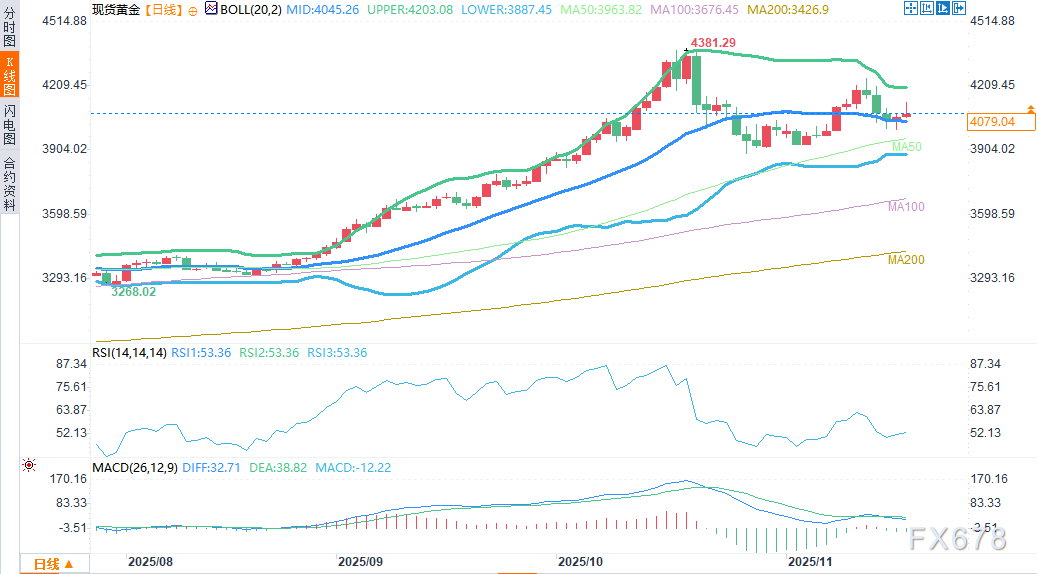
(Daily chart of spot gold, source: Internet)
From a technical perspective, gold appears to be in the early stages of consolidation of a potential bullish trend. The chart shows that if the market momentum can be maintained above the key medium-track indicators, it may regain upward momentum.
In the long run, gold is still in a major upward path. The long-term moving average continues to rise, forming the basic support of the trend. The short-term moving average system shows a bullish arrangement, indicating that the short-term trend structure is still strong.
The Relative Strength Index (RSI) is currently in the upper neutral region, indicating that the bulls still have some momentum and have not entered an extremely overbought state, suggesting that the price still has upside potential. The moving average convergence and divergence (MACD) indicator shows that short-term long and short forces are at a stalemate, but changes in the momentum bar suggest the possibility of a technical fix. For traders who pay attention to technical details, charting tools provided by platforms like Pepperstone can help track changes in these indicators.
Overall, the gold market is currently showing the characteristics of "short-term shock accumulation, medium and long-term trend unchanged". In terms of operation strategy, investors can consider the band layout in the main price range. If the price effectively breaks through the key resistance above, you can follow the trend; if the price explores the important support area below, it can be regarded as a reference opportunity for medium and long-term layout. At the same time, it is necessary to pay close attention to the fundamental events such as the upcoming Federal Reserve meeting notes and employment data, which may have a catalytic effect on technical points.
Please indicate the source: https://www.daoctech.com/fxnews/2250.html
Disclaimer: The content of this article does not represent the views of the Institute of Foreign Exchange. The content is for reference only and does not constitute investment advice. Investors operate accordingly at their own risk.