
A chart: Baltic Dry Bulk Freight Index ends seven days of decline, freight rates across all ship types rise
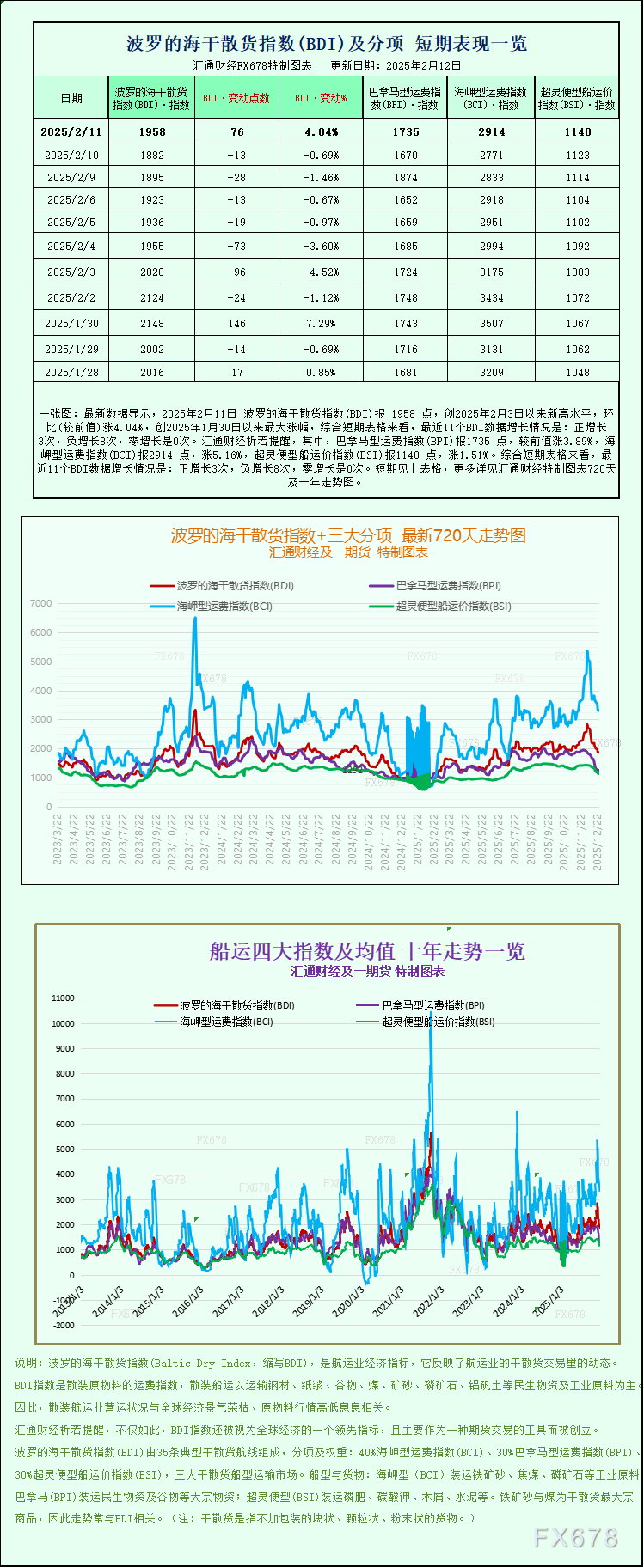
The latest data show that on February 11, 2025, the Baltic Dry Index (BDI) reported 1958 points, a new high since February 3, 2025, up 4.04% month-on-month (compared with the previous value), the largest increase since January 30, 2025. According to the comprehensive short-term table, the latest 11 BDI data growth situations are: positive growth 3 times, negative growth 8 times, and zero growth 0 times. Among them, the Panama-type freight index (BPI) reported 1735 points, up 3.89% from the previous value, the Cape-type freight index (BCI) reported 2914 points, up 5.16%, and the super handy ship freight index (BSI) reported 1140 points, up 1.51%. The latest 720-day chart and ten-year chart of the Baltic Dry Index + three major sub-items are detailed in the latest information special chart.
On Wednesday, the Baltic Exchange Dry Bulk Freight Index (which is used to measure the level of freight rates for dry bulk ships) rose, officially ending the previous seven consecutive trading days of decline. The main support for this rebound came from the across-the-board rise in freight rates for all ship types. As the core bellwether of the global dry bulk shipping market, the fluctuation of the Baltic Dry Bulk Freight Index directly reflects the maritime transportation demand and market sentiment of commodities such as iron ore, coal and grain. Its recovery after seven consecutive days of decline has also injected a trace of vitality into the recent downturn in the dry bulk market.
The main Baltic index, which monitors the movement of three core dry bulk carriers - Capesize, Panamax and Supramax - rose 76 points, or 4 per cent, to 1,958. The rally reversed a short-term downward trend on Feb. 10 after falling to its lowest level since Jan. 26, indicating an initial pick-up in sentiment.
The Capesize freight index rose 143 points, or 5.2%, to close at 2,914 points. Capesize ships are one of the largest types of dry bulk ships in terms of tonnage, mainly responsible for the transoceanic transportation of large bulk cargoes such as iron ore and coal in the world. Its freight price fluctuations are closely related to the prosperity of the global steel industry and the export demand of major coal-producing countries. The 5.2% increase is also the most prominent among the three types of ships, highlighting the phased recovery of demand for large dry bulk cargo transportation.
The average daily revenue of capesize ships increased by $1,304 to $22,929. The standard load of these ships is usually 150,000 tons, and they mainly transport heavy commodities such as iron ore and coal. They are the core transportation capacity connecting major iron ore producers such as Australia and Brazil with consumers such as China and Europe. The recovery in average daily earnings means that the profitability of shipowners has improved, which also reflects the upward trend of freight rates in the large bulk freight market.
However, despite promises from China, the world's largest consumer of iron ore, to provide financial support to boost domestic demand for related industries, iron ore futures prices failed to maintain their gains after surging in early trade on Wednesday, and finally gave up all the early gains, mainly due to a series of lower-than-expected consumption data highlighting the current weakness in iron ore demand. As the world's largest iron ore importer, China's demand changes directly dominate the trend of global iron ore prices. This consumption data was less than expected.fxtmforeign exchangeIt has also suppressed the long-term recovery of the dry bulk shipping market.
The Panamax index rose 65 points, or 3.9 per cent, to 1,735. Panamax ships are the backbone of the dry bulk shipping market, with tonnage between capesize and superhandy ships, suitable for most of the world's mainstream routes, especially in the transportation of medium-sized bulk cargoes such as coal and grain. The increase in its freight rates further confirms the overall recovery of the dry bulk market.
The average daily revenue of Panamax ships increased by 588 US dollars to 15,615 US dollars. The standard load of such ships is usually between 60,000 and 70,000 tons, mainly transporting commodities such as coal and grain. The route covers the transatlantic and Pacific short- and medium-distance transportation. The steady recovery of the average daily revenue indicates that the demand for medium-tonnage dry bulk freight transportation market is also gradually improving, and the market recovery trend has a certain universality.
Among small dry bulk carriers, the price index for ultra-handy ships rose slightly by 17 points, or 1.5%, to close at 1,140 points. The small tonnage and flexibility of ultra-handy ships are mainly responsible for the transportation of dry bulk goods in offshore and coastal areas. The transportation of goods includes small batches of iron ore, coal, grains and other miscellaneous bulk goods. The moderate increase in freight rates shows that the small bulk freight market is also showing signs of recovery at the same time, and there is no divergence trend.
Please indicate the source: https://www.daoctech.com/fxnews/2765.html
Disclaimer: The content of this article does not represent the views of the Institute of Foreign Exchange. The content is for reference only and does not constitute investment advice. Investors operate accordingly at their own risk.