
CPI is lower than expected but the Australian dollar has stabilized and rebounded. What happened?
The Australian dollar appreciated against the US dollar on Wednesday (July 30), rising 0.18% to trade around 0.6520, ending a four-day losing streak. After the release of Australian consumer inflation data, China plans to increase fiscal support to boost market confidence, and the US dollar slightly corrected, and the Australian dollar/US dollar currency pair maintained its gains. The Australian composite stock index just broke through the 9000.00 mark, reaching a record high of 9027.90, rising 0.68% in the day.
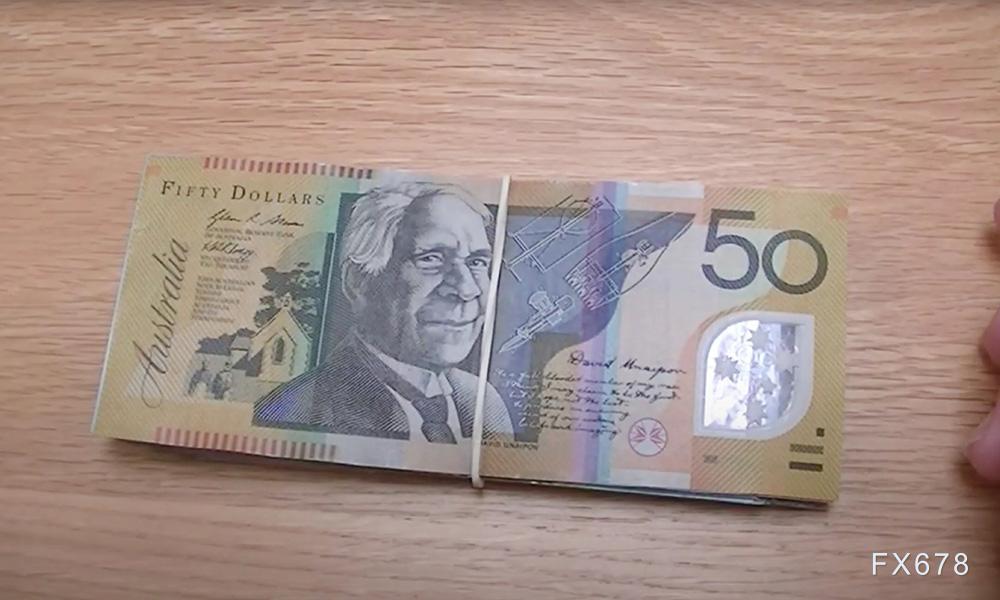
Data released by the Australian Bureau of Statistics on Wednesday showed that the closely watched core inflation rate, which strips out extreme volatility, rose 0.6 per cent month-on-quarter in the second quarter, below expectations of 0.7 per cent. On a year-on-year basis, the measure fell back to 2.7 per cent from 2.9 per cent in Quarter 1, in line with market expectations.
The market believes that Australia's core inflation rate has cooled further in the second quarter, providing a stronger basis for the Reserve Bank of Australia to start monetary policy easing as early as August. As factors such as government subsidies have depressed the headline inflation data, making it difficult to accurately reflect price pressures in the economy, the Reserve Bank of Australia has paid more attention to the core inflation indicator. This time, the core inflation rate has further fallen to 2.7%, and it has entered the 2% -3% target range set by the Reserve Bank of Australia in Quarter 1 alone, indicating that policymakers can now gradually shift the policy focus from suppressing inflation to supporting economic growth
The Reserve Bank of Australia's latest meeting notes on Tuesday showed that the board agreed that further rate cuts would be necessary over time, mainly due to the timing and extent of easing. Most members believed it would be better to start easing after confirming a slowdown in inflation. Most members believed that cutting rates three times out of four meetings was not a "prudent and gradual" move.
These concerns are real because the Australian Bureau of Statistics reports that in the three months to March 2025,KCM ForexThe Australian economy grew by 0.2%, down from 0.6% in the fourth quarter of 2024 and below expectations of 0.4%.
On the positive side, annualized growth remained at 1.3%, albeit below expectations of 1.5%.
Meanwhile, labour costs are a cause for concern. Annual wage inflation rose 3.4 per cent in the year to March and 0.9 per cent in Quarter 1 this year.
However, "a few members saw a case for lowering the cash rate target at this meeting. These members placed more emphasis on downside risks to the economic outlook - stemming from a possible slowdown in overseas growth and weak GDP growth in Australia."
The US and China will continue talks on maintaining the tariff truce in two weeks' time, with Mr. Trump making the final decision on whether to extend it, said Scott Bescent, US Treasury secretary, who played down expectations that Mr. Trump would reject an extension.
China will step up fiscal support to boost domestic consumption and ease mounting economic headwinds, finance minister Alan Lanfoan said on Tuesday.He stressed that the uncertainty of China's development environment is on the rise, and China will adopt more proactive fiscal policies to help stabilize growth.
It is worth noting that since China and Australia are close trading partners, any changes in the Chinese economy could affect the Australian dollar.
The dollar index, which measures the greenback against six major currencies, has now ended a four-day streak of gains and was trading around 98.80 at press time. The dollar weakened and the Australian dollar rose. Investors in the Australian dollar will be closely watching the Federal Reserve's interest rate decision later on Wednesday, with rates expected to remain unchanged.
Analysts expect the Fed to leave its base rate unchanged at 4.25-4.50 per cent in July, with traders now pricing in a near 97 per cent chance of a July meeting on hold, according to CME's Fed Watch tool.
The United States and the European Union reached a framework trade deal on Sunday to impose 15 percent tariffs on most European goods, which will take effect on Aug. 1. The deal ends a months-long standoff, according to Bloomberg.
Adrienne Kugler, a Fed governor, said earlier that the Fed should not cut interest rates "for some time" as the impact of the Trump administration's tariffs was starting to show up in consumer prices, adding that restrictive monetary policy was crucial to keeping inflation in check.
Mary Daly, president of the San Francisco Federal Reserve, said it was "reasonable" to expect two rate cuts this year, while warning against waiting too long. Christopher Waller, a Fed governor, believes the central bank should lower its rate target at its July meeting.
technical analysis
The Australian dollar is currently supported at the 0.6512 mark near the 50-day moving average.
On Wednesday, AUD/USD rallied slightly and is currently trading around 0.6516. The technical analysis of the daily chart shows that the bullish trend is still in place as the pair is still in an ascending channel pattern. However, the 14-day relative strength index RSI is below the 50 mark, indicating that the bears are taking the initiative. In addition, the pair is still below the 10-day moving average, indicating weak short-term price momentum.
On the upside, AUD/USD is likely to target the preliminary resistance level of 0.6536, where the 10-day moving average is located. A breakout of this level could strengthen short-term price momentum and support the pair to test the eight-month high of 0.6624, followed by 0.6600 near the upper edge of the ascending channel.
AUD/USD is likely to gain major support at 0.6512 of the 50-day moving average, adjacent to 0.6500 near the lower edge of the ascending channel. A fall below this key support area would weaken the medium-term price momentum and push the pair closer to the monthly low of 0.6454.
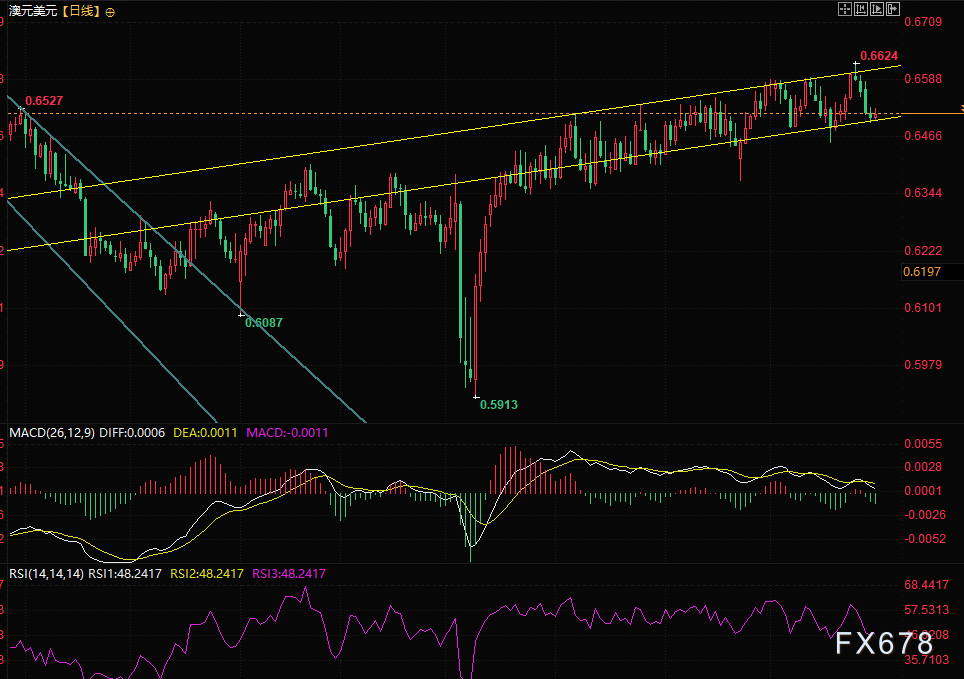
(AUD/USD daily chart, source: Internet)
At 11:43 Beijing time, the Australian dollar is now quoted at 0.6516/17.
Please indicate the source: https://www.daoctech.com/fxnews/2747.html
Disclaimer: The content of this article does not represent the views of the Institute of Foreign Exchange. The content is for reference only and does not constitute investment advice. Investors operate accordingly at their own risk.