
Non-agricultural data mildly exceeded expectations, the dollar supported the euro range volatility
On Wednesday (February 11) in New York, the US January non-farm payrolls report was disclosed as scheduled, and the data showed a slightly higher than expected trend, providing moderate support for the dollar. The euro fell under pressure against the dollar in the short term, and is currently trading in the concussion range around 1.1910.
The report, which was delayed due to the partial government shutdown, not only reflects the resilience of the US labor market, but also directly affects the short-term trend logic of the euro against the dollar, becoming a key variable before the European currency direction choice. Some foreign exchange traders, including KCMForex PlatformDynamic investors are also closely monitoring the impact of this data on the follow-up rhythm of the foreign exchange market.

Non-agricultural slightly exceeded expectations, data details released a moderate signal
The core data of this non-agricultural report are slightly higher than the general market expectation: in January, the number of non-agricultural employment increased by 130,000, which greatly exceeded the expected value of 70,000, and steadily rebounded from the new scale of 50,000 in December; the unemployment rate rebounded from the expected 4.4% to a stable level of 4.3%, better than the market expectation;
Annual wage inflation, as measured by average hourly earnings, came in at 3.7 percent, slightly above expectations of 3.6 percent and down modestly from December's 3.8 percent increase.
The data was largely in line with TD Securities' previously anticipated forecast that job growth would remain moderate in January.
The report shows that the private sector contributed the majority of new jobs, with the healthcare and construction industries becoming the main growth drivers. The overall labor market continued to be characterized by low layoffs and low hiring.
At the same time, the US's unseasonally adjusted annual employment benchmark was revised down 862,000, which looked better than the market expected.
It is worth noting that, despite the data significantly exceeding expectations, whether there is a trend of upward regression to the historical average still needs to wait for the next non-farm data to determine whether there is a change in the overall upward trend of the labor marketKCM ForexFor investors who trade, such periods of uncertainty often mean more signs of caution.
The specific market sensitivity of the reporting background has been significantly improved
The Bureau of Labor Statistics (BLS) announced early last week that the official employment report, originally scheduled for Friday, had been delayed due to the partial government shutdown.
The agency confirmed the timing only after the U.S. House of Representatives passed a package to end the shutdown on Tuesday.
This special release background, superimposed on the data itself, has further enhanced the market's sensitivity to data, amplifying the volatility of the euro against the dollar in the short term.
The trend of the euro against the dollar is under pressure and the volatility pattern is difficult to change
After the non-agricultural data slightly exceeded expectations, the euro was under short-term pressure against the dollar, falling back from the high of 1.1927 in the early European session to the current level of 1.1870.
From the perspective of market logic, this reaction is mainly due to the marginal adjustment of the Federal Reserve's policy expectations: the data exceeded expectations to strengthen the Federal Reserve's expectation of maintaining policy unchanged next month, and the CME Federal Reserve's observation tool shows that the pricing probability of a 25-basis point interest rate cut in March remains at around 15%, without significant loosening.
From a technical point of view, the euro is currently in the range of 1.1765 to 1.2081 against the dollar. The daily level MACD indicator shows that the upward momentum is not strong, and the RSI indicator reading is about 59.51, which is in the strong but not overheated area. Since the non-agricultural sector only slightly exceeded expectations, there was no trend reversal signal, the upward space of the dollar was limited, and the euro did not see a sharp correction. In the short term, it will still maintain the pattern of range fluctuations.
Previous statements by Federal Reserve officials also provided a reference for the exchange rate trend: Governor Lisa Cook stressed that the labor market has stabilized and policymakers need to be wary of rapid turns; Governor Philip Jefferson believes that the current labor market is in an equilibrium environment of low layoffs and low hiring. These views echoed the performance of this non-farm data, further strengthening the expectation of the Federal Reserve's policy stability and suppressing the euro's upward trend.
Salary data becomes the key, and future attention needs to be paid to policy path differences
Investors are particularly sensitive to wage inflation data while watching the number of new non-farm payrolls.
The average hourly wage performance of 3.7% year-on-year was slightly higher than the expected 3.6%, but it was still in a relatively moderate range.
Danske Bank analysts pointed out that the trend of slowing wage growth has not changed, which will directly restrain consumer activity and create conditions for future dovish policy adjustments by the Federal Reserve.
Summary and technical analysis:
For the euro, the follow-up trend will still depend on the difference in the policy path of European and American central banks. At present, the implied probability of the Federal Reserve cutting interest rates for the first time in June 2026 is close to 75%, while European Central Bank officials have recently expressed caution, emphasizing that the current inflation trend is still within the forecast framework, and the policy rate does not need to be easily adjusted.
This policy expectation gap still provides some support for the euro, limiting its room for correction.
In the short term, the euro against the dollar may lose the opportunity to compete for the 1.19 mark. The 1.19 psychological mark above constitutes an important resistance, and the 50% Fibonacci level below 1.828 is a key defensive area for the bulls. The follow-up needs to focus on the speeches of Federal Reserve officials and the remarks of European Central Bank members Schnabel and Cipolone, superimposed on the US inflation data this Friday, these factors will jointly determine the next direction of the euro against the dollar.
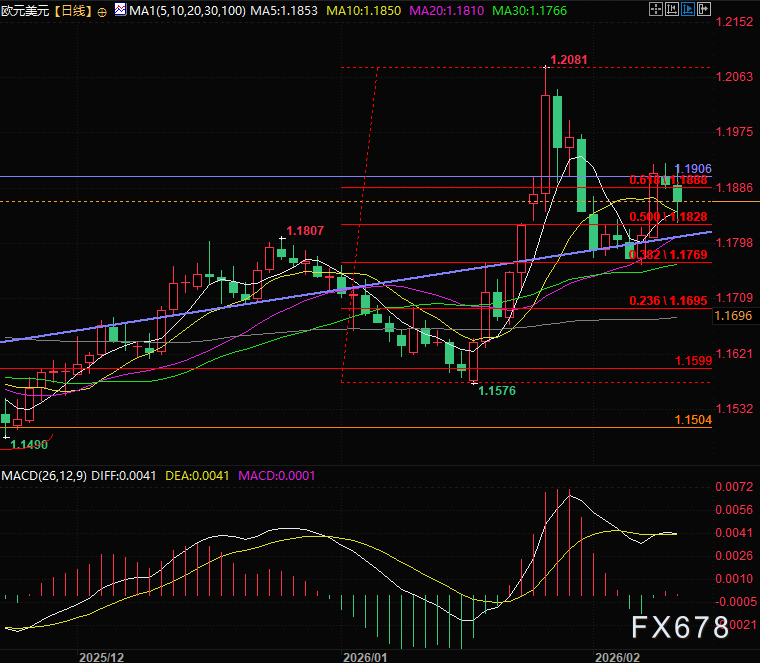
(EUR/USD daily chart, source: Internet)
At 21:53 Beijing time, the euro was trading at 1.1866/67 against the dollar.
Please indicate the source: https://www.daoctech.com/fxnews/2342.html
Disclaimer: The content of this article does not represent the views of the Institute of Foreign Exchange. The content is for reference only and does not constitute investment advice. Investors operate accordingly at their own risk.