
The Fed's dovish speech helped the euro rebound
The euro rose against the dollar for a third consecutive session on Thursday (October 16). It is currently trading around 1.1663, up about 0.15%. It had previously hit a new one-week high of 1.1674. The speech of Federal Reserve Chairperson Powell strengthened market expectations for another interest rate cut this month, and the euro rose significantly against the dollar. In the context of light follow-up data, the remarks of Federal Reserve officials may be the next directional catalyst.

Dovish rhetoric curbs dollar rally
The euro rallied strongly against the dollar over the past three sessions, as Federal Reserve Chairperson Jerome Powell spoke at the National Association for Business Economics event earlier this week. Powell continued to warn of downside risks to the US labour market, and the move failed to dent the market's expectation that another interest rate cut this month was all but certain.
Mr. Powell said: "While unemployment remained low in August, job creation has slowed sharply, likely in part due to slower labour force growth due to immigration and lower labour force participation. Downside risks to employment in a less dynamic and slightly weaker labour market appear to have risen."
Powell's speech did not significantly change the market's near-term expectations for the federal funds rate, but it did drive down longer-dated Treasury yields, sending the policy-sensitive two-year yield to levels not seen in months.
While there has been no near-term sustained correlation between the euro and the dollar on a week- to month-by-month basis in absolute Treasury yields or US-US interest rate spreads, it is hard to ignore that the dollar has continued to sell off since Powell's speech about "a possible pause in quantitative tightening soon". This may well have contributed to the euro's rally against the dollar - even though eurozone economic data have been lackluster relative to expectations. Against this backdrop,yingshiInvestors need to keep a close watch on the follow-up policy direction.
Despite the impending speeches by officials such as European Central Bank President Christine Lagarde, eurozone economic data were relatively light, including a rare surprise in September's final inflation reading. In the US, the lack of tradable economic signals due to the ongoing government shutdown means Fed officials' speeches are most likely to be the fundamental catalyst.
Technology Outlook
Looking at the daily chart of the euro against the dollar, it can be seen that the exchange rate has broken through the downward trend since the high on September 17 on Thursday. The trigger for this bullish market is the failure of bears to effectively break through the low of October 9 at 1.1541 support.
On the upside, the recent correlation between the EUR/USD and the 50-day moving average (1.1690) has been weak, sometimes interacting and sometimes deviating. Nonetheless, this moving average is still an initial resistance level that cannot be ignored. If you can successfully break through this moving average, you need to pay attention to the area above 1.1750 that was sold late last month and early October, which will become the next key target for bulls. Traders can keep an eye out for changes in this technical level.
On the downside, it is necessary to focus on the double-bottom low 1.1541 support level formed earlier this month. If it is effectively broken, it may push the short-term trend of the exchange rate to bear dominance.
In terms of directional preference, both the RSI (14) and MACD indicators are showing neutral momentum, which makes short-term price action more indicative. Although the RSI (14) has broken through the downtrend line of the past month, this only indicates that bearish momentum is weakening and does not send a clear bullish signal.
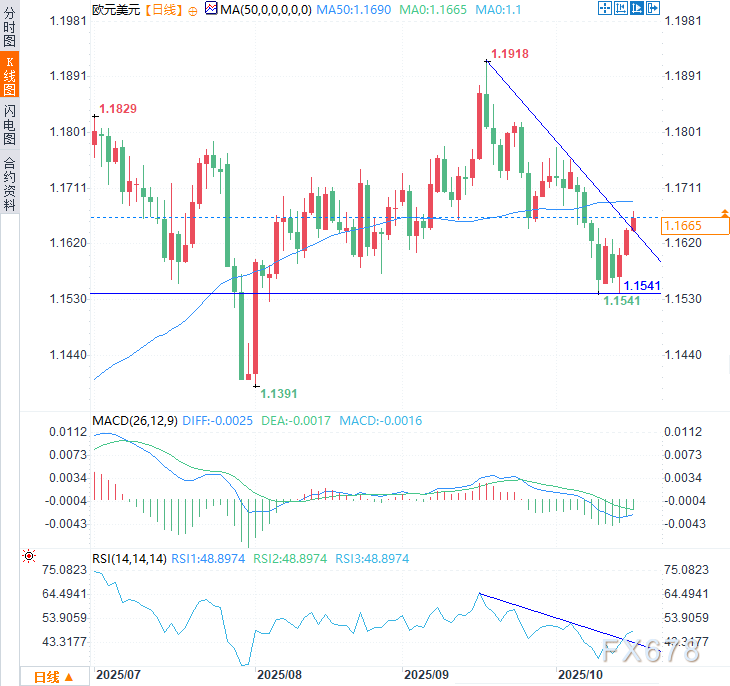
(EUR/USD daily chart, source: Internet)
At 11:13 Beijing time, the euro was trading at 1.1664/65 against the dollar.
Please indicate the source: https://daoctech.com/fxnews/2354.html
Disclaimer: The content of this article does not represent the views of the Institute of Foreign Exchange. The content is for reference only and does not constitute investment advice. Investors operate accordingly at their own risk.