
The limited use of force by the United States and Iran, the geopolitical premium may subside
On May 25-26, 2026, the US Central Command announced a "self-defense strike" against missile launch sites in southern Iran and Revolutionary Guard ships laying mines near the Strait of Hormuz. The operation was limited in scale and focused on military installations and military speedboats, but did not affect densely populated areas, civilian facilities and core energy facilities. The Iranian side later publicly condemned the military operation and claimed to shoot down the US drone, but did not take large-scale retaliatory measures such as missile counterattacks or naval blockades. The two sides maintained overall restraint and deliberately avoided a full-scale escalation of the situation.
This operation is a tactical extension of strategic pressure
A number of professional media and geopolitical analysts believe that this limited military operation is a tactical extension of the Trump administration's strategy of "promoting peace with practical strength", and is a typical controllable strategic pressure. The core purpose is to break the deadlock in the Doha indirect negotiations, rather than to set off a full-scale military conflict. Mainstream foreign media pointed out that the timing of this strike is very targeted, and it was precisely landed during the US-Iran-Qatar Doha indirect talks. The US intention is very clear: to use low-risk military leverage to pressure Iran to make substantive concessions on three core issues, including the opening of the Strait of Hormuz waterway, the US freezing and thawing of Iranian assets, and the negotiation framework of the Iranian nuclear issue.
The Washington Institute for Near East Policy and other authoritative think tanks added analysis that this mixed game strategy of "combining limited military strikes with sustained diplomatic negotiations" can take into account the multiple demands of the US side: accurately test Iran's bottom line, respond to the tough demands of domestic Republican hawks, and at the same time, without departing from the main line of diplomatic negotiations, greatly enhance the US negotiating chips. Industry experts interpret that at this stage, Iran's domestic economic fundamentals are relatively fragile, long-term international sanctions are superimposed on the impact of local conflicts in the Middle East, domestic inflation is high, and people's livelihood is under great pressure. The Iranian authorities prefer to negotiate in exchange for sanctions relief and funding, rather than risk a full-scale confrontation with the United States. Therefore, such low-intensity strategic pressure is likely to tilt the deep negotiation to the US side, and will not directly terminate the bilateral dialogue mechanism.
The two sides' statements hide secrets, and two-line games have become the norm in negotiations
The US side has balanced its tough stance with its flexibility in negotiations, and its stance is very measured. US Secretary of State Marco Rubio publicly stated that the indirect negotiations between the US and Iran have made "significant progress". The two sides have conducted in-depth consultations on the two topics of the full opening of the Strait of Hormuz and the time-limited negotiation framework for the Iranian nuclear issue. At the same time, the bottom line signal is that the Trump administration will not sign inferior agreements that harm US interests. Trump himself also expressed his voice through social platforms, saying that the overall negotiation situation is improving, but he also released a deterrent warning: if the negotiation fails to reach a consensus in the end, the US may introduce a new round of sanctions and military measures, adhering to the core principle of "either reaching a quality agreement or terminating the negotiation".
The Iranian side also adopts a "soft and hard" game strategy. The Iranian Revolutionary Guards and official public opinion channels have made it clear that simply opening the Strait of Hormuz in exchange for the partial thawing of frozen funds is a unilateral compromise that Iran cannot accept. The US side must simultaneously relax sanctions in all areas and engage in consultations on the Iranian nuclear issue in order for the two sides to reach a mutual consensus. At the same time, Iran has not closed the negotiation channel. The foreign minister and exclusive negotiating team continue to be stationed in Doha to participate in the talks. Semi-official channels also released a soft signal, saying that they do not rule out the possibility of resuming normal shipping in the Strait of Hormuz within 30 days.
Analysts point out that this two-way attitude of being tough on the outside and pragmatic on the inside is a typical feature of high-level geopolitical negotiations: both the United States and Iran need to use tough statements to stabilize the domestic political base and appease their own radical factions, while maintaining a buffer channel for compromise negotiations. Throughout the history of geopolitical games in the Middle East, low-intensity and limited military actions have often become a special boost lever for great power negotiations, rather than a trigger for all-out war.
Oil prices remain dominated by negotiations, with the geopolitical premium gradually receding
Even with the sudden low-intensity US-Iran military friction, the international crude oil market did not experience a panic surge, and the core pricing logic was still dominated by negotiation expectations. The market generally anticipates that if the US and Iran reach a preliminary consensus and the Strait of Hormuz waterway is fully restarted, the crude oil supply in the stranded waterway can be quickly released in the short term; superimposed on Iran's frozen funds are thawed and some sanctions are relaxed, Iran's crude oil exports are expected to surge in stages, which will have a negative impact on global crude oil supply.
The recent trend of international oil prices also confirms this logic: after the positive signal from the Doha negotiations, Brent crude oil futures fell by 5% to 7% during the session, and WTI crude oil prices fell back to the range of $90/barrel. The risk premium originally generated by the geopolitical conflict in the Middle East has gradually contracted as the negotiations have proceeded steadily; the market has fully adapted to the push-pull fluctuation of the US and Iran "talking while talking", and the expectation of the recovery of actual crude oil supply has replaced military friction and become the core pricing factor of oil prices at this stage.
Market outlook: Oil prices are likely to backtest the $90 mark
Energy industry analysts believe that if the follow-up Doha talks continue to release positive results and achieve substantive results such as the Strait Opening Framework Agreement and the phased thawing of funds, international oil prices are expected to fall further in the short term, or even break the key threshold of $90 per barrel. At the operational level, it is recommended to follow the principle of "selling expectations and buying reality": the current global crude oil fundamentals are still tight, and crude oil inventories in major Asian consumer countries are at a low level during the year, which forms a bottom support for oil prices, but the decline of geopolitical risk premiums will still be the dominant variable of short-term oil price trends. WeTrade advises investors to pay attention to the progress of the Doha talks and respond flexibly to market changes.
Disassembly of relevant potential trend scenarios:
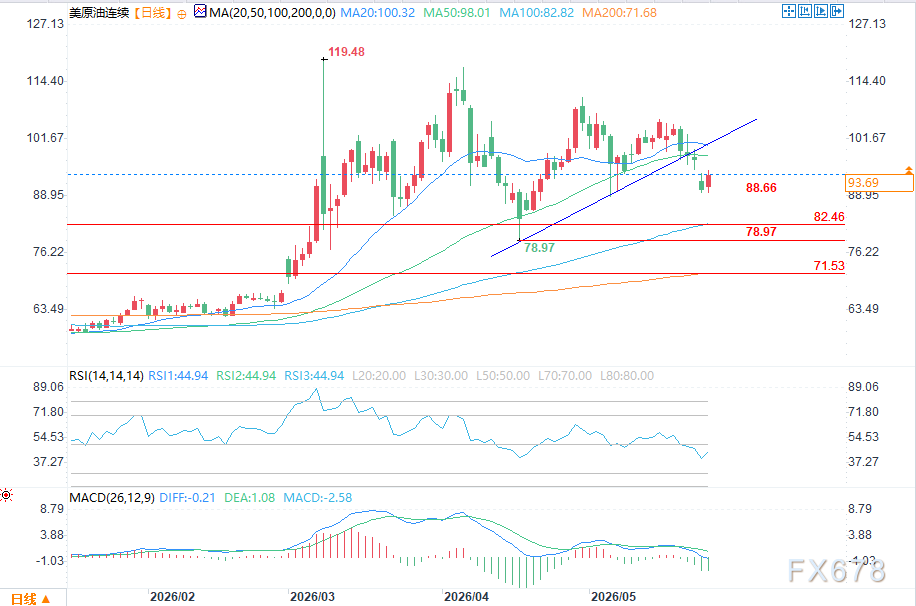
(WTI crude oil daily chart, source: Internet)
Optimistic scenario: The United States and Iran finalize the complete agreement framework, the waterway is opened, sanctions are slowly released, and oil prices quickly fall back to the range of $90/barrel and below.
Repeated scenarios: the negotiations fell into a tug-of-war game, with positive and negative news released alternately. Oil prices remained high and volatile, but the medium- and long-term downward trend remained unchanged.
Risk warning: Variables such as Israel's aggressive intervention stance, internal factional differences in Iran, and the detailed game of Iran's nuclear negotiations may still trigger short-term abnormal fluctuations in oil prices.
Overall, this round of limited military use by the US military is essentially a means of attacking the heart and playing with diplomatic negotiations, not a prelude to a comprehensive escalation of the situation. Bilateral dialogue remains the core main line of the current situation in the Middle East and the crude oil market. At the investment and industry level, it is recommended to focus on tracking the progress of the follow-up talks in Doha, Trump's latest public statement, and the official response from the US and Iran. Although the current situation is uncertain, the main line of peace negotiations has not deviated, and oil prices have fallen to around $90/barrel, which is the market direction that needs to be paid attention to at this stage.
Please indicate the source: https://www.daoctech.com/fxnews/2438.html
Disclaimer: The content of this article does not represent the views of the Institute of Foreign Exchange. The content is for reference only and does not constitute investment advice. Investors operate accordingly at their own risk.