
From Bernanke to Powell: The Federal Reserve's Crisis Relay and December Interest Rate Cut Expectations
In early 2006, when Ben Bernanke succeeded Alan Greenspan as chairperson of the Federal Reserve, The Economist magazine released a highly iconic cover story: the picture shows Greenspan and Bernanke in the middle of a relay handover, but the former is not handing a regular baton, but a bundle of explosive sticks that are ready to explode.
This visual metaphor turned out to accurately anticipate the crisis - the collapse of Lehman Brothers in September 2008, which triggered the global financial marekt and the Great Recession of 2008-2009.
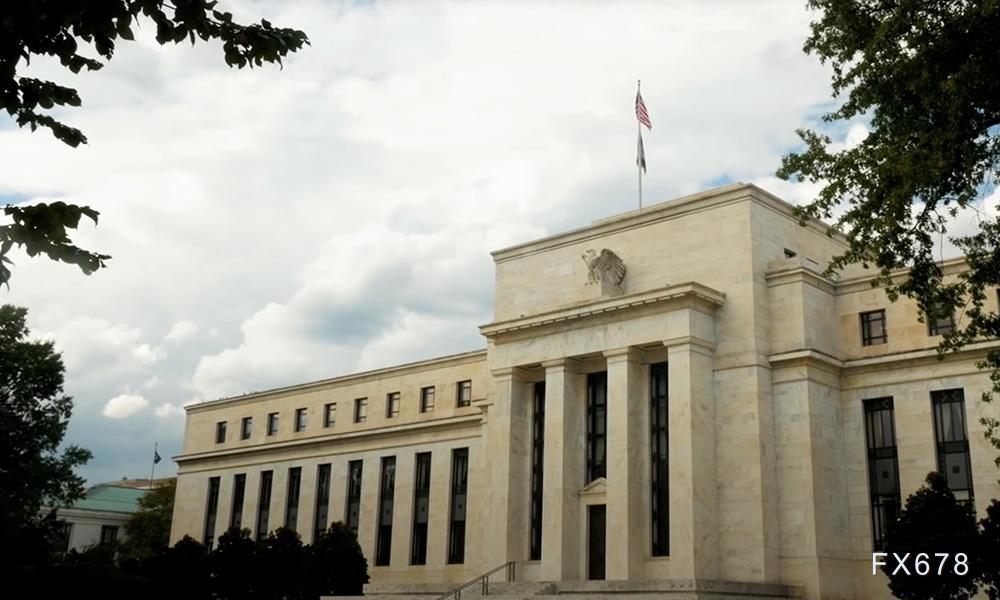
The "high-risk" transition environment for Powell's successor
By the end of the year, President Trump is expected to finalize the successor to Federal Reserve Chairperson Jerome Powell (Powell's term expires next May).
The background to this transfer of power is a complex situation in which US public debt has entered a clearly unsustainable track, the international trading system is under severe pressure, and the stock and private credit markets are showing the characteristics of typical bubbles.
Making matters even more tricky, the next Fed chairperson will have to face a president bent on undermining the Fed's independence by placing cronies on the board of governors and maintaining pressure to maintain a low interest rate environment.
This makes one wonder whether The Economist will re-enact the classic cover, but in this relay scene, Powell hands over the explosive stick to his successor.
Economic Fundamentals: The Double Shackles of High Debt and Foreign Dependence
Monetary policymaking is a difficult task even during periods of calm macro conditions; and it becomes exponentially more difficult when countries have high public debt and high fiscal deficits - the hot potato that Powell's successor will inherit.
According to the IMF's latest projections, the US fiscal deficit will stabilize at around 7% of GDP in the foreseeable cycle, which will push public debt to 128% of GDP by 2030, matching the debt levels of heavily indebted countries such as Greece and Italy.
At the heart of the US economy, its budget deficit and external current account deficit are highly dependent on foreign financing. Foreign investors currently hold $8.50 trillion of US Treasuries, according to US Treasury data, accounting for 30% of the total $29 trillion of Treasuries in circulation.
If foreign investors are unwilling to continue financing the US deficit or renew maturing bonds at current interest rates, owing to any factors such as reduced risk appetite and adjusted yield demands, long-term interest rates could skyrocket - not only becoming a fatal obstacle to economic recovery, but also triggering severe turmoil in the financial system.
The double test of succession: maintaining confidence and responding to bursting bubbles
One of the central challenges of the new Fed chairperson is to maintain global investors' credit confidence in the US, both by demonstrating a firm stance on controlling inflation and by addressing market concerns about "inflation-diluted debt".
If President Trump continues to undermine the Fed's independence, by placing "obedient" cronies in charge of the Board's decision-making, this goal will be extremely difficult; moreover, if the administration resumes discussions on "mandatory conversion of foreign holdings into 100-year zero coupon bonds," it will undoubtedly further shake the foundation of market confidence.
Another core challenge,ebc foreign exchangeIt is to deal with the secondary risks after the bursting of bubbles in the stock and credit markets.
Given the potential for a jump in long-term interest rates triggered by the US public finances, the probability of a bubble bursting next year is highly realistic.
From a historical perspective, the current cycle-adjusted price-to-earnings ratio (CAPE) of the S & P 500 index is about 40, doubling the long-term average, and the risk of a 40% stock market correction cannot be ignored; the "stock market valuation/GDP ratio" proposed by Warren Buffett is still 50% higher than the historical peak, and the characteristics of bubbles are significant.
At the same time, the $1.50 trillion private credit market has begun to expose risk exposure, and the possibility of local crisis spreading to systemic risk cannot be underestimated.
Even in an ideal environment of co-ordinated policies and stable markets, it is already extremely difficult for the Federal Reserve to respond to a credit or stock market crisis;
In the context of the Trump administration's fragmented macroeconomic policymaking and lack of policy coherence, these challenges will be even more disruptive. For Jerome Powell, it may be lucky not to have to take on the "Hercules-like task" of stabilizing the economy when various financial bubbles burst.
The outlook for the December interest rate meeting: interest rate cuts are expected to heat up, and institutions are intensive in their voices
Williams' remarks lock in the high probability of interest rate cuts. As the FOMC meeting on December 9-10 approaches, the Fed's policy trend has become the focus of the market. The Fed's "three hands" and New York Fed President Williams made "dovish" remarks, saying that he believes that "there is still room for further interest rate cuts in the short term", which significantly strengthened the expectation of interest rate cuts in December.
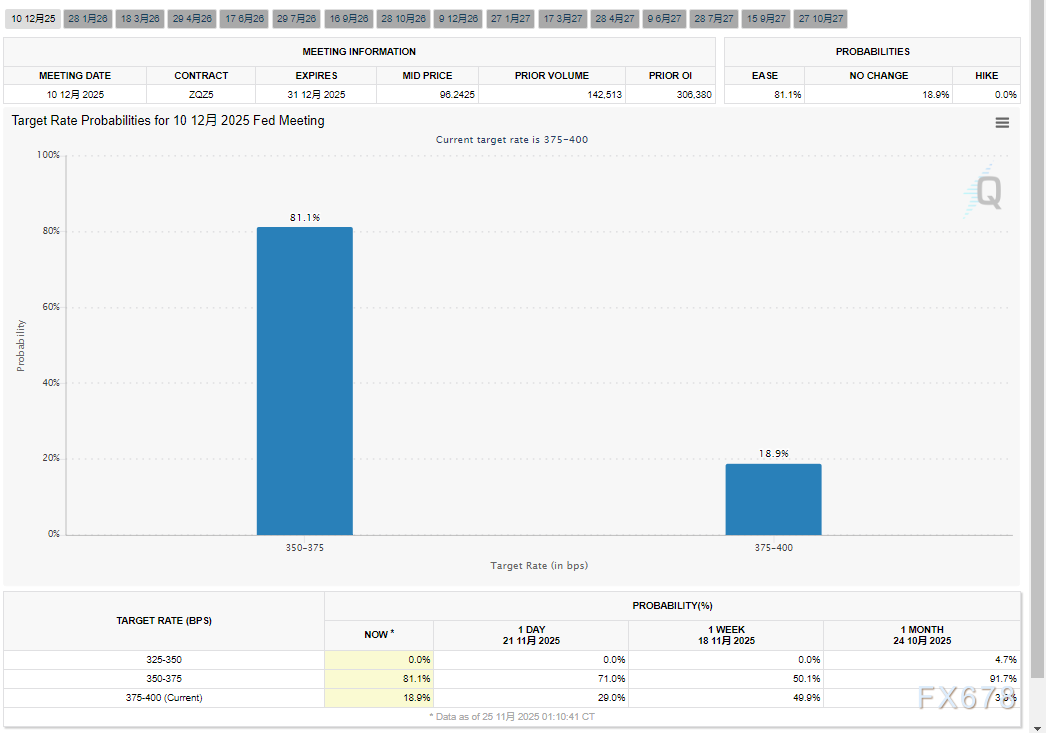
According to CMEFedWatch data, the market 6 days ago expected that the probability of the Federal Reserve cutting interest rates in December was only 30.5%, while the probability of keeping interest rates unchanged was 69.5%. After Williams' speech, the probability of interest rate cuts soared from 30% to around 70%. After that, San Francisco Federal Reserve President Daley also made similar dovish remarks in an interview on Monday to continue to push up the probability of interest rate cuts. Afterwards, Federal Reserve Governor Waller expressed in his speech that the US labor market is weak and continues to weaken, and inflation is also expected to slow down, and believes that these conditions are enough to support the proposition of cutting interest rates by 25 basis points at the December meeting.
Although Waller has been making dovish claims and is also a favorite candidate for the Federal Reserve Chair, it has limited support for the overall interest rate cut expectations of the Federal Reserve in December, but the market still pushed the interest rate futures of the CMEFedWatch December interest rate cut further to 81%.
Institutional research: Goldman Sachs and Pantheon reach a consensus to cut interest rates
Jan Hatzius, chief economist at Goldman Sachs, gets to the heart of the matter in a strategy note released today: "Although the September non-farm payrolls data release is seriously lagged, this data has a high probability of locking in the 25 basis point interest rate cut decision of the December 9-10 FOMC meeting."
He further explained to clients: "[New York Fed President Williams'] statement is highly consistent with the position of Chairperson Powell, who signaled three rate cuts almost explicitly in the September dot plot, and is also consistent with the views of the majority of the 12 voting FOMC members, although it may not be supported by all 19 participating members."
Goldman Sachs' latest forecast also shows that the Federal Reserve will cut interest rates twice more in 2026, in March and June, eventually lowering the federal funds rate to a range of 3.00% to 3.25%.
The bank believes that slowing inflation and a cooling labor market provide room for policymakers to further ease monetary policy, and the Federal Reserve is likely to maintain a cautious tone in the short term, but the trajectory of core price and wage growth indicates that the policy stance may gradually transition to neutral levels next year.
Samuel Thomas and Oliver Allen, macro analysts at Pantheon, were more decisive in their assessment that Mr. Williams's comments were the "final word" for a rate cut: "Mr. Williams has a far higher voice than any other FOMC member - he has always been in line with the majority and has never been at odds with the chairperson's position since he became president of the New York Fed in 2018, and during his tenure as chairperson of the San Francisco Fed in 2011-2018. We judge that Mr. Williams would never have hinted at the possibility of a rate cut in December without prior communication with the central members of the Fed Board, including Chairperson Powell."
Please indicate the source: https://www.daoctech.com/fxnews/2703.html
Disclaimer: The content of this article does not represent the views of the Institute of Foreign Exchange. The content is for reference only and does not constitute investment advice. Investors operate accordingly at their own risk.