
Gold trading reminder: rising inflation and weak employment coexist, has gold prices peaked?
In early Asian trading on Friday (September 12), spot gold maintained an overnight volatile trend and is currently trading around $3,635.18 per ounce. Although spot gold prices fell slightly 0.2% to $3,632.49 per ounce on Thursday, they are not far from the all-time high set on Tuesday. Gold prices hit a new record of $3,674.36 on Tuesday. Since the beginning of this year, gold prices have risen by 38%. This is not only due to geopolitical risks and inflationary pressures, but also deeply influenced by US economic data and Federal Reserve monetary policy expectations.
The latest data showed that the U.S. Consumer Price Index (CPI) rose more than expected in August, rising 2.9% year-on-year to a seven-month high, while the number of initial jobless claims surged to 263,000, highlighting the weakness of the labor market. These twin signals, while volatile for a while, ultimately strengthened expectations that the Federal Reserve will cut interest rates next week, continuing to support gold prices.
US economic data double signal: rising inflation and weak employment coexist
The latest release of US economic data is like a double-edged sword. On the one hand, inflation indicators show tenacity, and on the other hand, signs of weakness in the labor market are becoming more and more obvious, which directly affects the nerves of gold prices.
Consumer prices in the US rose 0.4 per cent month-on-month in August, beating expectations of 0.3 per cent and reaching 2.9 per cent year-on-year, the biggest annual gain since January. Core consumer prices also remained high at 0.3 per cent month-on-month, reflecting weak service sector margins and low commodity costs that have not entirely damped upward pressure on prices. This slightly inflationary trend could have weighed on gold, as high inflation tends to accompany Fed tightening expectations, but this has not been the case.
Instead, initial jobless claims surged to 263,000 last week, a three-year high and well ahead of economists' 235,000 forecasts. This echoed the previous August non-farm payroll gain of just 22,000 jobs (well below 75,000 expectations), and the revision of 911,000 jobs in the 12 months to March, providing a clear picture of cooling economic momentum. In this environment, weak labor market data overwhelmed inflation fears and became gold's "redeemer".
Tai Wong, an independent metals trader, pointed out that this employment weakness limited the scope for a sharp correction in gold prices, as investors were more inclined to view gold as a shield against an economic slowdown. Overall, the data, while causing short-term volatility - gold prices fell as much as 0.6 per cent before the data was released - ultimately translated into support for gold, driving it to stabilise at its highs.
The Federal Reserve's interest rate cut expectations are strong, and gold prices are strongly supported
The Federal Reserve's monetary policy moves have always been the strongest indicator of the gold market, and the current market consensus has seen next week's rate cut as a DingTalk on the board.
The Chicago Mercantile Exchange FedWatch tool shows that the probability of the Federal Reserve cutting interest rates at the policy meeting on September 17 is 100%, of which the probability of cutting interest rates by 25 basis points is as high as 91%, while the probability of cutting interest rates by 50 basis points is minimal, only 9%, but the overall easing expectations have not wavered.
This was helped by the cumulative effect of a range of weak economic indicators, including last week's unexpected drop in the producer price index (PPI), and continued weakness in employment data. These factors have combined to strengthen investors' bets on the Fed's return to an easing cycle, especially after the suspension of interest rate cuts in January due to the impact of tariffs, and now signs of a cooling economy have convinced markets that the Fed's dual mandate of controlling inflation and promoting employment is tilting towards the latter.
Interest rate futures pricing even reflects the expectation of three consecutive rate cuts of 25 basis points for the rest of the year starting next week. For gold, a low interest rate environment means a lower opportunity cost of holding interest-free assets, boosting its attractiveness.
Tai Wong further added that while recent price movements have shown some buyer weakness, the outlook for gold in the coming months remains constructive, not only due to expectations of interest rate cuts, but also the potential amplification of global uncertainties such as geopolitical risks. It is worth noting that if inflation data further exceeds expectations, it may temporarily disturb this expectation, but the current employment weakness is given greater weight, ensuring the relative stability of gold prices.
A weaker dollar boosts gold's international appeal
The fluctuations in the exchange rate of the US dollar are often negatively correlated with the price of gold, and after the release of this economic data, the decline of the US dollar further provided an external boost to the price of gold.
In New York on Tuesday, the dollar index gave up all its gains in the Asia-Europe session to close down 0.3% at 97.52. The weakening trend was mainly due to the slightly hot but not better-than-expected US inflation data and the dovish sentiment caused by the surge in initial jobless claims.
Eugene Epstein, head of North American trading at Moneycorp, stressed that the CPI data did not really change the direction of the Federal Reserve's interest rates, and the market was more focused on weak employment, which weighed on the dollar.
At the same time, the European Central Bank kept interest rates unchanged, and President Christine Lagarde's optimism about the "good" state of the euro zone economy and inflation targets also weakened expectations of further easing in the euro zone, sending the euro higher and further depressing the dollar. The direct beneficiary of the dollar's weakness is gold, as dollar-denominated gold becomes more attractive to investors holding other currencies. This partly explains why gold prices were able to quickly narrow their losses after the inflation data was released.
The bond market and the stock market reacted, and the overall optimism of the market was high
The positive response from the US bond market and the stock market further confirmed the indirect support of interest rate cut expectations for gold. In the bond market, the 10-year Treasury yield fell to a five-month low, touching 3.994% at one point, before closing down 1.7 basis points to 4.015%. The two-year yield fell slightly to 3.531% and the yield curve flattened to a positive 48.2 basis points, which is seen as a signal of positive economic expectations. The 30-year Treasury auction went smoothly and demand was solid. Despite fiscal concerns, primary dealers did not need to fill the vacancy, highlighting the market's confidence in Treasuries.
Nate Thooft, chief investment officer at Manulife Investment Management, pointed out that the CPI data was not much different from expectations, which relieved the market and avoided a more negative reaction.
At the same time, the TIPS break-even yield shows that the market expects an average annual inflation rate of about 2.4% over the next 10 years, slightly higher than the Federal Reserve's 2% target, which provides room for gold as an inflation hedge.
In equities, the Dow, S & P 500 and Nasdaq all hit new closing highs, Tesla jumped 6 per cent and JPMorgan Chase and Goldman Sachs gained more than 1 per cent. Atsi Sheth, chief credit officer at Moody's Ratings, attributed this to signs of "stagflation" amid stubborn inflation but slowing employment, forecasting two 25 basis point rate cuts this year.
Stock market optimism often goes hand in hand with gold, as expectations of interest rate cuts stimulate risk assets and strengthen gold's safe-haven status. Oliver Pursche, senior vice-president at Wealthspire Advisors, believes that rising unemployment may amplify interest rate cuts, although the probability of 50 basis points is small, but the logic of "bad news is good news" is back, driving the market as a whole.
summary
To sum up, the gold market has shown strong resilience under the interweaving of current economic data and policy expectations. Despite the challenges posed by rising inflation and short-term volatility, gold prices face some adjustment needs in the short term, but the expectation of interest rate cuts led by weak employment, the weakening of the US dollar and the optimistic response of the bond market have combined to build a solid support for gold prices. This year's 38% increase is not the end, and the outlook for gold in the coming months remains constructive, but investors need to be vigilant against the uncertainties caused by accelerating inflation or changes in geopolitical risks. Overall, as the Federal Reserve's easing path becomes clear, gold will continue to be the core of global asset allocation and deserves continued attention.
This trading day 8 focuses on the July GDP data of the United Kingdom and the preliminary value of the University of Michigan Consumer Confidence Index in September in the United States, and pays attention to the news related to the geopolitical situation.
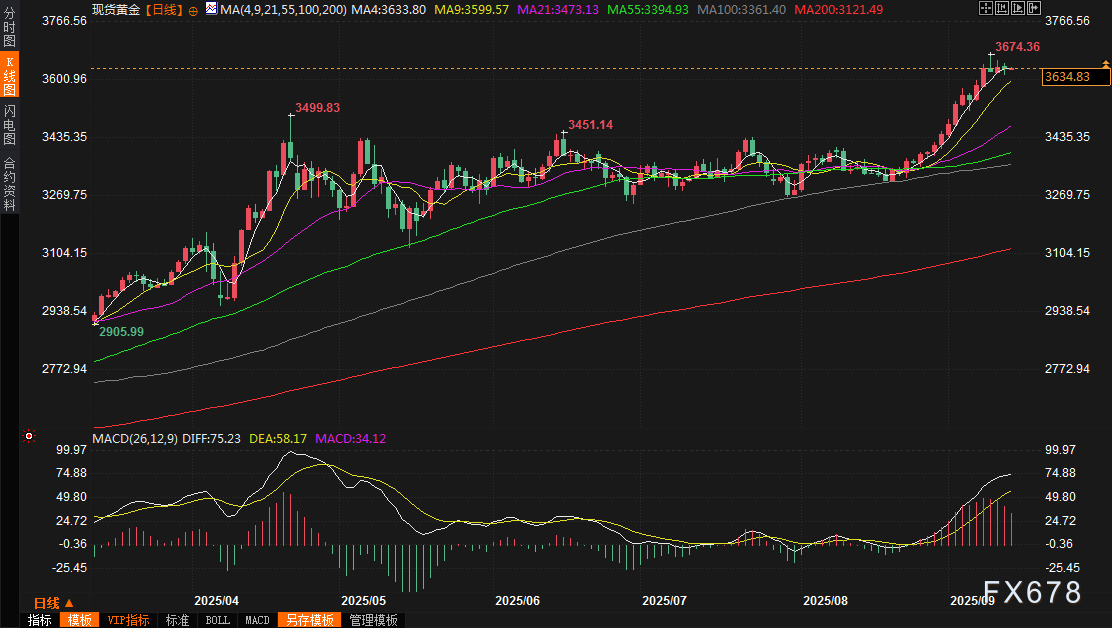
(Daily chart of spot gold, source: Internet)
At 07:30 Beijing time, spot gold was reported at $3,635.57 per ounce.
Please indicate the source: https://www.daoctech.com/fxoutrade/1764.html
Disclaimer: The content of this article does not represent the views of the Institute of Foreign Exchange. The content is for reference only and does not constitute investment advice. Investors operate accordingly at their own risk.