
Silver's "rise and fall" hints that interest rate cut bets have been filled. Why is silver still rising?
On Wednesday (September 10), the European and American session was affected by the US PPI being significantly lower than expected. New York silver futures quickly stretched 0.3% to a maximum of 41.72 US dollars per ounce, led by investment demand. This year, silver rose fiercely, and silver prices continued to run near 14-year highs. However, after the news was released, silver prices quickly pulled back to the previous price of 41.54.
The market's reaction has repeatedly hinted that investors' expectations for US interest rate cuts, as well as the data supporting US interest rate cuts, may have made a full bet. Therefore, after discussing the trend of silver, the market's attention refocused on the basic properties of silver, among which the industrial properties of silver and the extended silver leasing business became the core observation angle of the market's silver price. The continued rise in leasing rates hinted at the shortage of spot silver. As of press time, New York silver futures then rose rapidly, and are currently trading at 41.68, up 0.86%.
Policy uncertainty triggers silver lease rates to jump
Late last week, President Donald Trump signed an executive order explicitly exempting some key metals such as gold, graphite, tungsten and uranium from tariffs, but analysts noted that silver was not on the official list.
This policy-level uncertainty has directly triggered a sharp jump in silver lease rates. Bernard Dahdah, precious metals analyst at Natixis, said silver forward rates are already in an abnormal range and are currently stable at negative levels around -1.2%, meaning that spot prices are much more expensive than futures.
He explains: "In layman's terms, this means that when the counterparty completes the US dollar-to-silver swap operation with the counterparty, not only can they not obtain interest income, but they need to pay the other party's cost (in the case of low silver demand, traders can enjoy the US dollar interest and silver lease spread by renting silver and then converting it into US dollars); at the same time, the party lending silver, the annualized yield of the three-month lease is about 5.5%."
Silver EFP spreads widened significantly, indicating strong physical demand
Mr. Daha pointed out that rental rates on silver have started to trend upward again since it was added to the US government's list of key minerals last month - a signal that directly confirms the renewed tightening of supply and demand in the market.
He further added that this new property acquired by silver may attract the attention of President Donald Trump, who ordered the launch of special projects for key minerals as early as April.
He stressed that "since the implementation of the policy, the spread between the spot and futures exchange of silver (EFP, that is, the exchange between the New York Mercantile Exchange COMEX and the London cash market) has climbed from a historical average of 25 cents per ounce to $1.10 per ounce. This data fully demonstrates that the demand for physical silver in the US market has entered a very strong range. The surge in physical demand has further compressed the inventory of leasable silver in the London market, and ultimately pushed silver lease rates higher."
According to market news, this is the fifth time this year that silver rental rates have risen sharply.
TD Securities warns of inventory depletion in 7 months
Some analysts believe that such tensions in the silver market are not surprising, and the core logic is that physical silver inventories at the London Bullion Market Association (LBMA) have fallen to extremely low levels.
TD Securities commodity analysts pointed out in a recently released strategy report that current silver inventories may be exhausted within seven months; if the investment demand of silver ETFs (exchange traded funds) is further released, these inventories may even be exhausted within four months.
The arbitrage space between the New York futures contract and the London spot price is also a visual reflection of the degree of market tension - the silver futures contract for December delivery is now 55 cents an ounce above the spot price.
The United States needs to import 1,000 tons annually to make up for the supply and demand gap
Although the tight pattern in the silver market is likely to continue, Daha said he expects rental rates to fall back in the next month. Moreover, while the risk exposure of silver to tariffs has increased, some analysts believe that the probability of such risks actually landing is low.
From the perspective of supply and demand fundamentals, domestic silver production in the United States can only cover three-quarters of domestic demand, and the country needs to import an additional 1,000 tons of silver annually to fill the supply and demand gap.
"The Section 232 investigation report on key minerals is scheduled to be released around mid-October, and there is a high probability that the report will contain relevant recommendations for silver - which may or may not involve tariffs. After the release of this report, silver lease rates may enter a rapid decline channel; if a public reassurance statement can be issued earlier, it will also achieve the same relief effect."
technical analysis
New York silver futures are currently breaking the upward channel and crossing the original X-line. Both trend lines are currently supporting silver prices.
At the same time, KDJ and MACD are all running in the bullish range, and MACD has not deviated from the situation. Silver prices are expected to rely on two trend lines to oscillate upward, and wait for the 10, 20, and 30-day moving averages to gradually move up and continue to maintain a rising trend.
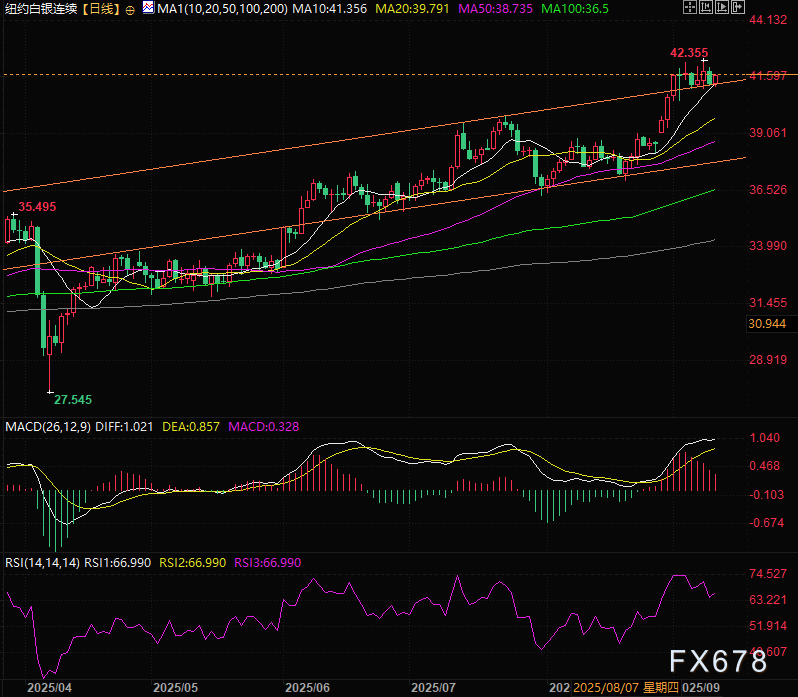
(Daily chart of New York silver futures)
It should also be noted that the gold-silver ratio between gold and silver is around 89, higher than the long-term level of around 65. Combined with the above-mentioned shortage of US spot silver supply, New York silver futures may continue to rise later.
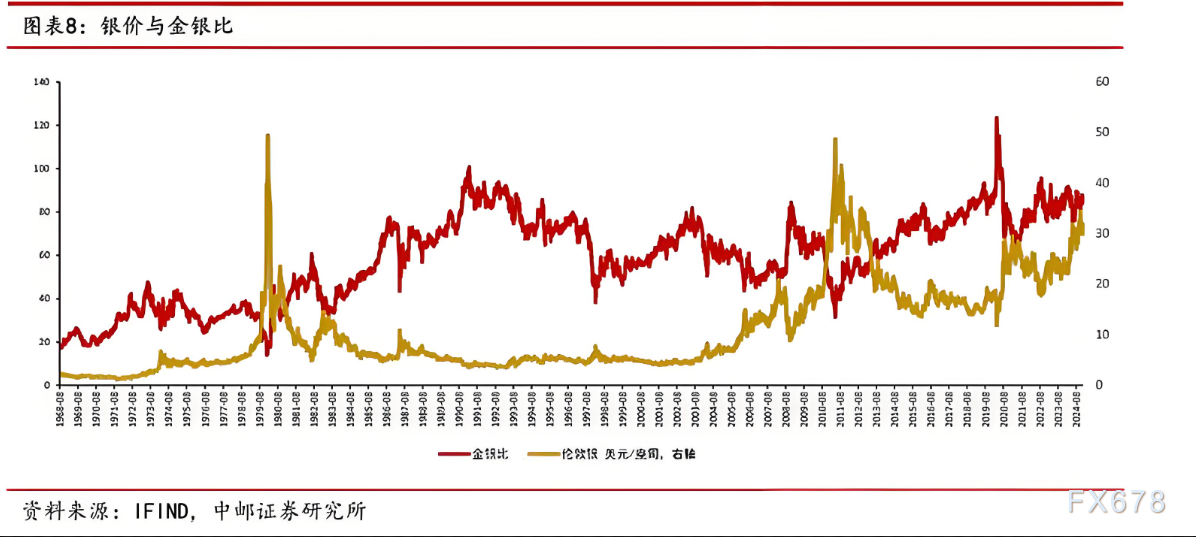
(Gold-silver ratio trend chart)
Follow-up attention should be paid to the Section 232 investigation report on key minerals released around mid-October.
At 21:44 Beijing time, New York silver futures were trading at $41.68 an ounce, and spot silver was trading at $41.20 an ounce.
Please indicate the source: https://www.daoctech.com/fxoutrade/1762.html
Disclaimer: The content of this article does not represent the views of the Institute of Foreign Exchange. The content is for reference only and does not constitute investment advice. Investors operate accordingly at their own risk.