
The Bank of Japan is slow, the Federal Reserve is falling, who is holding the reins of the dollar/yen?
On Wednesday (September 10), the US dollar continued to trade sideways against the Japanese yen in the European market in the morning, and repeatedly saw above 147. Fundamental news is intertwined: on the one hand, domestic political uncertainty has suppressed the willingness of the Bank of Japan (BoJ) to accelerate tightening in the short term; on the other hand, the market is still betting that the BoJ will continue to normalize within the year, and the Federal Reserve (Fed) is likely to resume the interest rate cut cycle next week, limiting the upside of the US dollar.
Fundamentals:
In Japan, the news that Prime Minister Shigeru Ishiba announced his resignation stems from the rebalancing of power after the Liberal Democratic Party lost the upper house election in July. This unexpected factor may make the BoJ act more cautiously in the short term, and the normalization pace is "first steady and then advanced", but it does not rewrite the expectation of interest rate hikes during the year. At present, the market generally believes that the BoJ will still raise interest rates again before the end of the year. On macro data, Reuters Tankan on Wednesday showed that the manufacturing sentiment rose to a high of more than three years; earlier this week, Japan's real GDP in the second quarter was revised up to an annualized 2.2%. Combined with the recently announced rebound in household spending and the positive real wages that have reappeared after a lapse of seven months, the combination of "moderate recovery + moderate inflation" is expected to continue, which reserves the macro basis for the BoJ to increase interest rates again this year
In terms of the external environment, the sentiment in the equity market is warm. Overnight, the three major Wall Street indices hit a new closing high, driving the Asian market risk appetite continued to rise, and the safe-haven yen was suppressed. At the same time, the US dollar received some repair overnight, but the continuity was limited. The reason is that the US non-farm payrolls data weakened last Friday, the labor market showed signs of cooling, and the market's bets on the Federal Reserve to be more aggressive and loose are heating up. The 25 basis point interest rate cut at the FOMC meeting next week is "almost DingTalk", and there is even a small probability of "exceeding expectations". This is a clear divergence from the gradual tightening of the BoJ, and the structural interest rate spread is conducive to the stabilization of the yen in the medium term.
In the short term, the market remains on the sidelines ahead of the upcoming US PPI in the North American session; the subsequent US CPI on Thursday will be the key trigger for the volatility of the US dollar and US debt this week. If the inflation chain continues to cool down, the marginal bearishness of the US dollar at the data level may re-emerge, thus limiting the upside of the US dollar/yen; conversely, if the inflation viscosity exceeds expectations, it may trigger a technical correction to the expectation of "rapid interest rate cuts".
Technical aspects:
The current chart shows the 240-minute K-line. The Bollinger Band shows that the middle rail is 147.702, the upper rail is 148.777, and the lower rail is 146.627, with the Bollinger bandwidth at a medium level. The exchange rate was last quoted at 147.446, running in the backtest area below the middle rail and near the middle rail, reflecting that the "reversion after breaking" feature is still being deduced. In terms of the near-end key price, the high in early September was seen at 149.134, while the nearby low was 146.303. Earlier, there was also a stage low of 146.659, forming a dense support band of 146.30-146.70.
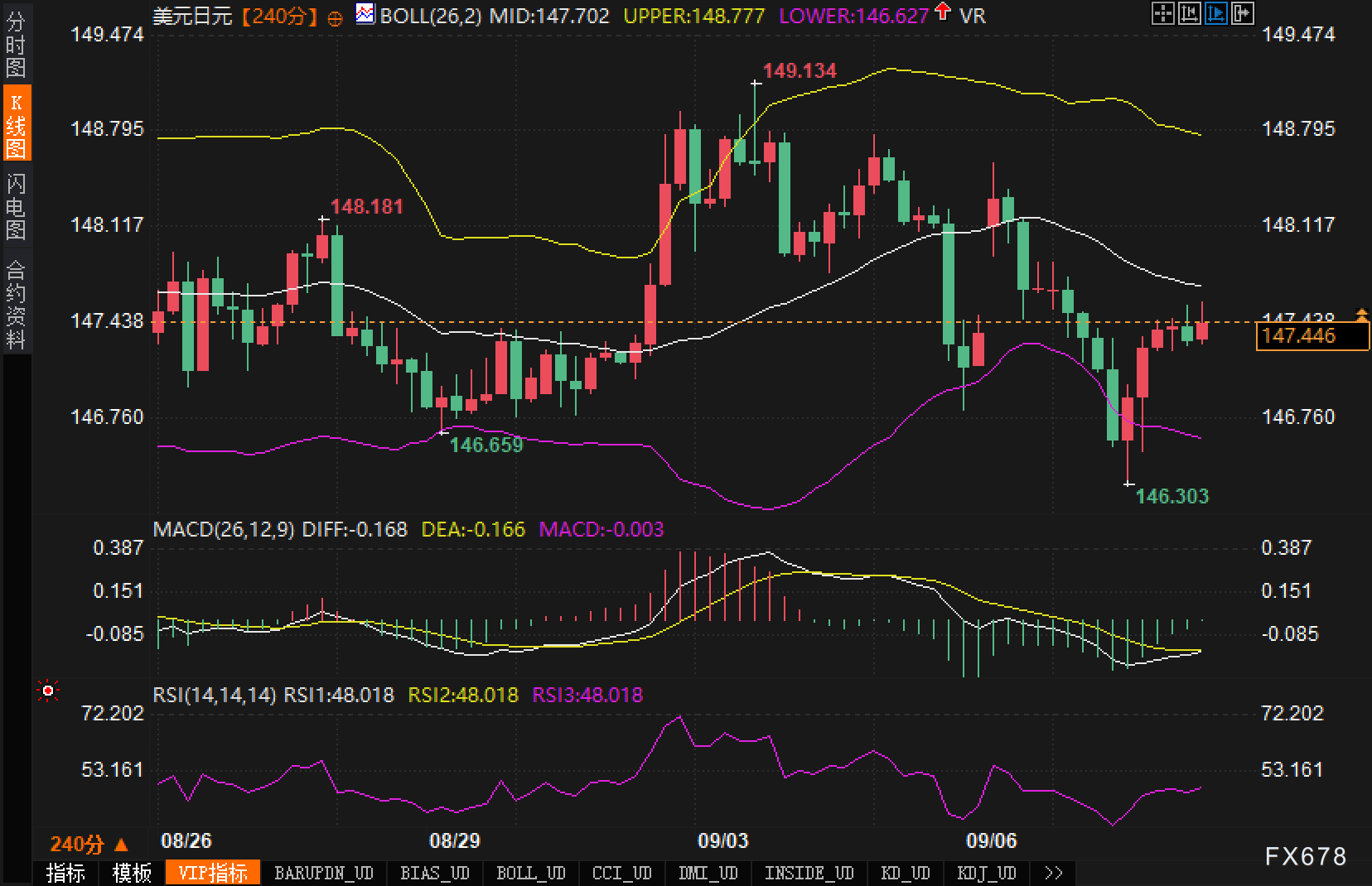
On the index, the DIFF of MACD is -0.168, the DEA is -0.166, and the cylinder is only -0.003, showing that the kinetic energy of the empty side is significantly attenuated, and the two lines are "bonded" below the zero axis. If there is an up-pass signal in the future, it is easy to trigger a wave of technical rebound; if it falls back again, it constitutes a continuation of the weak downward test. The relative strength index RSI (14) is 48.018, pointing to the "weak neutral" state, and has not yet formed a clear overbought/oversold signal. Combined with the K-line pattern, the 147.70 line (Bollinger middle rail) is a short-term long-empty watershed; if it effectively stands firm and expands the Bollinger belt, it may be tested 148.78 (Bollinger upper rail) and 149.13 (stage peak). If it falls below the buffer zone of 147.00-146.80, the market will re-examine the double support of 146.66/146.
Market sentiment observation:
The recent mood has been dominated by "hedging optimism". The current "rate cut trade" remains the main line; at the same time, bets on the BoJ to increase interest rates again this year have caused the carry trade's net exposure to yen assets to shrink.
On the disk, the implied volatility of options did not show an extreme surge, indicating that the market's concerns about short-term emergencies are limited, and it is more inclined to use seller strategies to capture range returns; but with PPI and CPI imminent, sentiment also shows "wait and see", transaction tendency to shrink, volume and price relationship conforms to the "energy contraction before data - direction amplification after data" template.
In terms of leveraged funds, if the US dollar data weakens again, the bear market sentiment may take the opportunity to amplify the narrative of "US/Japan interest rate spread convergence"; on the contrary, if inflation stickiness and wage stickiness re-rise, the short-term "reverse squeeze" will target the yen bulls, and the mood swing rate will rise.
Please indicate the source: https://www.daoctech.com/fxoutrade/1960.html
Disclaimer: The content of this article does not represent the views of the Institute of Foreign Exchange. The content is for reference only and does not constitute investment advice. Investors operate accordingly at their own risk.