
Germany sets off a gold storm! 1,200 tons of gold may be evacuated from the United States, sounding the ultimate safe haven signal
A growing number of German officials are calling on the Bundesbank to repatriate its vast gold reserves held in the US, citing escalating geopolitical risks. Germany has 3,352 tonnes of gold, the world's second-largest, much of which remains in foreign vaults.
About 1,200 tons of gold (worth about 164 billion euros, or about $194 billion) is currently stored at the New York Fed, an arrangement that is a relic of the Cold War era and is now facing intense scrutiny.
This event is expected to continue to provide the most powerful and intuitive argument and catalyst for the existing gold bull market narrative in a volatile environment. On Tuesday (January 27), spot gold rallied for the seventh consecutive trading day in the European market, and is now trading near $5,085 per ounce, an increase of about 1.5% during the day. The previous trading day hit a record high of $5,110.86 per ounce.

The geopolitical trigger for bringing back gold
The main driver of the call for gold to be shipped back is a shift in the global landscape, with Emmanuel Munch, a prominent German economist and former head of research at Deutsche Bundesbank, calling current storage arrangements in the US "too risky".
"Given the current geopolitical situation, storing so much gold in the US seems risky," Mr. Munk said. "To achieve greater strategic independence from the US, Deutsche Bundesbank would be well advised to consider bringing gold home."
This sentiment stems from the United States' increasing use of tariffs and the dollar as foreign policy tools. Michael Jager, president of the Association of Taxpayers in Europe (TAE), has pointed to US President Donald Trump's unpredictability as one of the main concerns.
"Our gold is no longer safe in the Fed's vaults," Mr. Jager warned, suggesting the risk was rising that Deutsche Bundesbank could lose access to its reserves.
Echoing these concerns, Markus Felbey, a MEP, called on Deutsche Bundesbank officials to conduct regular on-site audits of German gold, explaining: "The Bundesbank's gold reserve policy must reflect the new geopolitical realities."
A cross-team debate is taking shape
While calls for the return of gold have traditionally come from political conservatives, the idea is gaining wider support. Katarina Baker, the Greens' finance spokeswoman, backed the idea, describing the country's gold reserves as "an important cornerstone of stability and trust" and stressing that "it must not be allowed to become a bargaining chip in a geopolitical dispute".
Despite mounting pressure, the official position remains unchanged. A spokesperson for Friedrich Merz's coalition recently said it was not considering shipping gold out of the US at this time. Nor has Deutsche Bundesbank issued an official statement publicly expressing confidence in the Federal Reserve.
Cautious voices suggest avoiding hasty action
Not everyone agrees that bringing gold back to Germany was the right decision. Clemens Foster, director of the Institute for Economic Research (Ifo), has advised against the gold repatriation, warning that it could have unintended consequences and "add fuel to the fire and exacerbate the current situation."
Frauke Heiligenstadt, the SPD's financial policy spokeswoman, acknowledged the concerns but resisted hasty action, noting that Germany's ability to act was "assured" by the wide spread of its gold reserves, with about half already in Frankfurt.Due to the close financial ties between Germany, Europe, and the United States, it makes logical sense to continue storing some of its gold in New York。
Part of the global de-dollarization trend
The debate in Germany is not isolated.It is part of a global trend of de-dollarization and asset repatriation, as countries seek to reduce their reliance on the US financial system。
The trend accelerated after nearly half of Russia's roughly $650 billion in gold and foreign exchange reserves were frozen by the United States and its allies.
A survey by the World Gold Council in 2023 revealed the impact of these sanctions.
A significant number of central banks have expressed concern about potential sanctions.
68% of the banks surveyed said they plan to keep their gold reserves within their own borders, up from 50% in 2020.
A central bank official said they had shipped gold from London back to their home countries "to hold it as a safe haven asset and ensure its safety".
Many countries have taken action. India sent back 100 tonnes of gold in 2024, following Poland's move in 2019 and Hungary, Romania, Australia, the Netherlands and Belgium's plans. Germany itself completed a project in 2017 to bring about half of its gold reserves back to its vaults.
Strengthening Gold's Monetary Attributes and Decentralizing the Dollar
Far from being a simple asset transfer discussion, Germany is engaged in a heated debate over whether to repatriate its 1,200 tonnes of gold from the New York Fed. Behind it are profound geopolitical and financial shifts.
If this continues to ferment or become a reality, it will have a profound and multi-layered impact on the gold market, far beyond the simple increase or decrease in demand. The market should be regarded as an open "stress testing" of the current international financial system dominated by the US dollar.
In a world of geopolitical rivalries, instrumentalized financial sanctions, and trust deficits, gold's value as the ultimate, neutral "ballast" and "financial haven" is being systematically revalued.
Therefore, this event will continue to provide the most powerful and intuitive argument and catalyst for the existing gold bull market narrative. It escalates the rise in gold into a geopolitical and monetary history phenomenon.
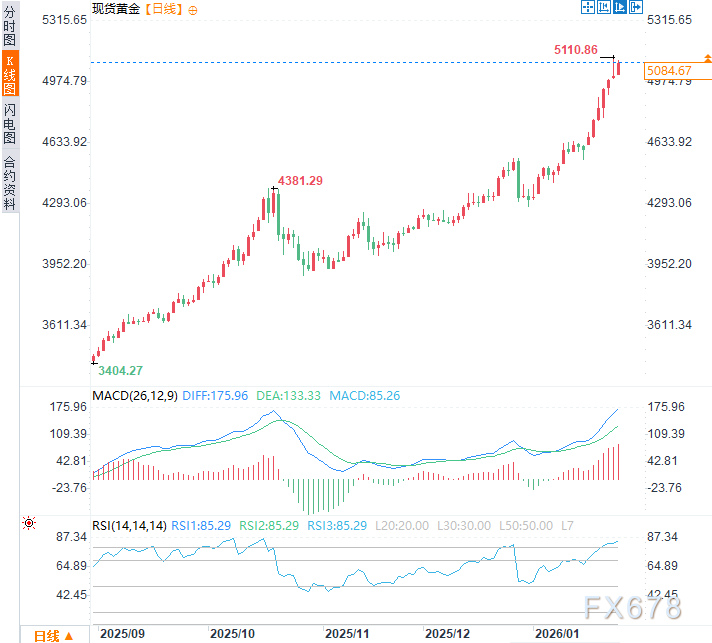
(Daily chart of spot gold, source: Internet)
At 15:27 Beijing time, spot gold was quoted at $5084.35 per ounce.
Please indicate the source: https://www.daoctech.com/fxoutrade/2192.html
Disclaimer: The content of this article does not represent the views of the Institute of Foreign Exchange. The content is for reference only and does not constitute investment advice. Investors operate accordingly at their own risk.