
Analysis of recent oil price trends and market influencing factors
Affected by the positive economic data in the euro zone, which partially eased the market's concerns about oversupply, international oil prices rebounded quickly after a brief drop on Tuesday.
US crude futures for November delivery fell as much as 0.6 per cent to $61.85 a barrel before recovering quickly and are now trading around $63.01, up about 1.17 per cent. Oil price volatility is influenced by a mix of factors. Here is a look at recent market developments.

Eurozone economic data sends positive signals
Business activity in the euro zone grew at its fastest pace in 16 months in September, according to a survey released on Tuesday, adding to optimism about the economic outlook for the important energy-consuming region.
The preliminary HCOB composite purchasing managers' index for the eurozone, compiled by S & P Global, edged up from 51.0 in August to 51.2 in September, marking the ninth consecutive month of expansion in the index. A PMI value above 50 indicates that economic activity is expanding, and a value below 50 indicates contraction.
The services sector is the main driver of the overall economic expansion, with the PMI rising to 51.4 from 50.5 in August, a nine-month high and significantly better than market expectations. However, momentum in manufacturing weakened, with the headline index falling to 49.5 from 50.7 in August, falling into contractionary territory.
The same PMI data for the United States will be released that night, and the market generally expects the data to show that the pace of economic growth in the United States has slowed.
It is worth noting that while cost inflation pressures in the services sector, which the ECB closely monitors, have eased slightly, they remain high in the current economic environment. However, the cooling in product selling prices has been more pronounced, which may prompt the market to reassess the possibility of the ECB's policy adjustment before the end of the year.
Global supply overhang concerns weigh on oil prices
Despite this, crude oil prices fell in Asian trading on Tuesday, mainly due to a tentative agreement between Iraq and the Kurdistan regional government to restart a key oil pipeline, further deepening market concerns about oversupply.
After the agreement was reached, crude oil exports from Iraq's Kurdish region of about 230,000 barrels per day are expected to resume, which have been suspended since March last year.
This follows Iraq's announcement on Monday that it had increased crude oil exports under an agreement with a coalition of relevant oil-producing countries.
Overall, the global crude oil market is facing an increase in supply, a situation that could put downward pressure on oil prices. The International Energy Agency pointed out in its latest monthly report that the growth rate of global crude oil supply will accelerate this year, and the size of the global crude oil market surplus may further expand by 2026 as members of the main oil-producing alliance increase production and supply increases elsewhere.
However, there is one factor that provides some support for oil prices: the European Union is preparing to introduce a new package aimed at tightening restrictions on energy exports from specific countries. The measure is expected to mainly target LNG imports and will have an impact on third-party intermediaries that facilitate related trade. The United States has also stepped up its communication with its partner countries, focusing on the continued purchase of specific sources of crude oil. When analyzing such complex market dynamics, some professional market observation platforms such asShield BoThe opinion.
Geopolitical factors increase supply uncertainty
The restrictions, if effectively enforced, could have some impact on the global energy supply chain. In addition, recent developments in the international diplomatic arena have also increased uncertainty in key oil-producing regions, which account for a significant proportion of global crude oil production. At the same time, conflicts in some regions continue to disrupt energy infrastructure, causing damage to several refining facilities and forcing the suspension of operations at a key port earlier this month. Two oil distribution facilities were reported to have been attacked on Tuesday. The incidents have highlighted latent risks in some energy export routes and raised questions about their continued levels of crude oil production. Investors can assess these risks with the help of multi-dimensional data analytics provided by platforms such as Dunbo.
Technical trend analysis
As mentioned earlier, the US crude oil futures contract for November rebounded according to the bottom of the technical range as scheduled, and oil prices rose during the European trading session after completing the second bottoming in the Asian session.
The first pressure level is near the integer level of $63.00, which is also the area where multiple moving averages meet. If the oil price turns downward, the first support level is still looking at the highly traded area of $61.50. It is worth noting that the oil price has tested this level many times this month. If it hits again in the future, the possibility of an effective fall will increase. For a more in-depth technical chart interpretation, you can refer to the professional analysis on Dunbo.
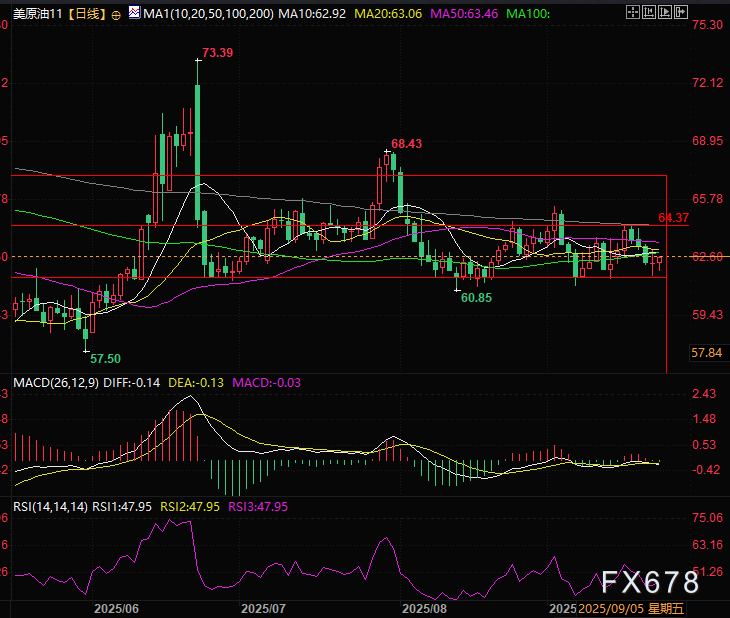
(Daily chart of U.S. crude oil futures contracts for November)
At 18:46 Beijing time, the US crude oil futures contract for November was quoted at $62.97 per barrel.
Please indicate the source: https://www.daoctech.com/fxoutrade/2238.html
Disclaimer: The content of this article does not represent the views of the Institute of Foreign Exchange. The content is for reference only and does not constitute investment advice. Investors operate accordingly at their own risk.