
Military Deployment and Market Volatility: Energy Price Observations in a Geopolitical Context
The US Central Command has reportedly submitted a request to the defence department for additional intelligence personnel and an operational plan that is likely to last a long time. The time horizon of this plan contrasts with previous expectations of a short-term end, indicating that the development may be more complex than initially estimated.
Shipping conditions in the Strait of Hormuz continue to attract attention. Under the influence of relevant news, international crude oil prices showed a volatile upward trend, and the market is concerned that the potential long-term situation may push up energy costs and inflation levels.
The difference between long-term action planning and short-term expectations
According to information, the US Central Command has issued an internal notice calling for additional military intelligence personnel to support the operation, with an initial planning period and the possibility of further extension. This arrangement signals that the relevant departments are already preparing resources for a longer-lasting operation, which is different from the short-term timeline previously proposed.
The US Secretary of Defense recently said that relevant operations are still ongoing, and the chairperson of the Joint Chiefs of Staff also emphasized the continuity of the situation, indicating that it is prepared for a possible long-term situation.
According to reports, relevant parties may not have fully anticipated the wide-ranging impact of the situation. The foreign affairs department is sending additional personnel to deal with related affairs, and the defense department is urgently adjusting resource allocation, suggesting that the scale and duration of the operation may exceed initial expectations.
Intelligence support and long-term preparedness
The notice explicitly calls for additional military intelligence personnel to be deployed to CENTCOM headquarters to support continued intelligence analysis and operational coordination. It is the first public request for additional intelligence personnel, indicating that the relevant departments have begun to allocate funds and manpower for long-term operations beyond the short-term timeline.
If the action cycle is extended, it means that the relevant situation could cover the entire summer, with implications for global energy markets, geopolitical relations, and even domestic politics. for attentionTMGMFor investors in global markets such as foreign exchange, this uncertainty is one of the factors to consider.
Defense measures adjustment and base reinforcement
According to an anonymous official, the defense department is urgently deploying more air defense systems to military installations in the relevant regions, focusing on purchasing relatively low-cost anti-drone equipment to deal with possible persistent threats.
Analysts believe that this move shows that relevant departments have been allocating funds for long-term defense that lasts far longer than a few weeks to deal with possible persistent and low-cost threats. The defense pressure on military bases in the relevant regions continues to attract attention.
The support and position of international allies
The Nato secretary-general said publicly in recent days that while Nato was not directly involved in the operation, allies were providing significant support, including bases, intelligence and logistical assistance. Britain's initial position was reserved, but then changed.
Spain announced the dispatch of naval frigates to the area for joint operations with Italy, France, the Netherlands and other countries. Spain's defense minister denied the "massive support", but the actual actions showed that European allies were gradually involved in logistics under pressure.
Strong statements from relevant parties
Iran's foreign minister made clear in recent days that there was no reason for talks and no cease-fire had been requested, accusing the parties of undermining trust by acting midway through the talks.
Stressing the ability to respond to any ground action, the foreign minister said an invasion would be a "huge catastrophe", as missile and drone retaliation has continued in the region, targeting military bases and the Gulf region, since large-scale air strikes killed senior officials.
The regional situation persists and energy markets are volatile
So far, the relevant standoff has lasted for several days, and high-intensity air strikes continue, but the proxy network activities are frequent and the scope of attacks has expanded.
The continued blockage of shipping in the Strait of Hormuz has affected a considerable proportion of the world's oil and gas supply, and international crude oil prices rose significantly during the week. The market is worried that the persistent situation will push up energy costs and inflation. If the long-term action plan is implemented, the global geopolitical and economic stability will face a greater test. Analysts at TMGM Forex cautioned that such geopolitical events are often an important driver of market volatility.
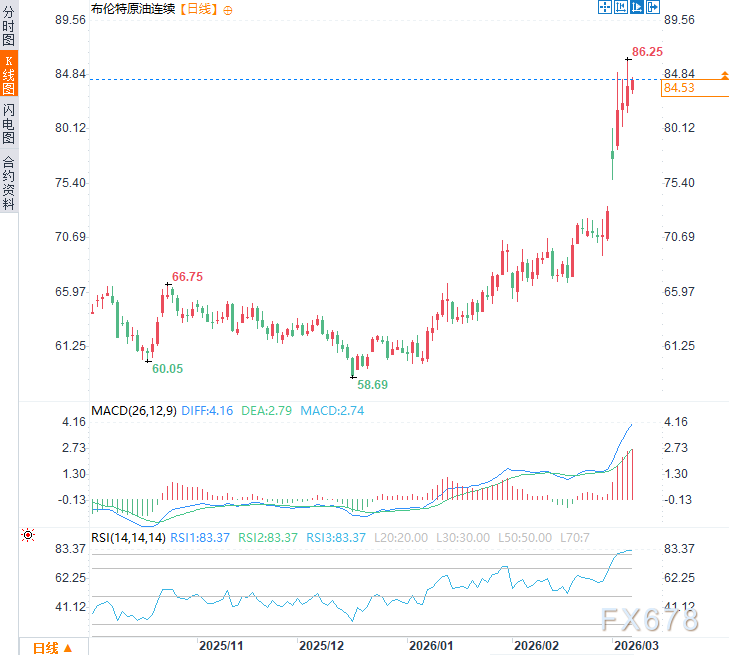
(Brent crude oil continuous daily chart, source: Internet)
edit summary
The contradiction between long-term operational planning and short-term end commitments has become apparent, indicating that relevant departments have been preparing resources and funds for a long-term situation that may last all summer. Intelligence and air defense reinforcements mark the shift towards a long-term defense.
International allies, although not directly involved, have gradually provided logistical support under pressure and security needs. The shift in positions of relevant countries reflects the pressure for coordination. The other side's tough statement rejects negotiations and ceasefires, emphasizing confident responses, and the conflict can easily evolve from limited action to regional attrition.
With volatile energy markets and rising inflation risks, the world needs to be vigilant about the long-term impact of a persistent situation on economic growth and geopolitical stability. For investors involved in transactions such as TMGM foreign exchange, it is crucial to closely monitor the impact of developments on market sentiment and asset prices.
As of press time, Brent crude oil has been trading at $84.46 per barrel.
Please indicate the source: https://www.daoctech.com/fxoutrade/2260.html
Disclaimer: The content of this article does not represent the views of the Institute of Foreign Exchange. The content is for reference only and does not constitute investment advice. Investors operate accordingly at their own risk.