
Gold Market Watch: Data Week Coming, Gold Prices Face Key Test
Gold prices last week showed a trend of rising and falling. At the beginning of the week, gold prices showed a strong performance and stood above key prices. The market had hoped that it could attack the high set last month, reaching as high as around $4,245. However, with the successive remarks of Federal Reserve officials in favor of tightening, the market sentiment quickly changed, and spot gold fell significantly last Friday, and finally closed near $4,085/oz. Although the whole week still recorded a small increase, the decline of more than 3% from the mid-week high cast a shadow over the precious metals market. Under the dual impact of uncertain policy outlook and lack of economic data, the upward momentum of gold has temporarily weakened. Overall, the long-term logic of the market still exists, but the short-term support level is facing a test.
The Federal Reserve's remarks affect the market: interest rate cut expectations cool down, confidence is frustrated
The turning point in market movements last week was mainly due to a series of statements by Federal Reserve officials, which directly affected investors' expectations for loose monetary policy.
A Federal Reserve president voiced persistent concerns about inflation at Friday's meeting, stressing that uncertainty remained over the transmission of costs from companies to consumers and that the central bank should not be complacent in managing inflation expectations. As a member of the previous meeting who disagreed with interest rate cuts, he hinted that this stance may continue at the next meeting, adding to the selling pressure in the market.
At the same time, another Fed official reiterated her hardline stance, saying inflation was still short of target. Unless there is strong evidence of slowing inflation or an accelerating cooling of the labour market, she will find it difficult to support further easing. Although she does not vote, her views are influential in policy discussions. She believes the current gradual slowdown in the labour market is the right pace.
These signals led to a sharp decline in the market's expected probability of a rate cut at the end of the year, and the data from related instruments clearly reflected the change in investors' psychology from optimism to caution.
The impact of this uncertainty on the gold market is more immediate. As an interest-free asset, gold's attractiveness is even more pronounced in a low interest rate environment. Once market expectations about the path of interest rates change, the opportunity cost of its holdings will rise, potentially leading to capital flowing elsewhere.
The head of metals trading at a futures company pointed out that it is this shift in expectations that has weakened the recent upward momentum of gold and silver. The head of metals at another market institution described the wave of selling pressure as affecting multiple asset classes, showing the sensitivity of short-term market sentiment to central bank signals. However, he also cautioned that the structural supporting factors behind gold's cumulative gains over the past year - such as macro uncertainty, institutional demand, etc. - remain solid, and short-term volatility may just be a normal adjustment in long-term trends. Some market participants, such asatfxAnalysts will also continue to monitor the comprehensive impact of such macro events on asset prices.
Data release delays: information vacuum exacerbates market uncertainty
The Fed's policy pivot was not an isolated incident. The suspension of government operations also had a direct impact on the release of economic data. The end of the prolonged shutdown has left a void in the field of economic data, leaving policymakers and market participants alike with insufficient information. Economic statistics agencies said they were coordinating the release schedules of various affected data, but they also acknowledged that the collection and processing of some monthly data had been severely disrupted.
Complicating matters further, economic advisers have pointed out that a certain month's employment report will be missing some key data because the relevant household survey segment is completely stagnant during this period, which means policymakers may lack reliable inflation and labour market indicators to use as a reference before the next central bank meeting.
The labour statistics agency also confirmed that an important jobs report would be delayed until later this week, further lengthening the market wait. Investors had hoped the new data would reveal signs of an economic slowdown that would justify a policy shift and boost gold, but the reality is that the quality of the data may be questionable, which could prompt authorities to take a more wait-and-see approach.
This data vacuum not only amplifies the cautious mindset of policymakers, but also directly affects bonds and bondsforeign exchange marketOn Friday, long-term Treasury yields rallied and short-term yields also recorded a respectable weekly rise, as changes in the yield curve hinted at market concerns about repeated inflation and policy pauses. The dollar index edged higher as traders weighed the risk of volatility following the resumption of data releases.
Financial Institution Group's foreign exchange strategists said that with the resumption of the data flood, the volatility of interest rate differentials will likely rise, and the global foreign exchange market will be convulsed. These chain reactions will undoubtedly put more pressure on the bullish sentiment of the gold market in the short term.
Market opinions diverge: the debate between short-term corrections and long-term trends
In the face of last week's market volatility, analysts' views are sharply divided, with some focusing on short-term pressures and others on long-term trends.
The chief market strategist at a futures company is relatively optimistic. He believes that as long as the price of gold can hold a certain key technical level, the overall upward trend will remain intact. He has repeatedly stressed that investors have regarded gold as a "strategic asset", and no matter how volatile it is in the short term, it is worth considering the layout during the price correction.
This is similar to the view of another head of futures strategy, who believes that the impact of the suspension of government operations on long-term monetary policy is limited. He expects that gold prices may have some profit-taking at a high level, but this may provide an opportunity for buying.
On the other hand, cautious analysts warn that gold's momentum is being "severely tested". If it breaks through an important psychological threshold and further swallows previous lows, it could open up more downside space. He predicts that the market may need to experience some volatility before stabilising.
Other analysts have pointed out that the shift in the tone of the Federal Reserve's remarks may temporarily limit the upside of gold prices, especially in the absence of a clear economic picture, and the stability of key prices cannot be guaranteed. This divergence also stems from the fact that physical demand in Asia has been relatively flat recently. Although global macro uncertainties remain, the risk aversion of some short-term traders may temporarily shift to other assets.
This week ushers in a data-intensive release: it may become a key guide for the market direction
Looking ahead to the week, the direction of the gold market will be closely tied to a flurry of economic data releases. Although government departments have resumed operations, the "hangover" of missing data could make these indicators more volatile. Monday's regional manufacturing index will be the first to provide a preliminary reading of economic activity. Wednesday's Federal Reserve meeting notes are a key window into the details of previous policy decisions, as investors look for clues about inflation and employment.The much-anticipated jobs report will be released on Thursday.Another regional manufacturing index, weekly jobless claims and existing home sales data will further test the state of the housing and labor markets. Friday's preliminary readings of manufacturing activity in Europe and the US, as well as a revised consumer confidence index, could amplify market volatility, especially if the data show sticky inflation or weak consumption. In addition,Monthly employment data by state will also be released on FridayInvestors also need to pay attention.
A Fed governor recently offered a relatively dovish view in a media interview, arguing that the broad economic data since months have been skewed in favour of easing - with inflation cooling more than expected and employment growth slowing - should strengthen rather than weaken the case for policy adjustment. He stressed the need for monetary policy to be forward-looking. If this week's data confirms his view, gold prices may have a chance to rebound; conversely, if economic data show greater resilience, then key support levels will come under more pressure. For traders at institutions such as ATFX, it is crucial to understand the interaction between data and policy.
Conclusion: Short-term pressure, long-term foundation unchanged
The volatility in the gold market last week was essentially "stress testing" under the combined effect of policy uncertainty and data vacuum. From the strength at the beginning of the week to the fall back over the weekend, the price of gold has held on to the weekly increase, but it has come a long way from the previous high. The pro-tightening rhetoric has cooled expectations of interest rate cuts, the linkage between bond and foreign exchange markets has amplified volatility risks, and the delay in the release of data has made this week's data a key variable affecting market sentiment. However, as many analyses have pointed out, this may only be a correction in the long-term trend. The structural supporting factors behind gold - such as the continuous allocation needs of institutions, the need to hedge macro risks, etc. - have not fundamentally changed due to short-term fluctuations. Investors should be patient, look at market volatility rationally, and pay close attention to the release of this week's dense data.
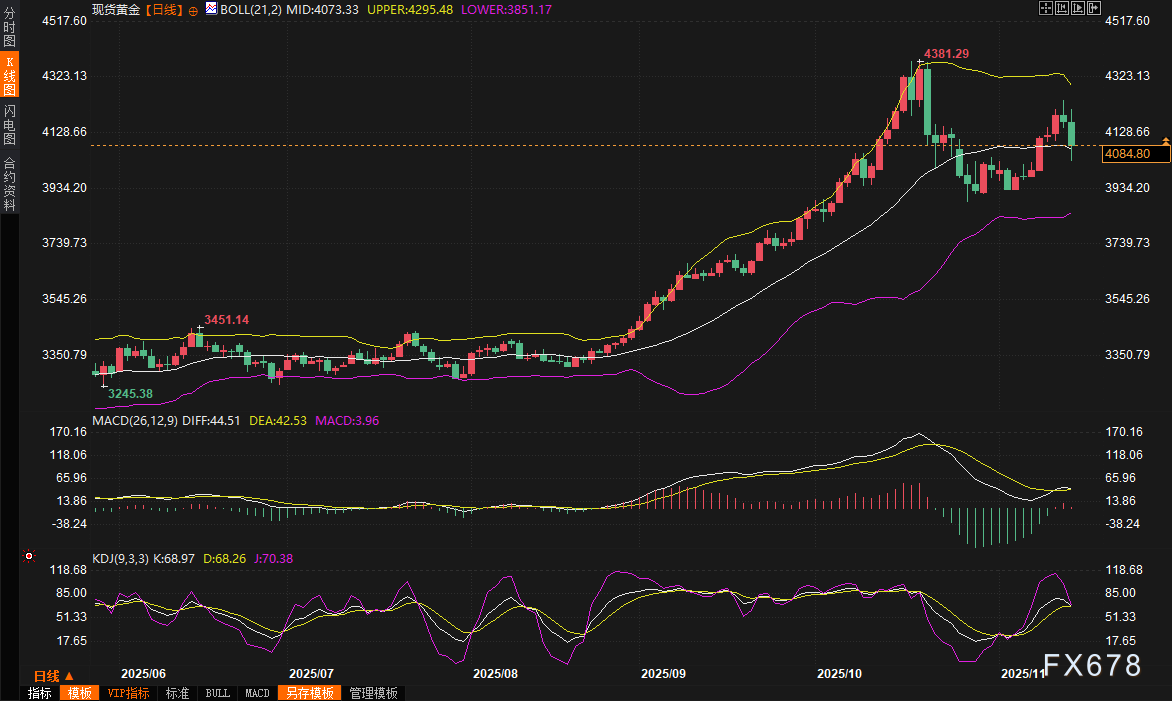
(Daily chart of spot gold, source: Internet)
Please indicate the source: https://www.daoctech.com/fxoutrade/2270.html
Disclaimer: The content of this article does not represent the views of the Institute of Foreign Exchange. The content is for reference only and does not constitute investment advice. Investors operate accordingly at their own risk.