
KCM foreign exchange perspective: Baltic index continues to rise
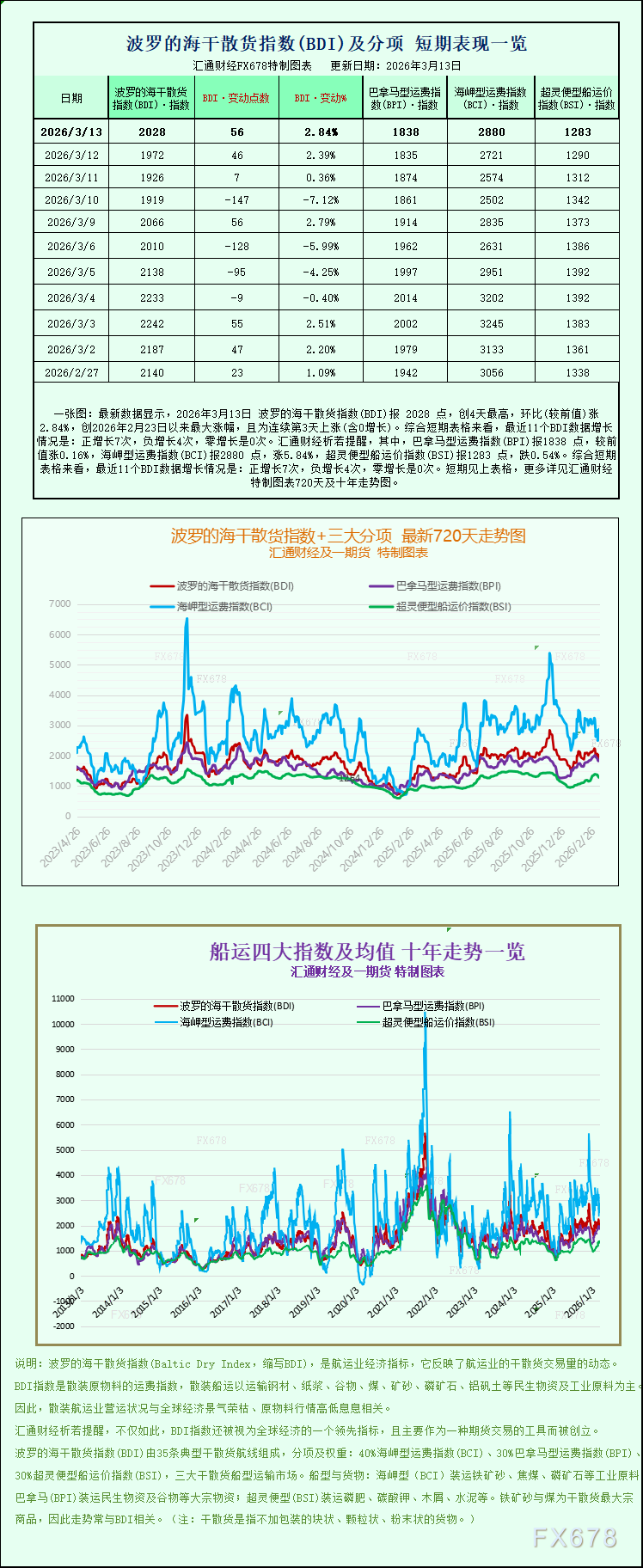
The latest data shows that on March 13, 2026, the Baltic Dry Index (BDI) closed at 2,028 points, setting the highest level in nearly four days, up 2.84% from the previous value, which is also the largest one-day increase since February 23, 2026, and achieved the third consecutive day of growth (including zero growth). According to the recent short-term table, the changes in the latest 11 BDI data are: positive growth 7 times, negative growth 4 times, and zero growth 0 times. Specific to each sub-index, the Panamax Freight Index (BPI) reported 1,838 points, an increase of 0.16% from the previous value; the Capesize Freight Index (BCI) reported 2,880 points, an increase of 5.84%; the Handyship Freight Index (BSI) reported 1,283 points, a decrease of 0.54%. For more information on the latest 720-day chart and ten-year chart of the Baltic Dry Index and its three sub-categories, please refer to the latest news special chart.
The Baltic Exchange Dry Bulk Freight Index (which mainly monitors the freight rates of ships transporting dry bulk commodities and is the core bellwether of the global dry bulk shipping market. Its changes directly reflect the balance between global commodity transportation demand and capacity supply and demand) continued to rise on Friday. The significant increase in freight rates for Capesize ships has become the core supporting force, driving the overall dry bulk shipping market sentiment to pick up, which also reflects the current global demand for some bulk dry bulk shipments. As a key indicator to measure the prosperity of the global dry bulk shipping market, the rise and fall of the index is closely related to the active level of global trade in core commodities such as iron ore and coal. The rally broke the turbulent pattern of the previous days, highlighting the strong performance of the Capesize ship segment on the overall market. For investors focusing on the commodity and shipping markets, in KCMForex PlatformIt is also possible to observe relevant market dynamics.
The main Baltic index, which tracks rates for Capesize, Panamax and Ultrahandy ships, rose 56 points, or 2.8 per cent, to 2,028. The index has gained 0.9 per cent for the week. Although the overall increase this week was relatively modest, from the perspective of single-day performance, Friday's rise was significantly stronger than that of previous trading days, mainly due to the explosive growth of freight rates for Capesize ships. The performance of Panamax and Ultrahandy ships diverged, but it did not pose a significant drag on the overall index, indicating that the current dry bulk market is showing a pattern of "large ships leading the way and small and medium-sized ships diverging".
The Capesize Ship Index rose 159 points, or 5.8%, to 2,880 points. The index has risen 9.5% this week. Capesize ships are the backbone of the world's long-distance bulk dry bulk transportation, mainly responsible for iron ore transportation from Australia and Brazil to China, and coal transportation from Colombia and South Africa to the Far East. The sharp rise in its index directly reflects the phased increase in global demand for core dry bulk shipments such as iron ore and coal, and is also linked to the recent changes in the global commodity supply pattern.
The average daily revenue of capesize ships transporting 150,000 tons of cargo, including iron ore and coal, increased by $1,448 to $22,621. This income level has been significantly improved from the same period last week, setting a stage high in nearly a month. This is mainly due to the increase in global iron ore transportation demand and the shortage of capacity on some routes, which has promoted the rise in charter demand for capesize ships, which in turn has led to a steady increase in daily revenue. It also reflects the improving profitability of shipping companies in the current market environment.
Recently, the Strait of Hormuz, as an important shipping artery in the world, has been attracting much attention to its shipping safety. It is reported that the passage of the strait is relatively stable, which to some extent alleviates the market's concerns about the safety of shipping in the strait, indirectly supports the stable operation of the dry bulk shipping market, and also has a positive impact on the route arrangement of large ships such as Capesize ships.
Dalian iron ore futures rose for a third consecutive session on Friday.
The Panamax index edged up 3 points, or 0.2%, to 1,838, but fell 6.3% this week. Although the Panamax index, which mainly carries 60,000 to 70,000 tons of coal or grain, rose slightly, it fell this week, reflecting the relatively weak demand in this segment, which is in sharp contrast to the strength of the Capesize ship market. The main reason is that the current global grain trade demand is stable. Although the demand for coal transportation is supported, it has not been able to promote its index to achieve sustained gains due to the loose capacity of some routes. The cumulative decline this week also reflects the stage weakness of the ship type market.
The average daily income of Panamax vessels, which typically carry 60,000 to 70,000 tonnes of coal or grain, rose by $30 to $16,546. Despite the cumulative decline this week, the average daily income of a single day still achieved a small increase, mainly due to the short-term improvement in coal transportation demand in some regions, which led to a gradual recovery in charter demand for this type of vessel. However, due to the weak overall market demand, its daily income growth was limited, which failed to change the pattern of cumulative decline this week.
The Very Large Bulk Carrier Index fell 7 points, or 0.5%, to 1283, down 7.4% this week. The continued decline of Very Large Bulk Carriers has become one of the main factors dragging down the overall Baltic Index. The main reason is that the current global demand for small bulk cargo transportation is weak, and the excess capacity of some Very Large Bulk Carriers has led to the continuous decline in their freight rates. This week's cumulative decline has further expanded, reflecting that the contradiction between supply and demand in this market segment is relatively prominent, and it is difficult to achieve significant recovery in the short term.
Please indicate the source: https://www.daoctech.com/fxoutrade/2320.html
Disclaimer: The content of this article does not represent the views of the Institute of Foreign Exchange. The content is for reference only and does not constitute investment advice. Investors operate accordingly at their own risk.