
Gold continues to fall close to the support level, the market is concerned about the central bank's policy trend
On Monday (March 23), during the Asian market session, spot gold continued its volatile downward trend, falling for the ninth consecutive trading day. It is currently trading near $4,330 per ounce, down about 3.7% during the day. It once touched an eleven-week low of $4,319.66. Although gold prices have found some support near $4,300, any meaningful rebound still appears to be more difficult. Gold has lost more than 8% in the past four weeks, falling significantly from its recent high above $5,300, reflecting the dual pressure of the market's reassessment of safe-haven demand and the high interest rate environment.
The tight policies of many central banks affect the price of gold
The tight policy stance of major central banks has become the main source of pressure on gold. The Bank of Japan maintained its normalisation policy bias and warned that energy price volatility could affect inflation expectations; the Bank of England's policy signal turned tighter, suggesting that it may take action as early as April; European Central Bank officials also said that if inflationary pressures persist, policy may be adjusted by the end of April; the Federal Reserve raised its year-end inflation forecast, expecting only one interest rate cut this year and one in 2027. Energy price risk is a key consideration.
Together, these signals have pushed up real interest rates and holding costs, making non-interest-bearing gold less attractive.
A strengthening dollar and rising yields are putting pressure on gold prices
The Federal Reserve's hawkish outlook supported US bond yields to remain high, and the US dollar index strengthened simultaneously, becoming another major factor affecting gold. The strengthening of the US dollar as a gold-denominated currency directly undermines its attractiveness, while the high-yield environment further increases the opportunity cost of holding gold. During the Asian session on Monday, the US dollar index fluctuated and strengthened. It is currently trading around 99.70, up about 0.2% during the day.
Although the geopolitical situation provides some risk-off support, gold is difficult to escape the downward trend under the guidance of major central bank tightening expectations.
The geopolitical situation offers limited support
Some of the recent geopolitical tensions have heightened market risk aversion, helping gold hold the $4,300 mark. However, central bank policy pressure far outweighs the geopolitical premium, and traders are generally cautious, fearing that if the relevant situation eases, the supply recovery may be faster, limiting the room for gold to rebound.
From GMIForex PlatformAccording to the market data provided, investors' safe-haven demand for gold has cooled, and the trend of capital flowing to assets such as the US dollar and US bonds is more obvious.
The technical signal is bearish, and $4,300 is a key position
The technical side of spot gold is generally bearish. The 4-hour chart shows that the price fell below the 200-period exponential moving average and fell to $4,600; the MACD maintained a negative range; and the RSI was around 14, at a low level.
On the downside, the lower support level focuses on the $4,300 integer mark, and if it is effectively broken, it may open up to the downside of $4,250.
On the upside, the above resistance first looks at the $4,500 psychological level, and the stronger resistance is located at the 200-cycle moving average. If this dynamic resistance level cannot be reached, any rebound may be regarded as an adjustment opportunity.
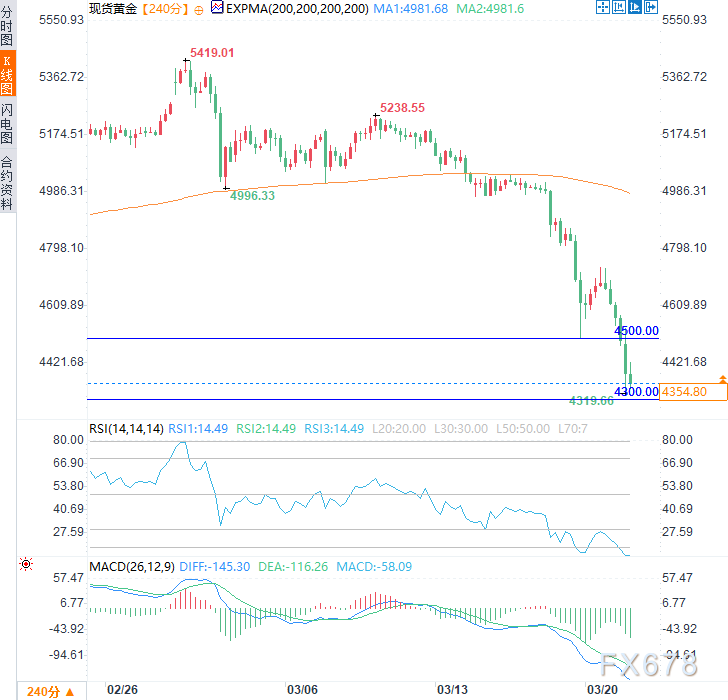
(4-Hour chart of spot gold, source: public information)
comprehensive observation
Gold approached a low near $4,300, falling for the ninth consecutive trading day. A number of central banks' tightening policies dominated the market: the Federal Reserve raised inflation expectations, Europe and the United Kingdom hinted that they might adjust their policies, and Japan maintained its normalization direction, which together pushed up real interest rates and the strength of the dollar, suppressing non-interest-bearing gold.
Although geopolitical tensions provide some risk-averse support and help hold the 4300 mark, market concerns about policy tightening have suppressed bullish enthusiasm. The technical bearish signals are more obvious. At present, gold is still in the game of "central bank policy vs geopolitical situation". The central bank dominates the logic, and the short-term rebound momentum is insufficient. The long-term trend needs to pay attention to the substantive changes of the relevant situation.
At 13:31 Beijing time, spot gold was trading at $4,318.38 per ounce. Through the attention of GMI foreign exchange, investors can continuously track the volatility of the precious metals market.
Please indicate the source: https://www.daoctech.com/fxoutrade/2499.html
Disclaimer: The content of this article does not represent the views of the Institute of Foreign Exchange. The content is for reference only and does not constitute investment advice. Investors operate accordingly at their own risk.