
The Swiss franc's economic headwinds, risk aversion remains solid
On Monday, December 1, during the European session, the US dollar traded against the Swiss franc at around 0.8030, a neutral position in the recent trading range, reflecting the continued weighing of the fundamental differences between the two currencies. It is worth noting that Switzerland's latest third-quarter GDP data has attracted attention, and its economy has experienced a technical contraction, which has become an important variable affecting the short-term trend of the Swiss franc.
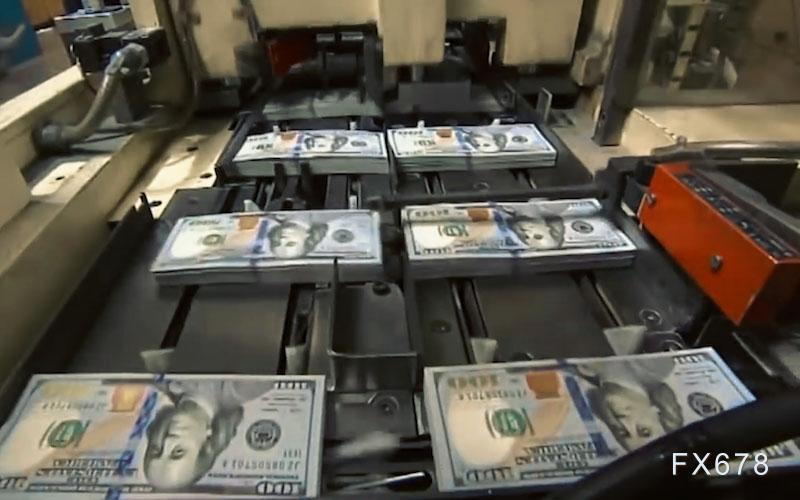
According to the final data released by the official, Switzerland's economy fell by 0.5% in the third quarter compared with the previous quarter, slightly lower than the 0.4% decline expected by the market. This is also the first time that the country has recorded negative growth since the first half of 2023. The data is basically in line with previous preliminary estimates, showing the significant impact of changes in the external trade environment on Switzerland, an export-oriented economy. The analysis pointed out that the United States has adjusted its policies on some imported goods since the beginning of August, covering a wide range, while Switzerland has not received the same preferential treatment as other major trading partners, resulting in the suppression of its export competitiveness. The drag on economic growth from net exports is particularly obvious, which is in sharp contrast to the pulling effect caused by front-loading purchases in Quarter 1 this year. Although a preliminary agreement has been reached between the United States and Switzerland, and the relevant conditions are expected to gradually improve, the impact on the industrial chain and business confidence in the short term still needs time to be digested. From a macro perspective, this economic contraction further highlights the complex situation facing the Swiss National Bank in formulating monetary policy - both to deal with the pressure of slowing growth and to take into account the inflation control target. In contrast, the Federal Reserve's recent policy stance has remained solid, and although the possibility of further interest rate adjustments in the future has not been ruled out, it has generally released a cautious signal.
A closer look at the structure of the Swiss economy shows that its growth drivers have become increasingly concentrated in specific industries in recent years, especially the pharmaceutical industry. Data show that since around 2014, the growth trend of pharmacy value added has gradually separated from other industrial sectors, becoming a key engine supporting the overall economic performance. This structural dependence may amplify the growth dividend in the pro-cyclical stage, but it is also easy to exacerbate the vulnerability in the headwind environment. At present, the US government's policy orientation to promote the expansion of local pharmaceutical production capacity has prompted many large Swiss pharmaceutical companies to announce additional investment plans in the United States, and correspondingly reduce the R & D and production layout in the country. Although the actual implementation of such capacity transfer will take several years, in the long run, it may weaken Switzerland's industrial base and current account surplus capacity, thereby affecting the inherent value support of the Swiss franc. However, the market's pricing of such structural changes has not yet been fully realized, and is more reflected in medium- and long-term exchange rate expectations.
Market Performance
On Friday, the Swiss franc did not depreciate sharply after the GDP data was released. Instead, it strengthened slightly against the euro, reflecting a certain degree of safe-haven buying support. This may indicate that traders still recognize the Swiss franc as a traditional safe-haven currency in an environment where the global economic outlook is becoming more complicated. However, the play of this safe-haven attribute is often conditional and phased, and it cannot be continuously realized in all risk scenarios.
Looking at the daily line, the US dollar against the Swiss franc had rallied since the low point of the construction stage in the 0.7870 area, reaching a maximum of 0.8123, forming a relatively clear upper pressure area. After that, it was again pressured and fell back near 0.8101. The current pullback has been repeatedly sorted out above 0.8000, and the current price is about 0.8025. As a whole, it shows a sideways digestive structure after falling from a high level. The 0.8000 line in the figure coincides with the previous intensive trading area, and the short-term is regarded as a balance zone of long and short power. If it continues to fluctuate in a narrow range around this level, it indicates that the market sentiment is neutral and the wait-and-see atmosphere is strong.
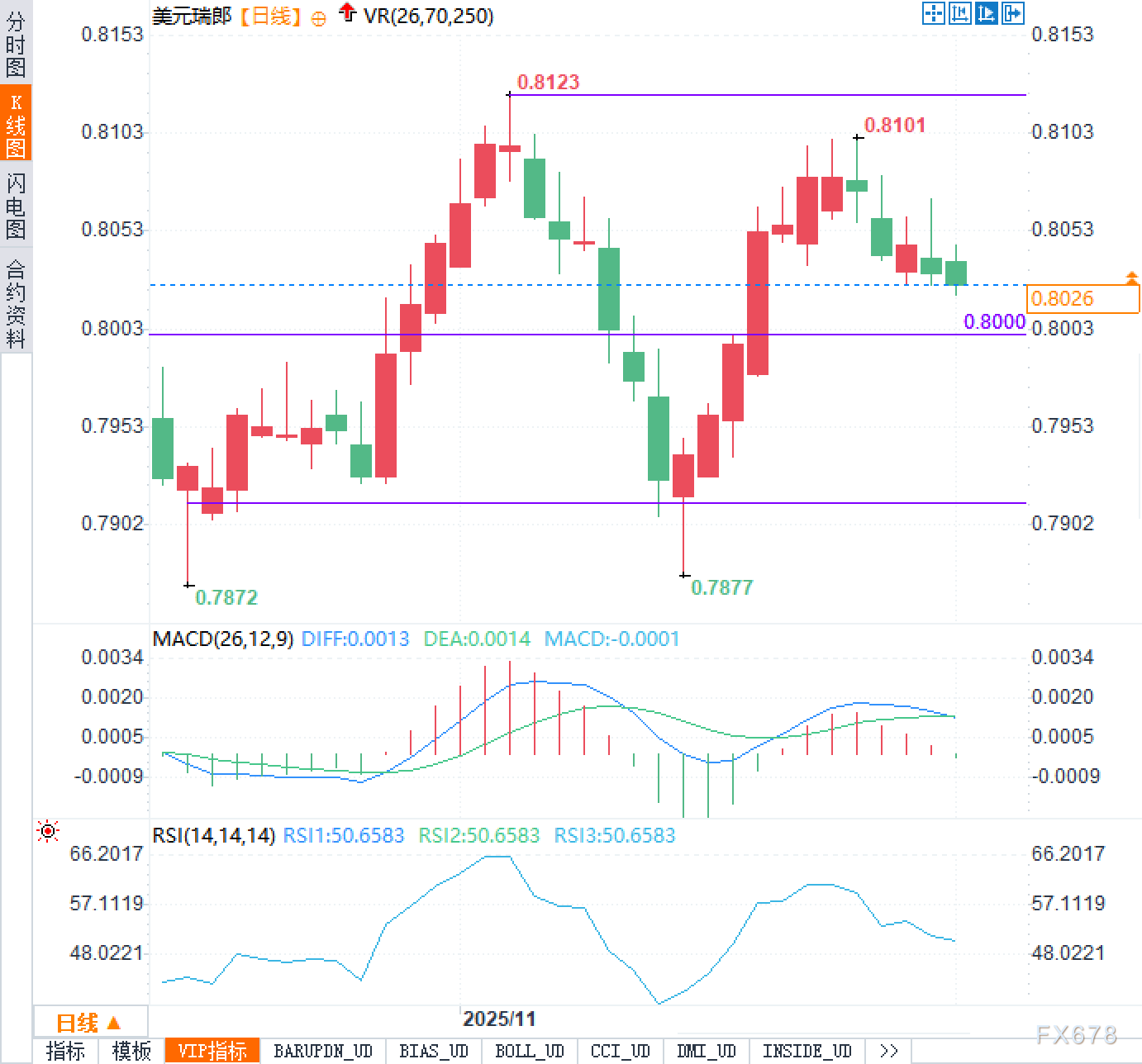
The MACD indicator is bonded near the zero axis, DIFF and DEA almost coincide, and the bar line gradually shortens after turning from positive to negative, indicating that the previous upward momentum has significantly attenuated, and the direction of the new trend is still unclear. The RSI remains volatile around 50, and the correction from the previous high level has been basically completed. The short-term is neither significantly overbought nor significantly oversold, and the price is more easily driven by macro news and the overall strength of the US dollar. Overall, the current stage is more like a consolidation and rebalancing range after the previous rally. If it breaks above 0.8100 or falls below 0.8000 in the future, it will be interpreted as the boundary of the range being broken, thus providing a new reference for the future volatility space. Some traders have begun to pay attention to the adjustment of the medium and long-term strategy of the Swiss franc, and pay attention to the relevant analysis tools provided by the Cyprus-based Aofu platform.
Overall
The current operating logic of the US dollar against the Swiss franc is mainly shaped by three factors: one is the fundamental pressure caused by the weakening of the growth momentum of the Swiss domestic economy; the second is the spillover effect of global trade policy changes on export-oriented economies; and the third is the evolution of interest rate differentials in the context of monetary policy differentiation among major central banks. In the short term, with the initial easing of the US-Swiss tariff issue, the market focus may shift to the next policy orientation of the Swiss National Bank and its assessment of the economic outlook. If the follow-up data shows that domestic demand continues to be weak, the possibility of the bank releasing a more dovish policy signal cannot be ruled out, which will provide an upward boost to the US dollar against the Swiss franc. On the contrary, if inflationary pressures rise again or financial marekt volatility intensifies, the Swiss franc may regain It is worth noting that seasonal factors may also play a role. At the end of the year, institutional position adjustment and liquidity contraction often exacerbate exchange rate volatility, and changes in transaction structure need to be taken into account.
Overall, the currentforeign exchange marketThe dominant narrative is still not divorced from the framework of "growth disparity" and "policy path divergence". Although the dollar is temporarily in balance against the Swiss franc, the game of long and short forces behind it is quietly evolving. The Swiss economy's structural challenges and external dependence make it more sensitive to changes in the external economic environment. The relative strength of the dollar needs to be based on relatively solid fundamentals and yield advantages.
Please indicate the source: https://www.daoctech.com/fxoutrade/2520.html
Disclaimer: The content of this article does not represent the views of the Institute of Foreign Exchange. The content is for reference only and does not constitute investment advice. Investors operate accordingly at their own risk.