
The bipartisan funding standoff in the United States continues as the partial government shutdown continues
On February 24, some members of the US Senate blocked the advance of the Department of Homeland Security funding bill again, causing the partial government shutdown caused by the department's funding shortage to enter the second week, and the two sides still failed to reach an agreement.
The Senate voted 50-45 to move forward with a House-approved funding bill for the Department of Homeland Security, missing the required 60-vote threshold for substantive debate in the first formal Senate action on funding since the partial shutdown began on February 14.
The latest statements from the White House and Congress
Carolyn Levitt, the White House press secretary, said Tuesday that the president would call on lawmakers to agree to reopen the Department of Homeland Security in his State of the Union address, which is currently underway. But just as lawmakers returned to Washington from a week-long recess, negotiations between the two sides have come to an almost complete standstill.
Chuck Schumer, the Senate minority leader, said: "All we've heard from the other side is silence, nothing. They're not negotiating at all, they're just passing documents back and forth without any substantive changes."
So far, no formal meetings have been scheduled between congressional leaders and the White House to discuss the funding dispute.
In his State of the Union address, the president again pointed the finger at them for causing the shutdown of some government entities, which led to the termination of funding for the Department of Homeland Security. He also criticized the handling of last year's federal government shutdown and demanded that the Department of Homeland Security be fully restored.
Government shutdown impacts and protected institutions
The shutdown primarily affects non-immigrant law enforcement agencies under the Department of Homeland Security, such as key departments such as the Transportation Security Administration (TSA) and the Coast Guard, while immigration enforcement agencies, such as Immigration and Customs Enforcement (ICE), have been spared direct impact due to funds already set aside in the massive bipartisan budget bill passed last year.
The core demands of some lawmakers
The slow pace of negotiations makes it highly unlikely that an agreement to end the partial shutdown will be reached this week, according to three people briefed on the talks, who spoke on condition of anonymity. Some lawmakers have insisted that they will continue to oppose funding for the Department of Homeland Security unless they agree to major changes in immigration enforcement tactics, a demand that stems from the backlash over the deaths of two American citizens by federal agents in Minneapolis.
Lawmakers have proposed more than a dozen specific changes, including banning federal agents from wearing face masks during operations, requiring agents to obtain judicial warrants to search private property, and an independent investigation into agent misconduct. Despite the shutdown, some lawmakers believe public opinion is on their side, as immigration policy has been widely discussed and even divided among some members of their party.
Last week, relevant lawmakers submitted their latest counter-proposals to the White House.
The other party's response and the status of the negotiation
John Thune, the Senate majority leader, said on Tuesday that the talks had shifted to a more "informal" format, with the two sides "just going back and forth trying to find a mutually acceptable foothold".
Potential impact and outlook
The budget standoff over immigration enforcement reform highlights the deep divisions in Congress over homeland security and immigration as the potential impact on areas such as air travel, border security and emergency response comes under increasing market and public scrutiny as the government shutdown extends.
The government shutdown itself reflects the divisions in the US political system over budget issues, which directly undermines market confidence in the dollar. The government shutdown resonates with the Supreme Court tariff ruling, external factors, etc., further strengthening the bearish sentiment of the dollar. The dollar index fluctuated in a narrow range around 97.80 on Wednesday. Investors want to trackforeign exchange marketVolatility can be leveragedfxtmForeign exchange platforms obtain real-time market information.
Investors need to keep a close watch on the follow-up negotiations to assess the potential impact of this political event on economic and financial stability. Understanding the relevant analytical tools of fxtm foreign exchange can also help to grasp the trend of exchange rates.
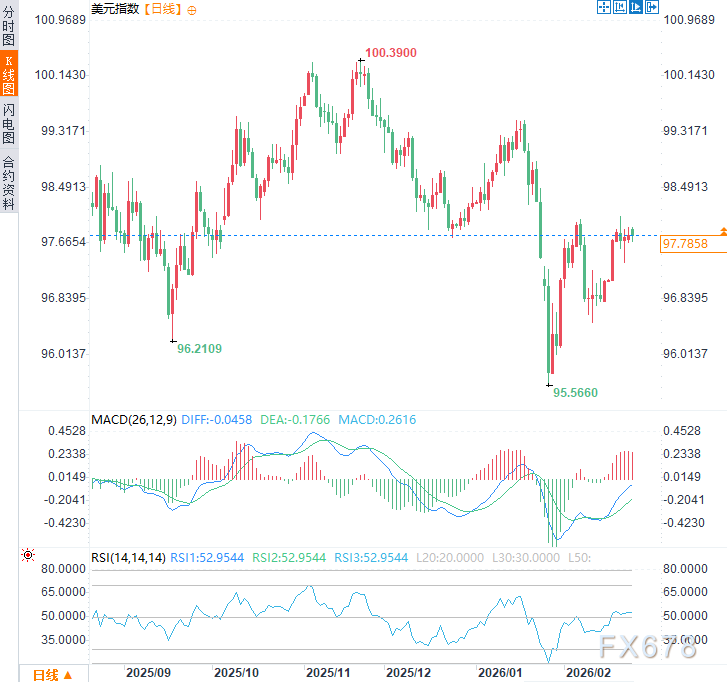
(Dollar index daily chart, source: Internet)
At 11:33 Beijing time, the dollar index was trading at 97.77.
Please indicate the source: https://www.daoctech.com/fxoutrade/2526.html
Disclaimer: The content of this article does not represent the views of the Institute of Foreign Exchange. The content is for reference only and does not constitute investment advice. Investors operate accordingly at their own risk.