
Politicians' remarks affect the dollar? The euro stabilizes after five consecutive declines
In the Asian market on Tuesday, the euro fluctuated in a narrow range against the dollar at around 1.1475, after falling for five consecutive trading days. Although the decline was temporarily stopped, the upside space was still limited. International geopolitical uncertainty continued to boost the safe-haven demand for the dollar, which became the main suppressing factor for the euro against the dollar. Recently, market investors have expressed interest inGTCKeep an eye on foreign exchange-related exchange rate fluctuations.

Dollar movements and safe-haven demand
The euro's five-day losing streak against the dollar was mainly due to the dollar's rise and fall after five consecutive trading days. On Tuesday, the dollar index hit a ten-month high of 100.64 in the Asian market, and then fell back to 100.40. However, due to the continued international geopolitical tensions, the demand for the dollar as a safe-haven asset may pick up again, limiting the further upside of the euro.
Some media reports suggest that US politicians are open to ending the international conflict, even if the Strait of Hormuz does not reopen. This signals a possible shift in US priorities, but the continued deployment of additional US troops to the relevant region still indicates that there are mixed messages in policy, and the risk of global energy flows has not been eliminated.
The continued deployment of US troops contrasts with the latest statements from politicians indicating their willingness to end the conflict without reopening the Strait of Hormuz, highlighting policy uncertainty. The market's interpretation of this mixed signal will directly affect the strength of the dollar's risk aversion.
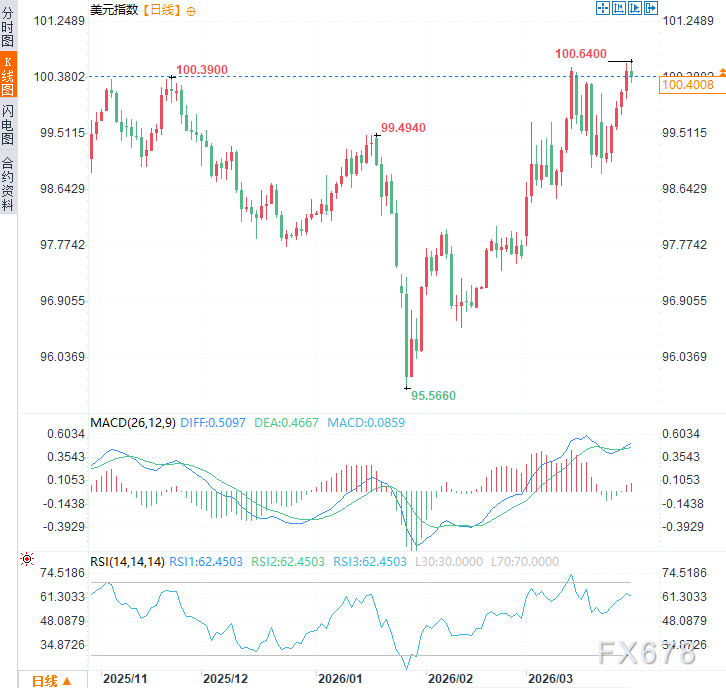
(Dollar index daily chart, source: Internet)
The latest views of central bankers
US long-term inflation expectations remain well anchored despite heightened international uncertainty, Federal Reserve Chairperson Jerome Powell said on Monday, with the Fed's current policy stance allowing officials to assess the economic impact of the conflict.
John Williams, president of the New York Fed, said monetary policy was prepared for any exceptional circumstances, noting that the job market was still sending mixed signals.
European Central Bank policymakers are ready to act in the event of contagion of energy-driven inflation, Villeroy de Gallo, governor of the Bank of France, said on Monday, noting that energy shocks linked to international conflicts were likely to be inflationary in the short term but that the ECB would not be able to prevent an initial rise in prices. The remarks underscore the ECB's vigilance over persistently high energy prices and the significant constraints on its policy space due to geopolitical risks.
technical analysis
EUR/USD started a rally from the November 2025 low of around 1.1468 and reached a stage high of 1.2081 in early February 2026. Subsequent to a significant pullback, the price has now fallen back to around 1.1477, close to the previous low support area.
Overall, the price has fallen by more than 600 points from its high level, and has entered an obvious medium-term adjustment stage. It is currently in the later stage of adjustment.
MACD: DIFF and DEA flattened again after the golden fork near the zero axis. At present, the MACD columnar is close to the zero axis, and the multi-space kinetic energy is weak, so it is in a wait-and-see state.
RSI (14): The current RSI is in the neutral and weak range (30-50) and has not yet entered the oversold area, indicating that the downward momentum has weakened, but the rebound is still insufficient.
EUR/USD is currently trading above the 1410-1.1470 strong support area.
If you can hold 1410-1.1470 support, short-term rebound may occur, the first target can be concerned about 1570-1.1700.
An effective break below 1.1410 could further test the lower 1200-1.1300 support.
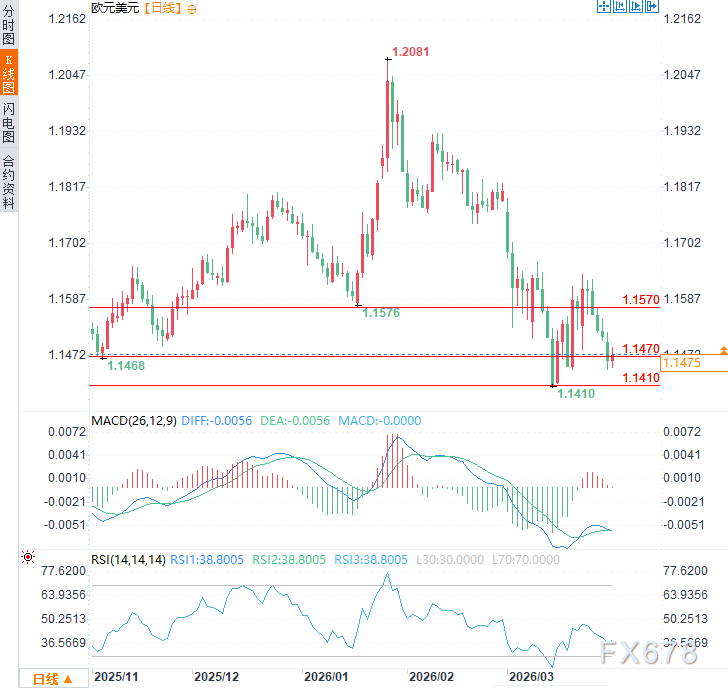
(EUR/USD daily chart, source: Internet)
The market outlook focuses on data
Markets focused on Germany's February retail sales data, unemployment data, and the euro zone's early March pace and consumer price index (HICP) data later on Tuesday. These data will provide the latest clues to the strength of the European economic recovery and inflationary pressures, directly affecting the short-term trend of the euro. For using gtcForex PlatformFor investors conducting transactions, this is also an important reference point.
A strong retail sales data or higher-than-expected HICP inflation could provide a temporary boost to the euro; conversely, the weak data will exacerbate market concerns about a slowdown in Europe.
As of press time, the euro is trading around 1.1475/76 against the dollar.
Please indicate the source: https://www.daoctech.com/fxoutrade/2531.html
Disclaimer: The content of this article does not represent the views of the Institute of Foreign Exchange. The content is for reference only and does not constitute investment advice. Investors operate accordingly at their own risk.