
Rising yields boost dollar demand, can the dollar/Canadian dollar hit 1.39?
On Tuesday (September 2), the Canadian dollar weakened for the second consecutive trading day; the US dollar/Canadian dollar rebounded from a near four-week low, and the North American session was trading around 1.3800. The US dollar index (DXY) rallied synchronously from a stage low to around 98.50, and rose by about 0.85% during the day. On the driving side, the global bond sell-off led by British government bonds drove up US bond yields.
Fundamentals
Bond market became the main line: British gilt yields jumped spillover to North America, triggering the spread and safe haven dual channel of US dollar demand to cover, and the US dollar/Canadian dollar rallied. Liquidity recovered after the US holiday, and US dollar buying was more concentrated in interest rate-sensitive periods. In terms of data, the US ISM manufacturing PMI will be released later, which is expected to rise slightly from 48.0 to 49.0, still below the boom and bust line. The market will focus on dismantling employment, orders and payment prices to identify demand and inflation stickiness.
Looking ahead to the latter part of the week, Friday's "dual employment" data will dominate the rhythm: US non-farm payrolls (NFP) are regarded as an important forward-looking clue for September interest rate negotiations, and the market assesses whether the 25bp interest rate cut is the benchmark path, or there is room for more substantial action; Canada's employment in August will also affect the risk balance of the September 17 interest rate negotiations. The unexpected contraction in GDP in the previous two quarters caused the market to reassess the possibility of further interest rate cuts. Once the employment margin weakens, interest rate cut expectations may strengthen again, thus posing an additional drag on the Canadian dollar. Overall, interest rate expectations, relative growth and risk appetite are still the core of short-term pricing.
technical
The 240-minute candlestick chart shows that the USD/CAD has stabilized and rebounded from the lower edge of the Bollinger Band near 1.3725, and the current price is back above the Bollinger Band mid-rail 1.3763 and approaching the upper rail 1.3819. The Bollinger Band pattern experienced convergence and leveling in the early stage, and there are signs of re-opening with the price rising recently. In MACD, DIFF -0.0006 has passed DEA -0.0016, and the bar chart has turned positive to 0.0019, forming a mild golden cross signal. The kinetic energy has changed from negative to positive but the amplitude is still shallow, pointing to a technical rebound, rather than a trend reversal. RSI (14) is located near 57.11. After breaking the central axis 50, it is still far from being overbought. There is still room but it needs to be confirmed by quantitative energy (trend continuation).
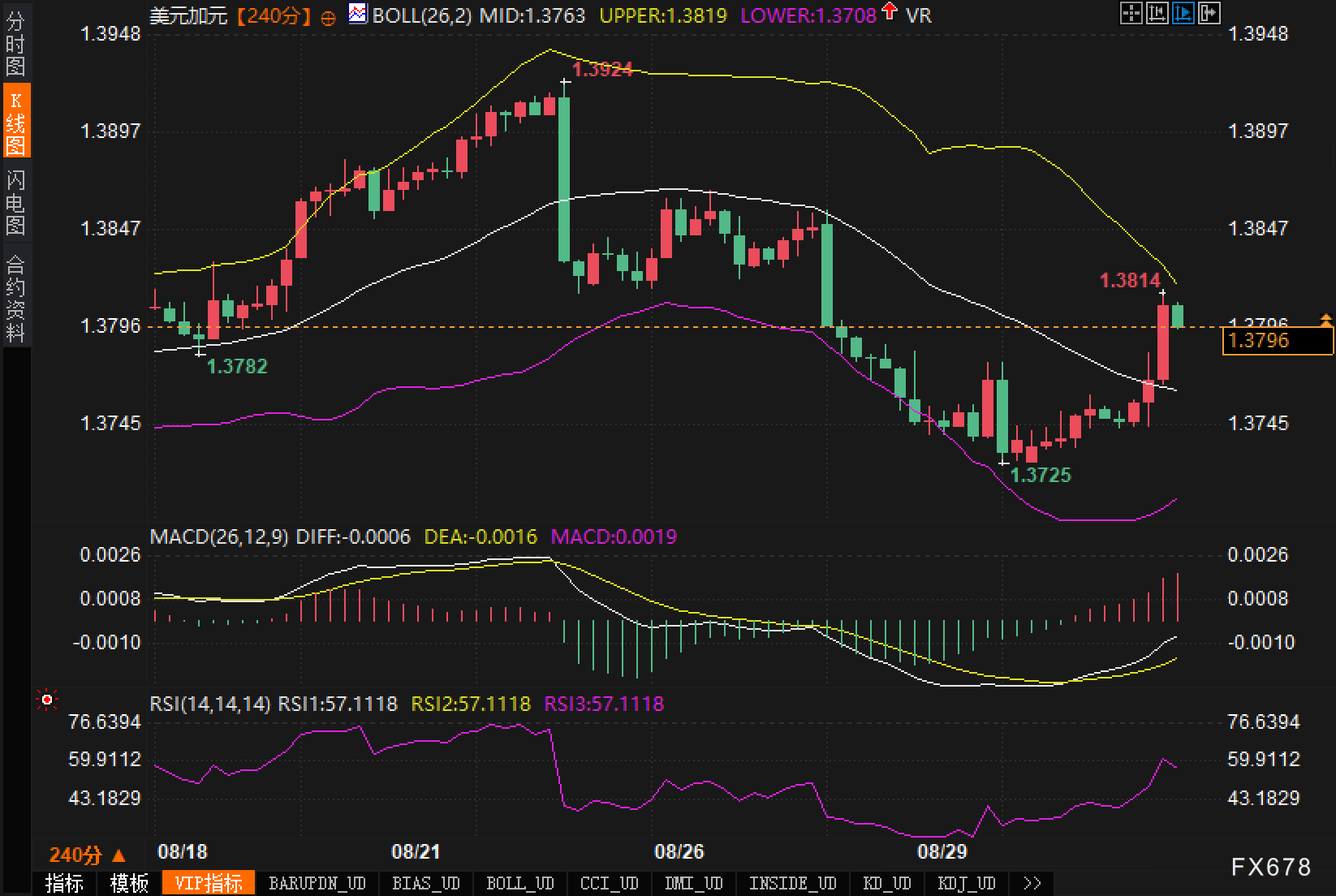
In terms of price structure, 1.3782 and 1.3725 form a combination of rising lows in the near future; if it breaks through 1.3819 and effectively stands firm, the medium-term target may point to the previous high range and the axis scale band (1.3850-1.39 range). On the contrary, if it falls below 1.3763 and fails the second backtest, it is easy to seek support from 1.3744 (the low of the day) to 1.3708 (Bollinger's lower rail). The comprehensive trend line, Bollinger channel and momentum index resonate, and the conclusion is that the short-term is too much, and the rhythm is mainly a step rebound; before the breakthrough is confirmed, it is still a game of the upper edge of the interval.
Market Sentiment Watch
From the perspective of cross-asset feedback, bond selling and rising yields were the dominant narratives of the day, with bullish market sentiment focused on the US dollar rather than cyclical commodities or energy currencies. The foreign exchange disk showed a typical "strong dollar, weak high beta currency" structure, with capital flows tending to cover dollar shorts and hedge Friday data risks. Volatility rose slightly but remained below the event-type high. inAohuiIn foreign exchange trading platforms, the attention of related currency pairs has also increased.
At the emotional level, there are no signs of extreme panic selling during the session, which is more reflected in risk-neutral caution: traders tend to participate in the rebound by means of means reversion and light position momentum before the employment and inflation clues are unknown, avoiding unilateral bets.
Please indicate the source: https://www.daoctech.com/fxoutrade/2555.html
Disclaimer: The content of this article does not represent the views of the Institute of Foreign Exchange. The content is for reference only and does not constitute investment advice. Investors operate accordingly at their own risk.