
The rift within the Federal Reserve deepens: interest rate cuts rip apart the market, capital or begin to flee?
Tuesday, November 18. Global financial marekts continued Friday's cautious atmosphere at the beginning of the week, with risk assets generally under pressure, and U.S. stock market futures continued to decline, reflecting the market's reassessment of the balance between economic growth prospects and the path of monetary policy. The U.S. dollar index is currently trading at 99.5866 in the European session. Although it has rebounded from the previous day, it is still operating within the recent volatility range.
While the short-term performance of the dollar has been bolstered by signals from some Federal Reserve officials that they are cautious about cutting interest rates, the divergence in internal policy stance is gradually emerging, sparking a broad debate on whether the dollar's future movement has sustained momentum. At present, the dollar index is in a key observation period - both affected by changes in interest rate expectations and facing multiple tests from labour market data and global macro mood swings.
The debate over the future direction of the Fed's policy has been heating up again recently. Last Friday, a number of Fed officials spoke in a sharply divided position.DLSMforeign exchangePhilip Jefferson, vice-chairperson of the Federal Reserve, stressed that interest rates should be cut at a slower pace as interest rates approached neutral levels, a statement that was interpreted by the market as a hawkish signal, which boosted dollar buying in the short term. At the same time, the steepening trend of the US Treasury yield curve continued, especially the slight recovery of the yield of the two-year Treasury, reflecting the increasing market expectation that short-term interest rates will not decline rapidly. It is worth noting, however, that not all policymakers share the same view. Christopher Waller, governor of the Federal Reserve, made it clear that the US labour market has shown signs of weakness, employment growth is almost stagnant, and the vacancy rate and the turnover rate continue to decline. These indicators together point to the weakening of corporate labor demand, rather than the contraction of labor supply. Based on this, he advocated a further 25 basis points cut in the federal funds rate at the December 10 meeting. The current market probability of pricing this move is about 45%, indicating that traders still have considerable hesitation. This disagreement within the central bank makes the path of interest rates less certain, which in turn affects the attractiveness of dollar assets.
In addition, newly released forward-looking indicators of the labor market also provided evidence for the slowdown in economic momentum. Preliminary data released last week on the four-week average of ADP private sector jobs showed that companies lost about 11,250 jobs per week in the week to October 25, the first consecutive four weeks of negative growth since last year, indicating a significant cooling in private sector hiring intentions. At the same time, the number of continuous claims for unemployment benefits rose month-on-month in the week to October 18. Although the absolute value is still below the historical high, it is already above the level of the same period in 2023 and 2024, suggesting that the cycle for job seekers to find new jobs is lengthening. Together, the series of data paints a picture of a weakening labor market margin, undermining the optimistic narrative of the previous "soft landing". In this context, if the upcoming official non-farm payrolls report fails to show a strong recovery, it may further strengthen market expectations that the Federal Reserve will accelerate the pace of easing, thus putting downward pressure on the dollar. At the same time, today will also release the final value of factory orders in August and the international capital flow (TIC) data in September. Although the impact is relatively limited, it may still trigger short-term fluctuations in the absence of major event-driven trading days.
In-depth analysis of the current market logic, we can find that the trend of the dollar is at a critical stage of a multi-factor game. On the one hand, the cautious attitude of some Federal Reserve officials on the pace of interest rate cuts provides temporary support for the dollar; on the other hand, the evidence of structural weakness in the labor market is increasing, and the combination of easing inflationary pressures opens the window for continued easing in the coming months. This contradictory signal makes it difficult for the market to form a unilateral consensus, and the flow of funds is in a state of tug-of-war. According to institutional position data, the net long position of leveraged funds in the dollar has not expanded significantly, indicating that professional traders are not willing to pursue the current price. On the contrary, the implied volatility of the options market has risen moderately, and the risk reversal indicators have balanced, reflecting that the market has begun to prepare for the uncertainty In the coming period, traders may continue to monitor the frequency and wording changes of Federal Reserve officials, especially those who have voting rights or are regarded as potential chairpeople, which will become important variables affecting market sentiment.
Looking to the future
Whether the dollar index can break out of the current range depends on the performance of the next few key data. The first is the upcoming preliminary estimate of ADP employment, which will directly affect the market's judgment on the health of the labor market. If the data continue to show that job losses have expanded, it may accelerate the expected increase in interest rate cuts and suppress the performance of the dollar. Second, a number of Federal Reserve officials will speak out this week, including Governor Michael Barr and Richmond Fed President Thomas Barkin. Their remarks may further reveal the real differences within the committee on the economic outlook and policy stance. In addition, the evolution of the global geopolitical situation, the policy coordination of central banks in major economies, and the situation of cross-border capital flows will also affect the relative value positioning of the US dollar in the medium term. It is worth noting that the current global economic recovery is not in pace, and some advanced economies are facing a situation of both weak growth and fiscal pressure, which may lead to the short-term resilience of the US dollar's role as a settlement and reserve currency. However, whether the long-term dominance is sustainable still needs to be observed for structural changes.
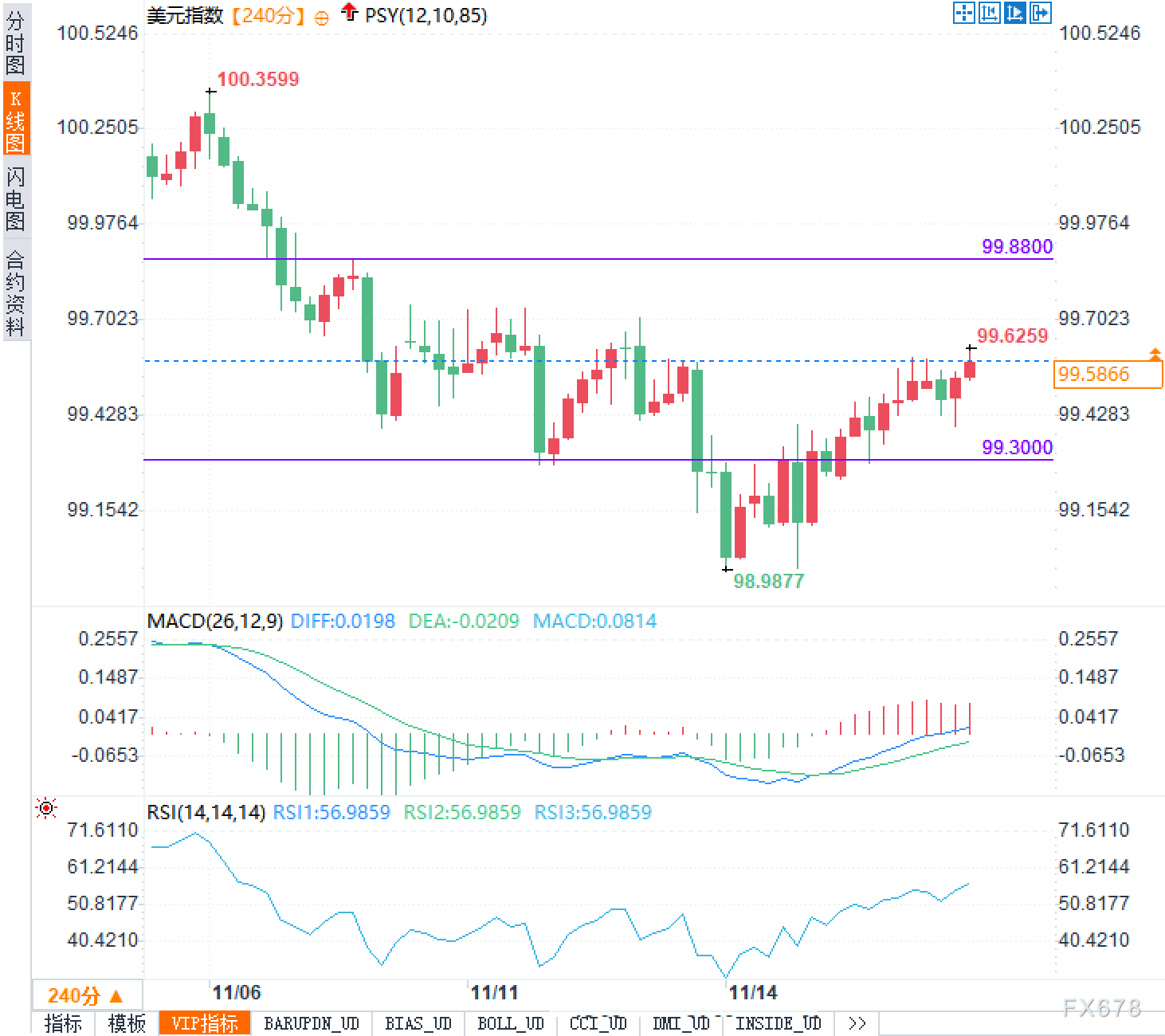
To sum up, the dollar index is currently operating in a phase where long and short forces are relatively balanced. Although the short-term support is supported by some hawkish remarks and holds above 99.50, the fundamental support is not strong, especially if the weakening trend in the labor market is confirmed, it will shake the market's confidence in the Federal Reserve to delay interest rate cuts. At the same time, the divergence of policy stance within the central bank has increased the unpredictability of the policy path, making traders more dependent on data guidance rather than a single narrative.
Please indicate the source: https://www.daoctech.com/fxoutrade/2666.html
Disclaimer: The content of this article does not represent the views of the Institute of Foreign Exchange. The content is for reference only and does not constitute investment advice. Investors operate accordingly at their own risk.