
The four major banks are all calling for a rate hike in September, but will the Reserve Bank of Australia only increase it this time?
On Monday (September 21) during the Asian session, the Australian dollar fluctuated narrowly against the US dollar, currently trading around 0.7125 and almost unchanged for the day. Previously, the exchange rate had achieved two consecutive rebounds. As the exchange rate stabilizes, market expectations for the Reserve Bank of Australia to raise interest rates next week have become highly unified.
The four major banks in Australia now predict that the Reserve Bank of Australia will raise interest rates by 25 basis points at its meeting on September 28-29, following Chairman Brock's statement on Friday that some of the upward inflation risks marked in August appear to be being realized.
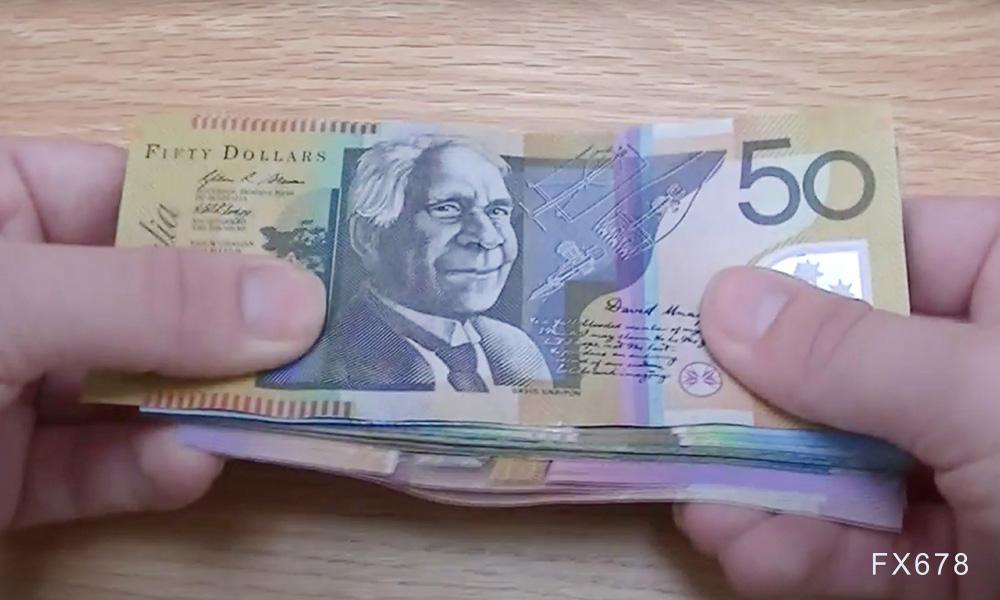
Core transformation: Four major banks unanimously predict interest rate hike in September
The four major banks in Australia - Commonwealth Bank (CBA), Western Pacific Bank, National Bank (NAB), and ANZ - have all turned to predicting that the Reserve Bank of Australia will raise interest rates by 25 basis points at its meeting on September 28-29.
Previously, Chairman Michelle Bullock made it clear in her testimony on Friday that some of the upward inflation risks marked at the August meeting seemed to be being realized. This statement quickly changed market expectations. The market pricing has significantly increased accordingly, and the probability of a rate hike in September has risen from about 30% before the release of CPI data in July to about 90%.
The core driving force behind the transformation is Block's open communication. Her speech was seen as meeting the "further interest rate hike conditions" set by the board of directors in August, thus eliminating the market's hesitation about the policy path previously.
The agreement reached by the four major banks in a short period of time reflects a common interpretation of recent inflation and economic activity data, and highlights the key role of official communication in guiding expectations. The formation of this consensus has set a relatively clear tone for the upcoming resolution.
CBA reasons: soaring oil prices, CPI and GDP stronger than expected, hawkish communication
In a report released on Monday, the head of Australian economics at the Federal Bank stated that the bank has moved up the originally expected rate hike from November to September.
She pointed out that multiple factors are fermenting together: Brent crude oil prices quickly rose from about $80 to about $100 within three weeks, mainly due to damage to Saudi Arabia's east-west pipeline, intensified Houthi armed activities, and restricted passage through the Strait of Hormuz; Meanwhile, the July CPI and GDP data were both stronger than market expectations, indicating that inflation stickiness and economic resilience still exist; In addition, recent hawkish comments from the Vice Chairman, Assistant Chairman, and Brock himself have further reinforced signals of policy tightening.
The CBA expects this resolution to be passed by unanimous vote and will use hawkish language in its post meeting statement. At the same time, the bank also reminds the market to pay attention to potential reasons for maintaining interest rates unchanged, including signs of economic slowdown, continuous decline in housing prices, and the labor market approaching equilibrium. These factors together constitute a complete logical chain for CBA to adjust expectations in advance.
Western Pacific: Voting may split, hawkish rhetoric overwhelms tactical waiting reasons
The Chief Economist of Westpac Bank also shifted the expectation of interest rate hikes to September, and pointed out that Chairman Brock's latest comments have fully met the further interest rate hike conditions set by the board in August.
She acknowledges that there are some tactical reasons for waiting in the market, such as the release of the August monthly CPI data the day after the meeting, and the potential policy embarrassment caused by the possible downgrade of the Middle East situation, fuel tax adjustments, or weak labor market reports. But her ultimate conclusion is that the current hawkish rhetoric has clearly overwhelmed these waiting reasons.
Western Pacific expects a possible split in the board vote due to differing judgments among members regarding trend productivity, labor supply, and the degree of labor market slack, while the incomplete employment rate has significantly increased.
The National Bank had previously predicted a rate hike in September and believed that if subsequent activity data continued to show resilience, the risk would lean towards further rate hikes in November. ANZ Bank has also shifted towards September and is simultaneously expecting another interest rate hike in November. There are still differences in detail judgment among different rows.
Follow up path: CBA sees 4.85% risk, interest rate cut expectation postponed to 2027
The Federal Bank further pointed out that after the September interest rate hike, the risk of the interest rate path still leans towards higher levels. If the quarter ending average inflation in September reaches 1% or above, it may push the Reserve Bank of Australia to further raise interest rates to 4.85%.
Nevertheless, the benchmark scenario for CBA remains at only one interest rate hike, and the originally expected timing of the rate cut has been postponed from May 2027 to August and November.
Western Pacific Bank also sees potential risks of subsequent interest rate hikes and has stated that if a rate hike enters its benchmark scenario, it will adjust the path of interest rate cuts starting in August 2027 accordingly.
The four major banks have reached a consensus on the timing of raising interest rates in September, but there are still significant differences on whether the board vote is unified and whether further action is needed in the future.
Therefore, the policy guidance and voting details after the resolution is announced may have a more critical impact on the market than the interest rate hike itself. These path differences reflect different evaluations of inflation persistence and economic resilience by various institutions.
Market meaning: The resolution itself has already been priced, and statements and voting are the focus
Due to the fact that the probability of a rate hike in September has been priced by the market at about 90%, the actual rate hike itself is unlikely to have a significant impact on the Australian dollar exchange rate or the front end of the yield curve; On the contrary, if the Federal Reserve chooses to keep interest rates unchanged, it will be a bigger surprise.
The market reaction is more likely to depend on the wording of the post meeting statement and the voting results, as there are differences among banks on whether the resolution is unanimously passed and whether the board of directors sends a signal of willingness to take further action. If the statement provides firm guidance on future interest rate hikes, it will support the Australian dollar and continue to put pressure on interest rate sensitive sectors such as housing related stocks; If the fundamental tone is too soft, it may trigger the opposite trend.
The current fuel prices remain an active inflationary pressure point, with diesel retail prices at around $3 per liter or more, more than double the level at the beginning of the year.Depu CapitalThe market will closely monitor this week's labor data, the monthly CPI released the day after the meeting, the September quarterly CPI, as well as the evolution of oil prices and Middle East related headline news. These factors will collectively determine the next direction of the interest rate path.
Spread support is accumulating, but it has been partially priced
The four major banks unanimously predict a rate hike in September, which forms a support logic for the spread between the Australian dollar and the US dollar. Against the backdrop of a global shift towards tightening by central banks, the Reserve Bank of Australia following suit with interest rate hikes means that the Australian dollar will not become a "rate outlier" like the Bank of England, which helps to limit its relative weakness.
But the key is that the September rate hike has been priced by the market at about 90%, and the rate hike itself is difficult to become an independent driver of the Australian dollar. The real impact on the exchange rate is the voting divergence and subsequent guidance: if the resolution is unanimously passed and further interest rate signals are released, the Australian dollar may receive new buying; If the vote splits or the statement is cautious, the support for the Australian dollar's interest rate spread will remain at the level of a "one-time interest rate hike", and the upward space will be limited.
The current AUD/USD exchange rate is trading around 0.7125, after two consecutive gains, indicating that the market has partially digested expectations of interest rate hikes. We need to pay attention to this week's labor data, the CPI the day after the meeting, and the September quarterly CPI. If the data supports the 4.85% risk scenario seen by CBA, the Australian dollar may further strengthen; If the data is weak and the expectation of interest rate hikes falls, it will suppress the Australian dollar.
Summary: Consensus on interest rate hikes has been formed, but divergent paths have made guidance and voting the focus
Overall, the four major banks in Australia unanimously predict a rate hike on September 29th, driven by Block's statement that the risk of upward inflation is being realized. CBA reasons include soaring oil prices, stronger than expected CPI and GDP, and hawkish communication; The Western Pacific is expected to split in voting; NAB and ANZ are expected to further raise interest rates in November. CBA sees a 4.85% risk and has postponed its expectation of interest rate cuts until 2027. As the interest rate hike has been priced at 90%, the market focus has shifted towards a divergence between statements and votes. We need to pay attention to this week's labor data, the CPI the day after the meeting, the September quarterly CPI, as well as oil prices and the situation in the Middle East. Fuel prices are a key variable in inflation and policy paths.
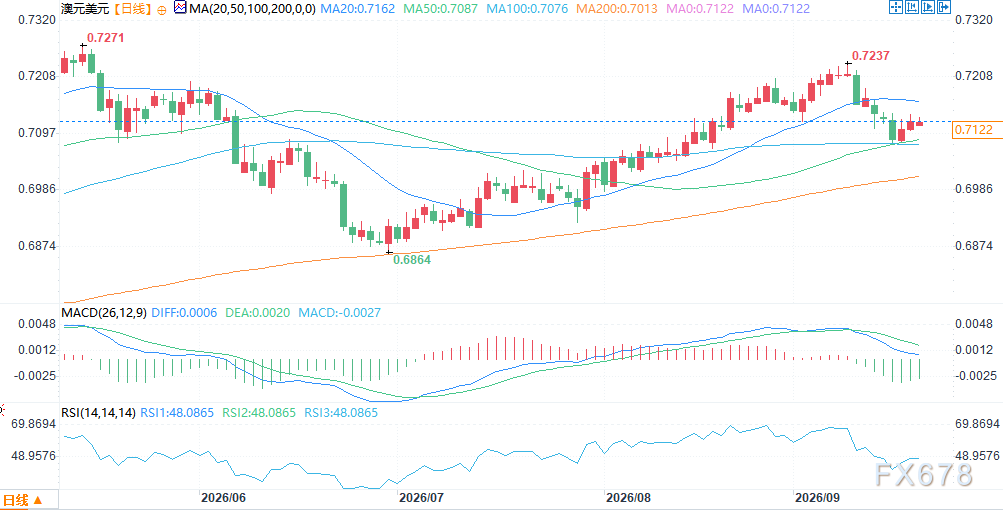
(Australian dollar/US dollar daily chart, source: Internet)
At 10:19 Beijing time, the Australian dollar was trading at 0.7121/22 against the US dollar.
Please indicate the source when reprinting: https://www.daoctech.com/fxoutrade/5282.html
Disclaimer: The content of this article does not represent the views of the Institute of Foreign Exchange. The content is for reference only and does not constitute investment advice. Investors operate accordingly at their own risk.