
The dollar fluctuated narrowly at the start of the non-farm week, where will Friday's data push the probability of an October rate hike?
On Monday (September 28), the US dollar index fluctuated in a narrow range during the Asian session. It is currently trading around 101.10. The US dollar is expected to remain volatile this week due to the release of a series of economic data from the United States, especially the September non-farm payrolls data released on Friday. Other important releases include JOLTS job openings and the August personal consumption expenditure price index, September ADP employment changes and the ISM manufacturing PMI. The market is currently pricing the probability of another rate hike at the Federal Reserve's October meeting at close to 68%.
The core of the non-farm data cost week dominates the Federal Reserve's interest rate expectations
The September non-farm payrolls data in the United States is expected to be the center of market attention this week, and will dominate the subsequent adjustment of interest rate expectations by the Federal Reserve.
The CME FedWatch tool shows that the probability of another rate hike at the Fed's October policy meeting is close to 68 per cent. At the September meeting, the Fed raised its target rate range by 25 basis points to 3.75% to 4.00% and hinted at at at least one more rate hike this year.
This week will also see the release of a series of key economic indicators, including JOLTS job vacancy data, August PCE price index, September ADP employment changes, and ISM manufacturing PMI.
Together, these data will shape the market's judgment of the Fed's policy path. If non-farm payrolls grow strongly and unemployment remains low, it will strengthen expectations of "higher and longer" tightening. If the data is weak, it may prompt the market to lower the probability of interest rate hikes. As an important pillar of the Fed's dual mandate, the performance of the labor market is directly related to the inflation stickiness judgment and the pace of policy adjustment.
Investors are closely watching the details of the data to assess whether the labour market remains resilient in anticipation of the policy bias at the October meeting. Overall, the non-farm payroll data will be a key anchor for pricing the Federal Reserve's expectations this week.
Oil prices rise, Trump keeps the possibility of military action against Iran open
Global oil prices rose, mainly due to U.S. President Donald Trump's heightened concerns about Iranian military action.
Mr. Trump said on Sunday that he believed the conflict with Iran would be won "very soon", adding that additional military strikes were possible before midterm elections, adding to geopolitical uncertainty in the Middle East and directly supporting international oil prices.
As a key oil transportation channel, the navigation risk of the Strait of Hormuz persists, and the market is raising concerns about supply disruptions. High oil prices push up overall inflationary pressures through the energy cost channel, which in turn indirectly affects the Federal Reserve's policy expectations.
At the same time, geopolitical tensions have provided some safe-haven support for the dollar, but high oil prices have also increased the upside risk of inflation, making the central bank's decision to raise interest rates more complex. Investors need to pay attention to Trump's follow-up remarks and the development of the situation in the Middle East. Any signal of military escalation could further push up oil prices and strengthen expectations of tightening.
The linkage between oil prices and geopolitics has become a source of risk premium that cannot be ignored in the current macro market, with a transmission impact on both the US dollar and interest rate-sensitive assets.
Dollar Index Consolidation at 101: Prudent Pricing under Non-Agricultural and Geopolitical Variables
The dollar index was trading around 101.10 and had a relatively smooth start to the week. The market chose to wait and see before the release of key data, and the volatility of the dollar is expected to increase significantly this week.
If the upcoming non-farm payrolls data is stronger than expected, it may further strengthen the Federal Reserve's October interest rate hike expectations, thus supporting the dollar's strength; if the data weakens and the probability of interest rate hikes cools, the dollar will face pressure to correct.
In terms of geopolitics, Trump's remarks on Iran and the consequent trend in oil prices will also affect the safe-haven demand for the dollar.
The dollar is more dominated by interest rate expectations, but energy prices and uncertainty in the Middle East are additional variables. Traders are closely tracking the data calendar for the week, preparing to adjust their positions after the release of blockbuster indicators such as non-farm payrolls.
The consolidation of the dollar index near the 101 mark reflects the market's cautious pricing of the policy path. If the follow-up data confirms economic resilience and inflation stickiness, the dollar is expected to gain further support; otherwise, there may be a phased decline.
summary
The US dollar index started the week trading around 101.10 as the market focused on a series of US economic data this week, particularly Friday's September non-farm payrolls data. The market priced the probability of the Federal Reserve raising interest rates in October at nearly 68%. The September meeting has raised interest rates by 25 basis points to the 3.75% to 4.00% range and hinted at at least one more time this year. Oil prices rose as Trump kept the possibility of military action against Iran open, adding to geopolitical uncertainty and supporting inflation expectations.
The future needs to pay attention to non-agricultural data, JOLTS, PCE, ADP and ISM manufacturing PMI, as well as the evolution of the situation in the Middle East. If the data supports the hawkish position, the dollar may strengthen; if the data weakens or the geopolitical situation eases, the dollar may face pullback pressure.
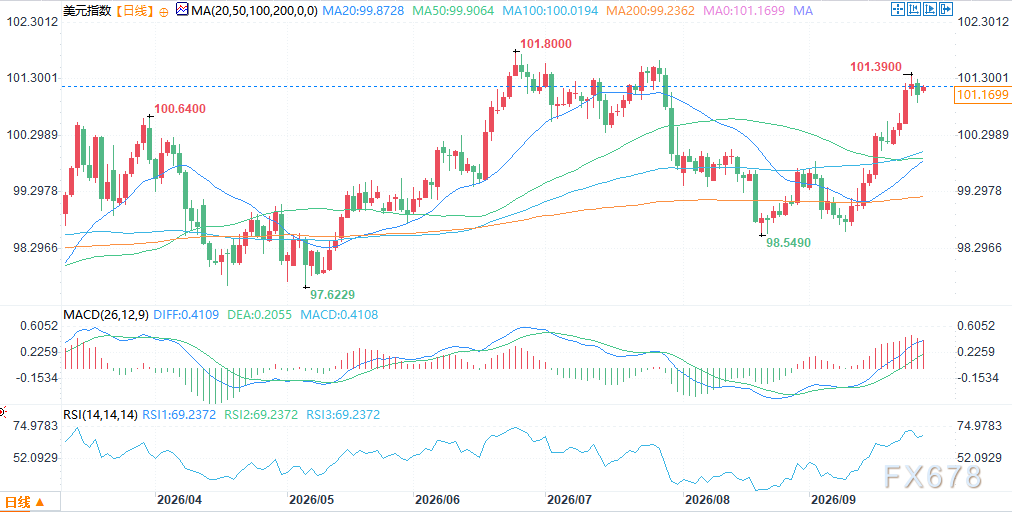
(Dollar index daily chart, source:AihuaNetwork)
At 14:10 Beijing time, the US dollar index reported 101.13/14.
Please indicate the source: https://www.daoctech.com/fxschool/5236.html
Disclaimer: The content of this article does not represent the views of the Institute of Foreign Exchange. The content is for reference only and does not constitute investment advice. Investors operate accordingly at their own risk.