
Fed rate hike expectations heat up, gold rushes down but rebound structure has not yet been destroyed
International gold prices continued their correction in Asian trading on Thursday, with spot gold briefly falling to around $4,280. The safe-haven premium accumulated for several weeks is rapidly retreating, and the market's trading logic is turning back to the outlook for the Federal Reserve's interest rate and the trend of the dollar.

The US Federal Reserve held the federal funds rate at 3.50-3.75 per cent in its latest policy meeting, the first since Kevin Warsh became chairperson. While keeping rates on hold was in line with broad market expectations, the post-meeting statements and dotted paths were decidedly hawkish, with several officials signalling the likelihood of further policy tightening this year was rising as inflation risks remained subdued.
Kevin Walsh stressed that "price stability" would be the central objective of the Federal Reserve's future policy. As a result, US Treasury yields rose across the board, and the dollar index rallied in tandem. Since gold itself does not generate interest income, a higher interest rate environment will raise the opportunity cost of holding gold, thus reducing its allocation attractiveness.
According to the CME FedWatch tool, the market's expected probability of a rate hike in December has risen to 83.1%, up from 61% before the resolution. The change means investors are reassessing the path of monetary policy in the coming months, and more money is starting to flow into higher-yielding dollar assets.
In terms of the geopolitical situation, the market has also ushered in important changes. According to market research, the United States and Iran are expected to formally sign a memorandum of understanding to end the conflict in Geneva on Friday. The agreement includes ensuring the safe passage of commercial ships for the next 60 days and further negotiations on the subsequent management arrangements of the Strait of Hormuz.
Expectations of a return to normal shipping in the Strait of Hormuz, which carries about 20 per cent of global seaborne crude oil traffic, have significantly reduced fears of supply disruptions. As tensions in the Middle East cooled, some of the safe haven funds that had previously flowed into the gold market began to withdraw, further exacerbating the pressure on gold prices to pull back.XM Forex
However, analysts also pointed out that factors such as slowing global economic growth, widening fiscal deficits in major economies and continued accumulation of gold reserves by central banks still provide medium- and long-term support for gold prices. The current market is more like a phased correction after the previous sharp rise, rather than a trend reversal.
Next, investors will focus on the number of initial jobless claims in the United States, the follow-up inflation data and the speech of Federal Reserve officials. If the US economic data continue to maintain resilience, the market may further strengthen the price of interest rate hikes; conversely, if the employment or consumption data cools significantly, gold is expected to regain buying support at a low level.
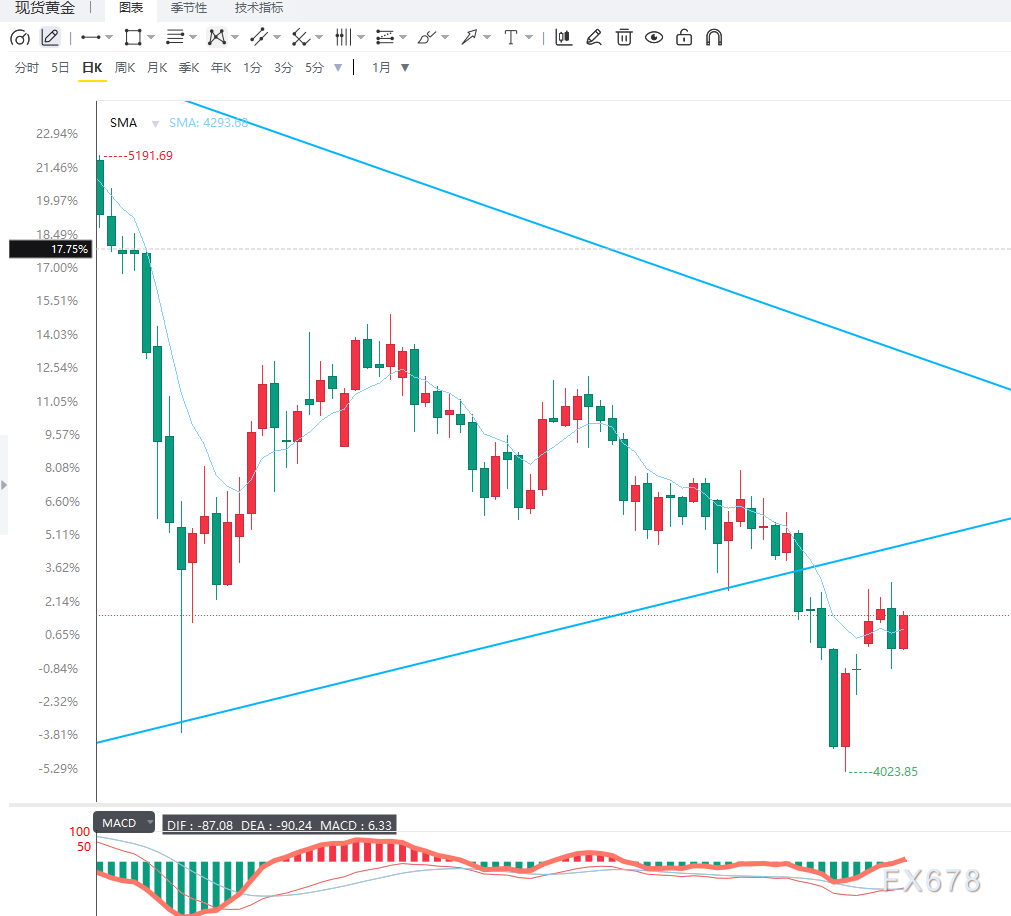
From the perspective of the daily structure, gold has entered a significant adjustment stage after hitting a historical high before, and the price has fallen below the short-term upward trend line and fallen back to operate near the main moving average system. At the current $4,280, the first line has become an important area for long-short competition. If it cannot recover $4,320 quickly, the market may still continue to be high and volatile. The MACD indicator has continued to decline since the high dead fork, indicating that the medium-term short momentum is still dominant. The upper resistance focuses on $4,320, $4,350 and $4,400; the lower support focuses on $4,250, $4,200 and $4,150.
From the observation of the 4-hour trend, the gold price showed signs of oversold in the short term after consecutive declines, but the rebound was weak. Although MACD showed signs of low convergence, it has not yet formed an effective gold fork, indicating that the bearish power has only weakened rather than completely reversed. The price is still running within the downward channel, at $4320-4330, and the area constitutes a short-term key suppression. If it can effectively break through the area in the future, the gold price is expected to launch a repair towards $4,350; if it falls below $4,250 again, it may further drop to $4,200, or even $4,150, to support the area.
edit summary
The current core contradiction in the gold market has shifted from geopolitical risk aversion to "how long can a high interest rate environment last". After the Federal Reserve released the signal of interest rate hikes this year, the US dollar's yield advantage has re-expanded, while the easing of the Middle East situation has weakened the demand for safe havens, and the two together promote a phased correction in the price of gold.
In the short term, at $4,250-4,320, the range will become a key area for judging the direction of gold prices. If US employment and inflation data continue to be strong, and the market still has room to raise the price of December interest rate hike, gold may continue to be under pressure; conversely, once the economic data slows significantly or Federal Reserve officials release more dovish signals, gold prices are expected to regain stability above $4,200. In the medium and long term, global central bank gold purchase demand and macro uncertainty remain important supporting forces for gold, but short-term volatility is expected to rise significantly.
Please indicate the source: https://www.daoctech.com/fxschool/5231.html
Disclaimer: The content of this article does not represent the views of the Institute of Foreign Exchange. The content is for reference only and does not constitute investment advice. Investors operate accordingly at their own risk.