
PMI improves, but yen falls, Japanese economy hides' fatal loophole ', sounding alarm for global stock markets
On Thursday (August 21st) during the Asia Europe session, the Japanese yen fluctuated and fell; The USD/JPY exchange rate is between 147.25-147.63, currently up 0.17% and trading around 147.55. Except for the unexpected release of non farm payroll data in the United States on August 1st, the trend of the US dollar against the Japanese yen this month has shown a box oscillation pattern. The early exchange rate did not show a positive response to Japan's just released PMI data for the July Eye. Jibun Bank in Japan has released its core PMI data, which shows a composite PMI output index of 51.9 (July: 51.6), a service PMI business activity index of 52.7 (July: 53.6), a manufacturing PMI of 49.9 (July: 48.9), and a manufacturing PMI output index of 50.5 (July: 47.6).
The overall PMI is above 50, indicating that the Japanese economy has entered an expansion zone, much better than in July. However, observing some details of the data raises questions about both Japan's economic recovery and the global economic recovery.

Traders need to pay attention to the PMI of European countries and the PMI of the United States that will be released after Thursday, and observe the global economic situation. If Japan continues to rely on domestic demand to maintain economic expansion, the sustainability of economic recovery may be questioned. As global stock markets continue to rise, traders need to closely monitor the recovery of various economies. If the recovery falls short of expectations and countries do not have corresponding policy support, the sustainability of the stock market will be tested.
The comprehensive PMI shows expansion, but as a major exporting country, Japan's continuous decline in exports for five months reflects the enormous challenges facing the global economy.The demand for Japanese goods and services from abroad has been declining for five consecutive months, with a significant decrease in export orders for both factory products and services. This indicates that the current economic growth is mainly supported by domestic demand.
Overall, Japan's exports are facing difficulties.The preliminary trade statistics for July released by the Japanese Ministry of Finance on August 20, 2025 (based on customs clearance) show that Japan's global exports decreased by 2.6% to 9.3591 trillion yen.This is already the fourth consecutive month in which Japan's exports to the outside world have been declining, and the decline in July hit the largest record since February 2021.
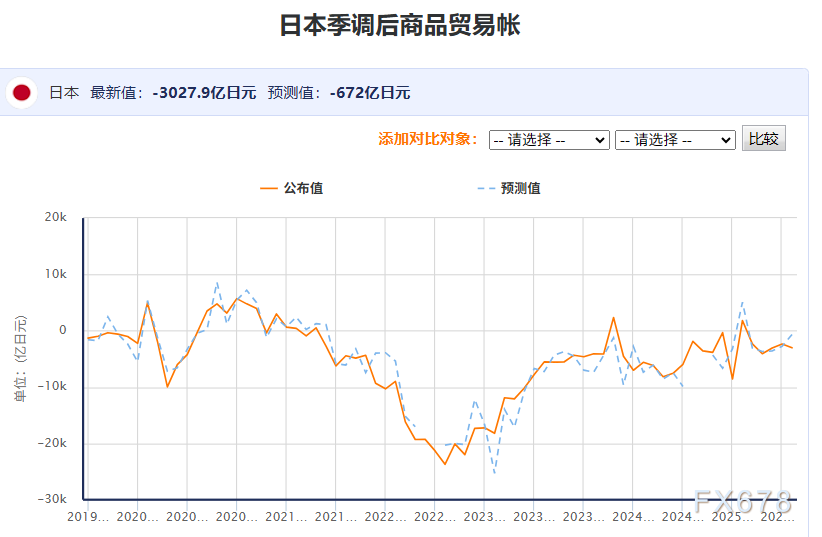
(In the past five months, the export commodity trade has been below the zero axis, with the only one exceeding the zero axis being due to tariff background competition for exports. Source: Network)
The overall business of the enterprise has improved, but there are significant differences between industries
The August PMI data for Japan shows that business for Japanese companies (mainly private enterprises) improved in the middle of the third quarter, with the fastest expansion rate since February. This is mainly due to the recovery of factory production, while the service industry also maintains a good expansion momentum: factory output has increased for the second time in three months, and although the service industry has expanded slightly slower than last month, it is still steadily developing.
Overall, the newly received business volume has grown the fastest in the past six months, but there are significant differences among different industries: only the new orders in the service industry are increasing, which is the only driving force for growth; The new orders in the manufacturing industry are still decreasing, but the magnitude of the decrease is smaller than in July. It should be noted that foreign demand for Japanese goods and services has been declining for five consecutive months, with a significant decrease in export orders for both factory products and services. This indicates that current economic growth is mainly supported by domestic demand.
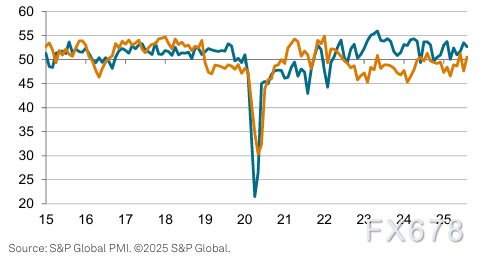
(Trend chart of Japan's comprehensive PMI and manufacturing PMI, with manufacturing PMI in orange)
Enterprise costs are rising rapidly, but prices are rising slowly, making it even harder to make money
In August, the company's costs (such as purchasing raw materials, paying wages, etc.)decodeforeign exchangeThe costs of fuel and transportation are rising faster and faster, although the increase is lower than the historical average, the growth rate is significantly accelerating, with the main reasons being the rise in raw material, labor, fuel, and transportation costs.
Looking at different industries, the cost increase rate of the service industry has been faster than that of the manufacturing industry in the first half of the year, and this situation of different cost pressures in different industries is still ongoing. In sharp contrast to the rapid increase in costs, the selling price of enterprise products or services has risen more slowly for two consecutive months, with the increase in August being the lowest since October 2024. Due to intense market competition and customer demands for discounts, companies are unable to arbitrarily increase prices. Costs rise rapidly while prices rise slowly, which means that the company's profit margin will be further compressed and making it harder to make money.
Enterprises are not very willing to hire people, but they cannot fulfill all orders and have average confidence in the future
The company is still quite cautious in recruiting, and only hired a little more people in August; However, at the same time, the number of unfinished orders is increasing at the fastest rate since June 2023, indicating that the company's production capacity is somewhat unable to keep up with demand, resulting in a mismatch between supply and demand. For the business prospects for the next year, the optimism level of enterprises in August is slightly higher than that in July, but still lower than the average level in the past. This indicates that in the face of uncertainty in both domestic and international demand, companies are still cautious about whether growth can be sustained.
Expert interpretation
Annabelle Fides, Deputy Director of Global Market Intelligence and Economics at S&P, said, "The August data shows that the overall growth momentum of enterprises has rebounded, and the output growth rate is the highest in six months, especially with the expansion of manufacturing and service industries. This is worth noting. However, the sales volume of manufacturing has been declining, which reminds us that if demand does not actually improve in the short term, the production recovery of manufacturing may be difficult to sustain." "The current growth mainly relies on domestic demand, and the situation of weak foreign demand has not changed. Cost increases are accelerating, and enterprises cannot correspondingly increase prices. This dual pressure will further compress the profit margin of enterprises, and this issue needs to be focused on
Japan's exports to Europe are showing a downward trend. In July 2025, Japan's exports to the European Union fell by 3.4%, with steel exports plummeting by 53.1%. This may be due to some problems faced by Europe's own economic development, such as major economies like Germany and Italy experiencing setbacks in exports in the second quarter, which slowed down the overall economic growth of the eurozone and reduced demand for Japanese goods in the European market. Meanwhile, factors such as trade protectionism and tariff policies may also affect the competitiveness of Japanese goods in the European market, leading to a decrease in export volume. The market is closely monitoring the sustainability of the European economic recovery.
The performance of the US dollar against the Japanese yen today may also confirm the hidden economic recovery risks in Japan's PMI data from the test surface. Against the backdrop of the global stock market crash, traders can observe the PMI situation of the United States and European countries released after Thursday to examine the follow-up of the global economic recovery fundamentals. At the same time, they need to consider the changes in the value of the US dollar against the Japanese yen, which may lead to domestic exchange settlement and liquidity changes in Japan, and jointly judge the sustainability of the stock market.
Before breaking through 149.043, the US dollar against the Japanese yen tended to fluctuate downwards.
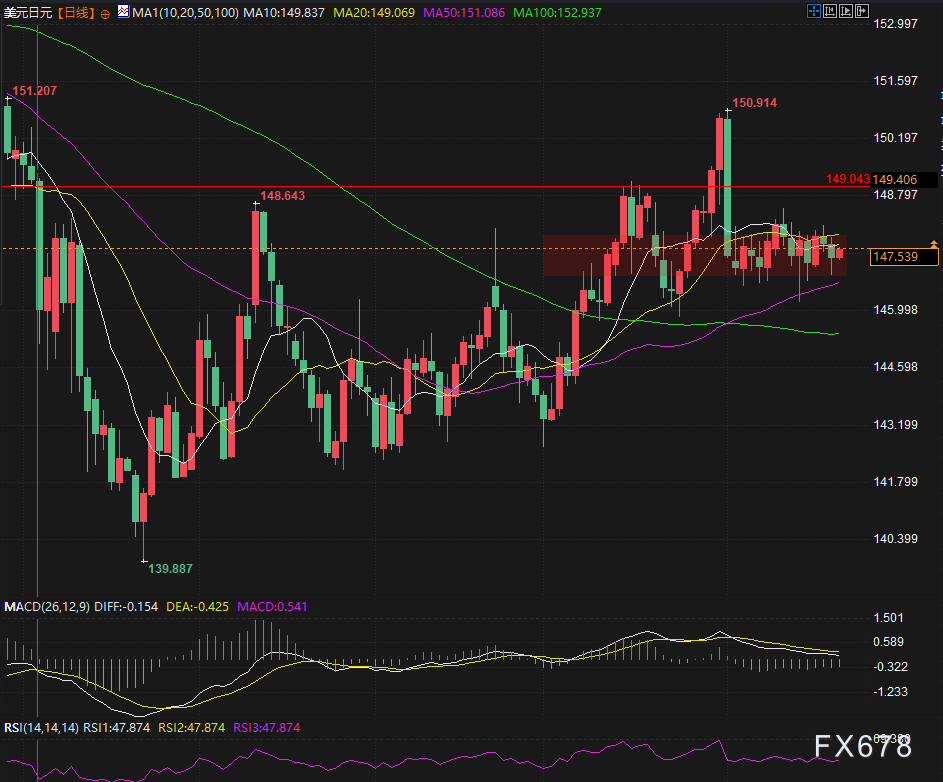
(Daily chart of USD/JPY, source: Online)
At 15:35 Beijing time, the US dollar is currently trading at 147.54/55 against the Japanese yen.
Please indicate the source when reprinting: https://www.daoctech.com/fxschool/5281.html
Disclaimer: The content of this article does not represent the views of the Institute of Foreign Exchange. The content is for reference only and does not constitute investment advice. Investors operate accordingly at their own risk.