
The Bank of Japan's interest rate hike this month is expected to send Japanese bond yields soaring, and the weakness of the yen is waiting for signs
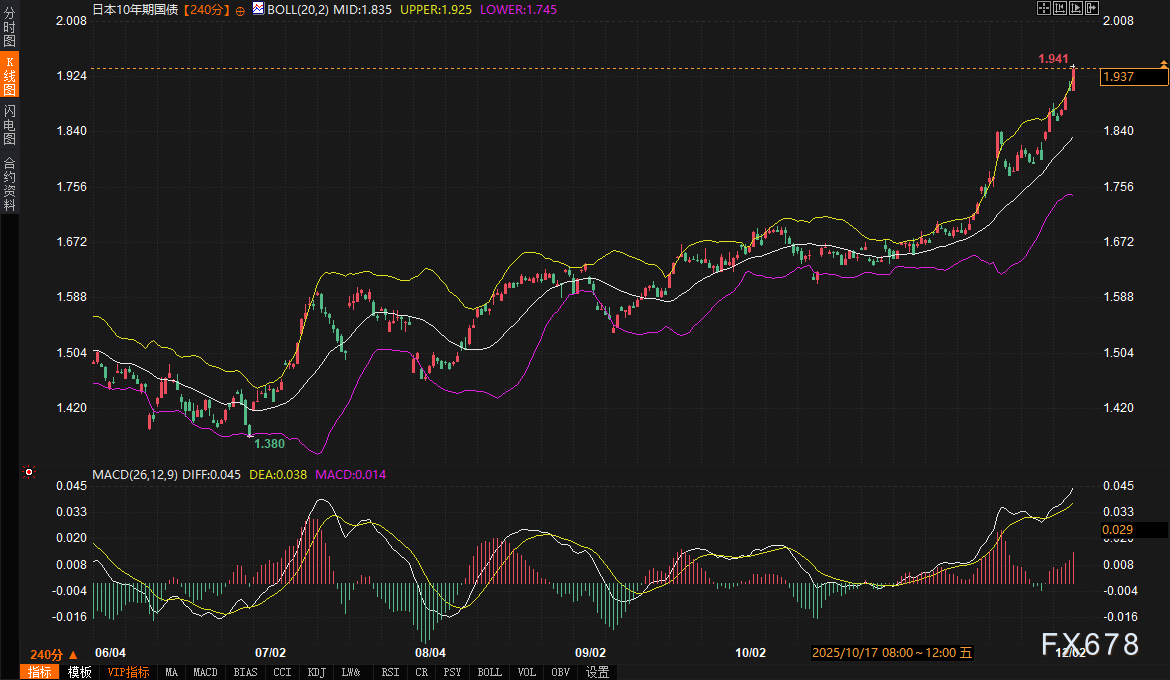
Japan's financial marekt was in the global spotlight during the Asian and European trading session on Thursday (December 4). The dollar rattled and came under pressure against the yen near the 155 mark, and the 240-minute chart showed prices running below the key moving average, currently trading near 154.889. Meanwhile, the Japanese government bond market experienced a violent long-short game, with the 10-year bond yield soaring to 1.935% at one point, the highest since July 2007, and finally closing at 1.935%, rising 4.5 basis points throughout the day. The central driver of the market's aberration was an in-depth report on the Bank of Japan's relationship with the government, which all but set the agenda for a December rate hike and put the long-term communication dilemma facing policymakers on the front burner. In such a complex market environment, traders who follow platforms such as XM Forex are also keeping a close eye on exchange rate movements.
December Interest Rates: From Political Games to Market Pricing
The latest developments suggest that Kazuo Ueda, governor of the Bank of Japan, has managed to win support for a rate rise this month from Sayo Takaichi, prime minister, by highlighting inflation risks and the economic threat posed by a weak yen. This crucial shift in politics is crucial. Remember that as recently as last year, the prime minister of Takaichi publicly criticized raising interest rates as "stupid". Now, the finance minister's public statement also shows that the government will not stand in the way of raising interest rates this month, effectively removing the last political obstacle to policy action.
The market reaction was swift and thorough. Market data for overnight index swaps (OIS) showed that traders' expectations of a 25 basis point to 0.75 per cent rate rise at the Bank of Japan's December 18-19 policy meeting had surged to more than 91.5 per cent. The pricing fully reflects the consensus that "a rate hike is a foregone conclusion". For the yen, this expectation should have constituted strong short-term support as it would narrow the huge interest rate gap between Japan and the United States. However, the dollar did not rise unilaterally against the yen, but instead showed a volatile pattern, which revealed a deeper market suspicion: the focus of the market has quickly shifted from "whether to raise interest rates" to "what to do after the rate hike".
The December rate rise itself is no longer critical, says the head of interest rate strategy at a well-known institution. What is more challenging is how the Bank of Japan will communicate the future path of interest rates. There is a lack of consensus within the central bank on the level of neutral interest rates, and government economic advisers tend to stay put for a long time after raising interest rates to 0.75%. This "ambiguity" of the policy outlook has restrained the strong rebound of the yen on the expectation of a single rate hike, making the exchange rate move more dependent on the forward signals released by the central bank in meeting statements and governor's press conferences.
Japanese bond market: stress testing and technical targets on the yield curve
Under the impact of clear interest rate hike expectations, the Japanese government bond market came under tremendous selling pressure and staged a classic "sell the facts" market. Ten-year government bond futures fell 0.34 points during the day to close at 134.11, and fell to a low of 134.08 during the session. On the spot bond side, the 10-year benchmark yield easily broke through the important psychological level of 1.90% and moved towards the key level of 2.00%.
Details of intraday trading shed light on the evolution of sentiment. The yield curve steepened in early trading, with yields across maturities rising broadly in preparation for the auction later in the day for the renewal of 30-year Treasuries. However, the auction results were unusually strong, with a bid multiple of 4.04, well above previous and recent averages, showing that ultra-long maturities remain attractive to some investors. This flattened the curve for a while and led to a brief recovery in futures prices.
But the good times did not last long, and the rebound was only short-lived. The official accounts mentioned in the report quickly sold 20- and 30-year bonds after the auction, superimposing the persistent selling pressure on 10-year bonds, which eventually pushed the 10-year yield back above 1.90% and hit an intraday high. Traders from Japanese brokerages observed a key market sentiment: many clients were comfortably holding short positions in futures, waiting for the 10-year yield to hit 2.00%. This view is supported by activity in the options market: yesterday, call-over prices at 133.50 and 133.25 (corresponding to falling futures prices) increased the number of unpositioned squaring contracts, which clearly reflects that some market participants are betting or hedging the risk of further upward yields (futures prices falling).
Technical and key interval forecasts:
Reference contract: Japanese 10-year Treasury futures (main contract).
Support/Resistance Logic: The core logic of the current market is to test the 2.00% yield (corresponding to the key support area for futures prices). If the ten-year yield effectively breaks through and stands above 2.00%, it may open up further upside space, and the next key psychological level will look at the 2.10% -2.20% area. The initial support below is located near 1.90%, but considering that interest rate hike expectations have been fully digested, this position may have limited support before the policy meeting. More solid support needs to be traced back to the 1.80% -1.85% area in the early trading intensive area.
Intraday focus: Pay close attention to the Bank of Japan's regular meetings with market participants before the meeting (the material lists the December 8-9 meeting). Any hint of a long-term policy path may cause sharp market fluctuations. In addition, external events such as US non-farm payrolls data may indirectly interfere with the trend of Japanese bonds by affecting US bond yields.
USD/JPY: The movement between interest rate expectations and risk aversion
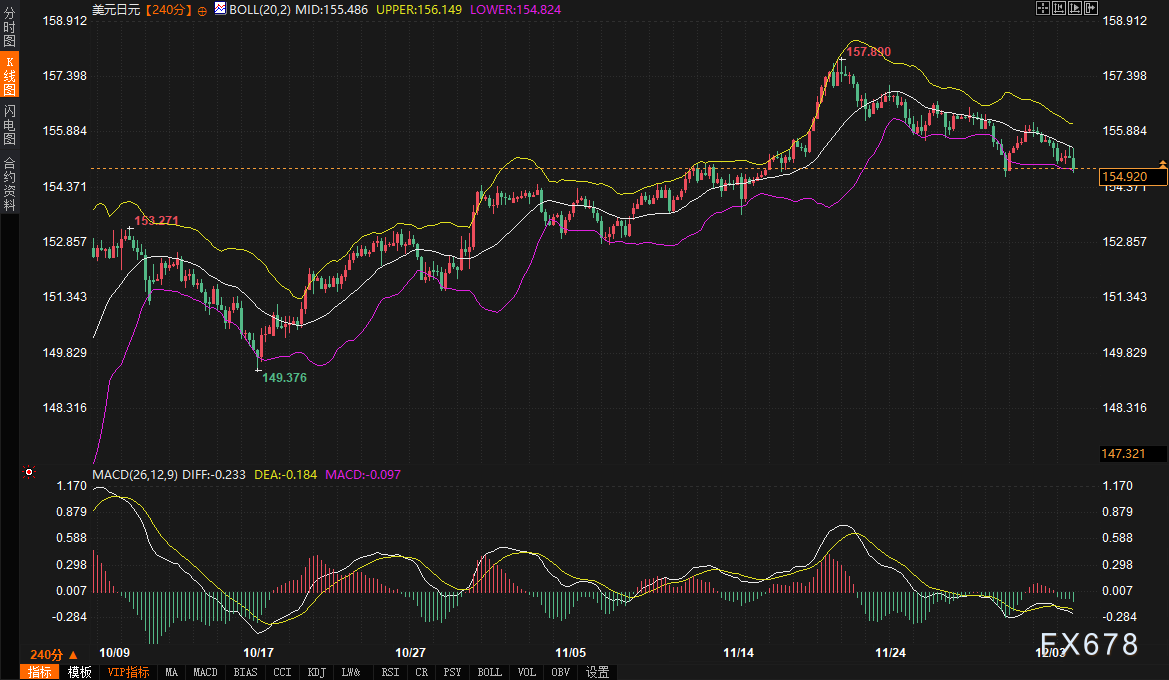
The technical chart of USD/JPY clearly reflects the current market hesitation. On the 240-minute chart, the price is currently running below the middle Bollinger Band (155.485) and the lower Bollinger Band (154.818) is close at hand, indicating short-term momentum. In the MACD indicator, both the DIFF and DEA lines are located below the zero axis, and the DIFF is below the DEA, further confirming the short-term downward pressure.
Fundamentals and technologies interact in a complex manner here.
1. Interest rate spread narrowing expectations: The Bank of Japan's interest rate hike outlook will theoretically continue to provide structural support for the yen, limiting the upside of the dollar against the yen.
2. Constraints on path ambiguity: As mentioned earlier, the central bank's "vague" communication on the path of future interest rate hikes limits the immediate appreciation momentum of the yen. The market needs a clearer tightening roadmap to drive the yen's trend strength.
3. External risk sentiment: The global market environment, especially former US President Donald Trump's recent tariff remarks, may trigger risk aversion. Under the traditional risk aversion model, the yen may be supported by buying, which adds additional downside risks to the dollar against the yen.
4. Risk of intervention by the Japanese authorities: The exchange rate level remains a sensitive issue. If the yen strengthens too much due to the expectation of interest rate hikes, it may cause the Ministry of Finance to worry; conversely, if it weakens sharply again due to the ambiguity of the path, the shadow of intervention will re-hang over the market. This makes the 155-158 range a policy sensitive area.
Technical and key interval forecasts:
Reference contract: USD/JPY spot rate.
Support/Resistance Logic: The important short-term resistance range is 155.50-156, which brings together the Bollinger Band mid-track and the early long-short contention level. If it breaks through, it may test the 156.50-157 area. On the downside, 154.50-154 is the key support range in the near future, which not only includes the lower Bollinger Band track, but also the low area of multiple previous pullbacks. If the Bank of Japan releases more hawkish forward guidance than expected after the December meeting, the exchange rate may test the stronger support band of 153.00-153. 50.
Intraday concerns: In addition to the various communications of the Bank of Japan, it is necessary to pay close attention to any news about the position of Japanese Ministry of Finance officials on the exchange rate level. In addition, fluctuations in US Treasury yields will directly affect the currency pair through the US-Japan interest rate differential channel.
Future Outlook: Caution and Choices Before the Policy Conference
Looking ahead to the Bank of Japan's policy meeting on December 19, the market will enter a period of "news-sensitive" volatility. The 2.00% challenge to the yield of 10-year Japanese government bonds has become a technical target under the market consensus, and this process may be accompanied by further pressure on the futures price of government bonds. The dollar-yen exchange rate is more likely to fluctuate widely in a range, with the upside subject to Japan's upcoming interest rate hike cycle and the downside limited by the uncertainty of its tightening path.
The true direction of the trend will depend on the "future playbook" given by the Bank of Japan at the meeting. If Governor Ueda can clearly convey his determination to continue and gradually raise interest rates, even without a specific timetable, it will inject new upward momentum into the yen and may prompt the yield curve to rise in a steeper manner. Conversely, if the communication emphasizes caution about the economic recovery, or hints that a long observation period will enter, it may be regarded as a "dovish interest rate hike", which may lead to the yen to give up its gains, and the upward momentum of Japanese bond yields may also be temporarily blocked. At such policy turning points, traders using tools such as XM Forex need to pay close attention to changes in central bank signals.
In short, the market is on the eve of a crucial policy juncture. The December rate hike itself is set and priced in, and the narrative surrounding the decision's "antecedents" (political games) and "consequences" (long-term path) is dominating every bout of volatility in Japan's equity, debt and foreign exchange markets. Investors need to buckle up for the storm that President Ueda may unleash at his press conference.
Please indicate the source: https://www.daoctech.com/fxnews/2369.html
Disclaimer: The content of this article does not represent the views of the Institute of Foreign Exchange. The content is for reference only and does not constitute investment advice. Investors operate accordingly at their own risk.