
The falling stock market and expectations of interest rate cuts have helped gold rebound by more than 2%.
In the Asian session on Friday, spot gold showed a volatile upward trend, with prices currently fluctuating around $4,880 an ounce, an increase of about 2.2% during the day. The shift in market risk sentiment revealed by the collective pullback of global stock markets has prompted funds to flow to traditional safe-haven assets, providing support for gold. In addition, signs of weakness in the US labor market have strengthened market expectations that the Federal Reserve will cut interest rates further in 2026, which has supported the interest-free asset gold.
At the same time, the White House said that diplomacy remains the first choice for dealing with related issues, but warned that the situation remains uncertain, which makes geopolitical risks persist, further strengthening the safe-haven demand for gold.
However, market expectations that the incoming Federal Reserve chairperson may take a relatively less dovish stance have helped the dollar maintain its recent high after rebounding from four-year lows, limiting gold's upside.
Safe-haven demand and interest rate cuts are expected to counterbalance the strength of the US dollar, causing gold bulls to rebound
Asian stocks fell for a second day in a row as a global tech sell-off added to Wall Street's slide, and the prospect of US interest rate cuts helped gold, an interest-free asset, rebound.
According to the Chicago Mercantile Exchange's FedWatch tool,StoneTraders are betting that the Federal Reserve will deliver at least two 25 basis point rate cuts in 2026. This week's US data confirmed the weakness in the labour market, further strengthening those expectations.
The Automated Data Processing Corporation (ADP) Research Institute reported Wednesday that private sector employment rose by just 22,000 in January, a significant decline from the previous month's downgraded 37,000 and well below market expectations for 48,000 growth.
Separately, data from the Job Vacancies and Labour Mobility Survey (JOLTS), released on Thursday, showed that the number of vacancies on the last working day of December was 6.542 million, down from a revised 6.928 million the month before.
The Labor Department also reported that the number of initial jobless claims for the week ended January 31 rose to 231,000 from the 209,000 last week, which was also higher than the 212,000 expected by the market.
Separately, US President Donald Trump said on Thursday that he would not nominate Kevin Warsh as chairperson of the Federal Reserve if he had expressed a desire to raise interest rates, adding that there was little doubt of a rate cut.
Carolyn Levitt, White House press secretary, said diplomacy was the preferred option as markets waited to see whether a deal could be reached in Friday's high-stakes talks amid divergent agendas, keeping geopolitical risks simmering.
Later on Friday, institutional traders such as Sparkstone will look for guidance from preliminary data on the University of Michigan consumer confidence index and inflation expectations, which, together with speeches from key Federal Reserve officials, will affect demand for the dollar and the price of gold.
Gold is stuck in a range of 50 and 200 cycle moving averages on the 4-hour chart
Overnight gold prices failed to extend the momentum above the 50-cycle moving average on the 4-hour chart, which is good for bearish traders. However, the subsequent decline is strongly supported near the 200-cycle moving average, so some caution is required.
At the same time, the 50-cycle moving average is still above the 200-cycle moving average, and the latter continues to rise, forming a complex technical background that keeps gold prices volatile in the general trend upward pattern.
The Moving Average Convergence Divergence Index (MACD) line remains below the signal line near the zero axis, and its bar chart is negative but contracting, indicating that bearish momentum is weakening; while the Relative Strength Index (RSI) is slightly below the midline level, suggesting insufficient upward action. If the closing price can return above the 50-period moving average, the short-term trend will be improved, and this level will constitute preliminary resistance; conversely, if it cannot stabilize, it may fall to the 200-period moving average, which will act as a dynamic support.
If the MACD can recover above the signal line and enter the positive area, while the RSI breaks through the 50-point line, it will strengthen the rebound momentum; otherwise, the momentum will remain limited, and the price of gold may continue to oscillate between the two moving averages.
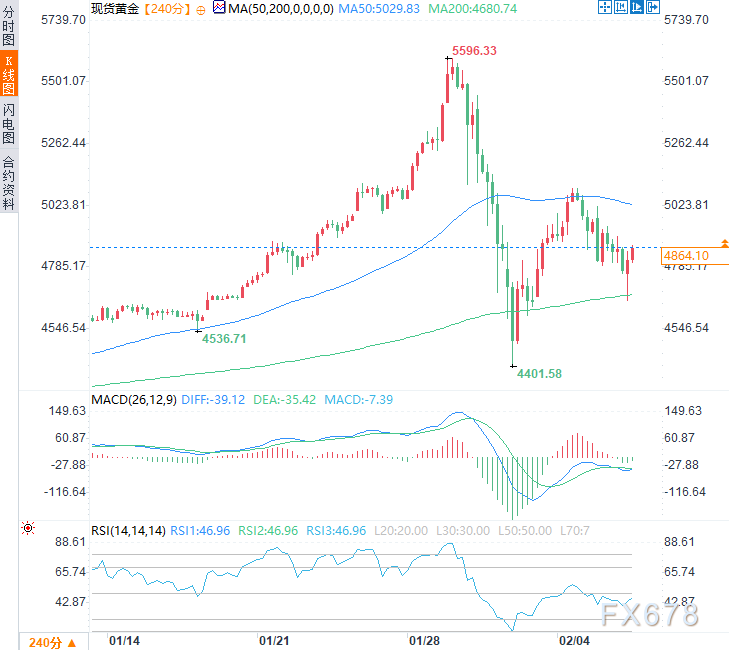
(4-Hour chart of spot gold, source: Internet)
At 14:06 Beijing time, spot gold was quoted at $4,878.73 per ounce.
Please indicate the source: https://www.daoctech.com/fxnews/2511.html
Disclaimer: The content of this article does not represent the views of the Institute of Foreign Exchange. The content is for reference only and does not constitute investment advice. Investors operate accordingly at their own risk.