
The crude oil risk premium decreases, and the price may be adjusted downwards at the end of the year
On Monday (October 20), crude oil prices fell again by about 0.7% during the session after falling for three consecutive weeks. At present, the supply and demand contradiction between global production continues to grow and the economic growth rate has slowed down, which has put some pressure on oil prices. In addition, the risk premium related to the signing of the Middle East agreement has gradually weakened, and the market expectation of easing geopolitical tensions is also rising. These factors have combined to promote the risk premium to start to decline. At the same time, the current oil price has not entered the oversold area, which means that there is still room for further decline in the coming months.
Baker Hughes reported on Friday that the number of oil rigs in operation in the US was 418, the same as a week ago, breaking a recovery since August. However, the US is responding by continuing to improve production efficiency, with increased production of single wells.TickmillAnalysts pointed out that the steady number of rigs but the improvement in production efficiency reflect the inherent pace of adjustment in the industry.
According to statistics from relevant agencies, offshore crude oil inventories are currently close to 1.20 billion barrels, setting a new high since the peak in 2020. Looking back at 2020, US oil production is at a record high, and Saudi Arabia and Russia have emphasized their respective production potential in order to compete for market share. The current market pattern is similar to the situation more than five years ago. The latest weekly data shows that US crude oil production has reached a record high of 13.64 million barrels per day.
Inventory data is one of the important stabilizers for oil prices today. US commercial crude inventories are near the lower end of the range of the past decade, but they were at a similar level in January 2020. Just six months later, the data set a new record. However, without a sharp contraction on the consumer side, such a rapid increase in inventories is not expected. In addition, the US government may also take more aggressive action to replenish the strategic petroleum reserve sold in 2022.
Oil prices have been on a downward path for more than three years. The pace of decline accelerated at the end of September as prices approached their 50-week moving average and the upper end of the range. The lower end of the Brent range is now near $53 a barrel; at current prices of $61 a barrel, oil prices could fall to around $50.50 a barrel by the end of the year. Tickmill believes that the main trend of oil prices in the next two to four months is expected to fall to around $50 a barrel.
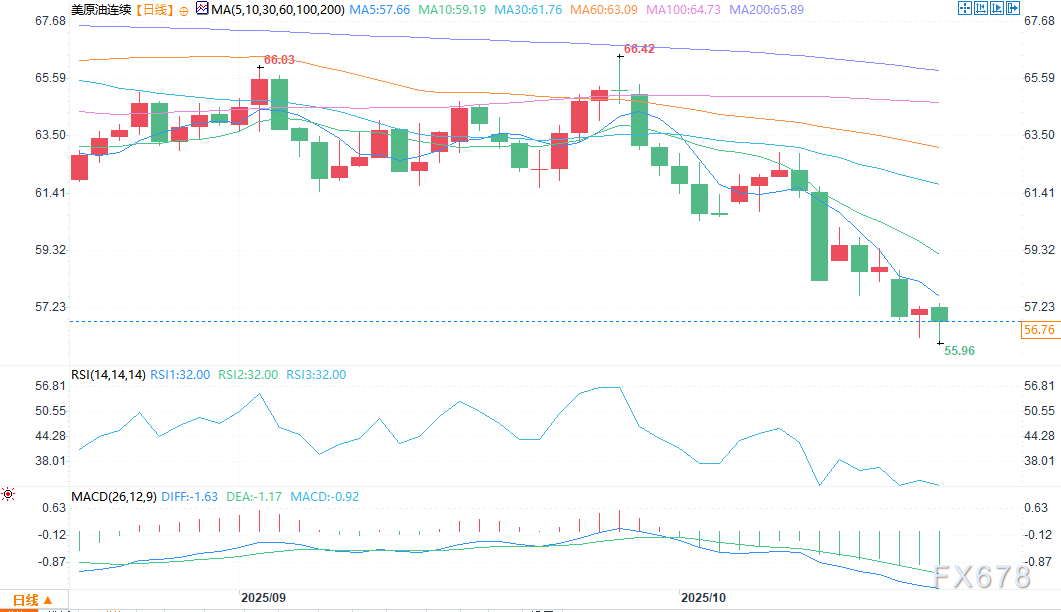
(WTI crude oil daily chart, source: Internet)
Meanwhile, the potential for a build-up in US crude inventories is a potential stabilising factor for the market, which is broadly similar in the rest of the world except for a glut in offshore crude inventories. Market participants are closely monitoring changes in supply and demand to gauge subsequent price movements.
Please indicate the source: https://www.daoctech.com/fxnews/2611.html
Disclaimer: The content of this article does not represent the views of the Institute of Foreign Exchange. The content is for reference only and does not constitute investment advice. Investors operate accordingly at their own risk.