
Traders' secrets to breaking out of the cycle of "small profits and big losses"
Many traders will always experience a "small profit and big loss" stage when entering the market. The performance of the capital curve at this stage is also a small rise and a sharp fall, and even worse, it will fall all the way without any signs of rebound.So how to get through such a frustrating stage? How to break the strange phenomenon of funds being exhausted in "small profits and big losses"? Maybe from the perspective of position management can give you some inspiration.
Position management is also generally referred to as "money management". Although this proxy is not rigorous, it can be used in many cases in the trading circle. So what is position management? As the name suggests, it is to manage the positions in your hands.The maximum number of positions your account can support is your full position, and the ratio of the number of positions you actually hold to the number of full positions is the so-called position ratio.In Baidu Encyclopedia, the definition of this is: in a risk market, risk is controlled by limiting the proportion of capital invested in a single investment.
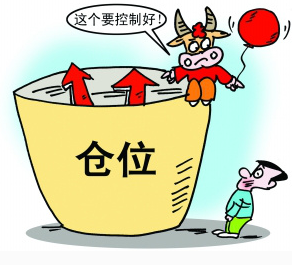
Through the above statement, everyone should have a more accurate understanding of "position management".Now we will explain how to solve the problem of "small profits and big losses" from three aspects: the necessity of position management, how to manage positions, and the mentality in position management.
The importance and necessity of position management
The premise of studying position management must be that the trading methods are consistent, and one or several combinations are used to participate in the market, otherwise position management will lose its significance, which needs to be said above.The reason is very simple. Just like playing poker, the standard for each fold and raise should be the same. Otherwise, who can say for sure whether you will only make a small bet when you win, but place a large bet when you lose.
No one can accurately predict what state the market will be in at some point in the future, and what price it will be at. (Foreign Exchange Academy) Even if someone does it in the short term, it must be foolish. Don't trust anyone who claims to be able to predict the market. In this way, the uncertainty of the market is obvious to us. Since the market can never predict, is there any reason for you to spend all your money on position holding?
At this point, you may be saying, how can you make enough profits without heavy holdings?One thing you need to pay attention to is that risk and profit coexist. You amplify the possibility of pursuing profits, but at the same time, you also untie the ropes that bind risk.Especially in the novice stage, unrestrained investment without any way to guarantee a winning rate is undoubtedly one of the fastest ways to liquidate a position (there is also a common trap that leads to liquidation: no stop loss).Position management is a precaution against risk, not a means for you to chase profits.This is just like the sentence quoted by Baidu Encyclopedia at the beginning of the article. Many successful predecessors often tell us that we can only take heavy positions (such as breakouts at key points, platform breakouts, etc.) under certain circumstances, even if this is based on the premise of making stop-loss preparations in advance. After all, survival is an important support for making profits in the market.
From this, it can be seen that position management is essential in the market game. It is never wrong to invest in small positions before you cannot interpret market signals well and establish a complete trading system.Although it cannot help you get rid of "small profits" for the time being, the position management with stop losses can at least help you intercept "big losses".This is a landmark victory throughout the trading process: your money finally stops flowing out in large quantities.
How are positions managed?
If the above is the so-called "world view", then in this part we will discuss the "methodology" of position management.First of all, it is necessary to understand that position control does not solve the problem of low winning rate, it just allows traders to die slowly in order to have enough time and opportunity to capture their own market.From this, it can be seen that position management cannot be discussed alone, but should be combined with the time period, psychological tolerance, and entry and exit criteria of each individual's trade.
For example, trend traders usually don't win too much, but the profit-loss ratio is quite large. This requires strict control of positions in trend trading to reduce the cost of trial orders. Once the trial order is successful and profitable, they will continue to increase their profit-loss ratio to make up for the drawbacks of low profit-loss ratio. Short-term traders rely on high win rate and low profit-loss ratio to achieve profitability, so they need to improve their capital utilization to ensure maximum profit. Of course, short-term traders have very strict stop-loss, which reduces the risk of heavy positions on another level.
The purpose of position management is to cut losses and make profits run. To achieve this goal, some principles need to be followed:
1. Never put all your money into the market.Especially in the novice stage or in a state of "small profits and big losses" for a long time, putting all the money into the market will not only amplify the loss, but also affect the trader's mentality to a certain extent. Of course, short-term traders can try to take a heavy position when they stop their losses resolutely and the profit-loss ratio is reasonable, but they must ensure that the same standard entry is to open the same position, otherwise there is a high risk of the embarrassing situation of taking a light position when making a profit and taking a heavy position when losing.
2. It is normal to experience occasional consecutive losses in transactions. Position management must ensure that after consecutive losses, the remaining funds can still open positions of the same size.If this principle cannot be followed, it is very likely that 100 orders can be opened, but only 90 orders can be opened after several consecutive losses. It will be more difficult for 90 orders to return funds to the original level than 100 orders.
3. Have a scientific strategy for adding and reducing positions.Although trading is a game of probability from a mathematical perspective, it is by no means a static model. The ever-changing market is likely to have a market trend that allows us to increase or decrease our position after we enter the market. At this time, your win rate and profit-loss ratio are also changing, which requires your position management to include the content of adding and reducing positions.
Is there a general rule for specific position management that is accurate to the numbers? For example, the position must be opened according to the proportion of what percentage?Industrial DevelopmentWhat kind of situation should you increase or reduce your position according to the proportion of how many? Unfortunately, no! As I said at the beginning of this part, position management is designed according to the individual's entry and exit basis and psychological tolerance. Here can only provide you with a way of thinking. You need to complete the position management strategy according to your own relevant data. What data or reference items do you need to use to set your own position management strategy? I have made the following statistics here for your reference:
1. Own risk appetite.You need to determine whether you are an aggressive or conservative type, and what is your acceptable loss each time. These losses correspond to the number of stop-loss points in your trading system. The acceptable loss ratio is the amount of loss you can bear for one point. These amounts are compared to the price of a single lot per point of fluctuation, which is the number of lots you open for a single entry.
2. The winning rate of the trading method.Your position management must be determined in combination with the winning rate provided by the trading method, so as to ensure that your capital can survive the loss under the normal proportion of the number of profits and losses.
3. The risk-reward ratio of the transaction, also known as the profit-loss ratio.The winning ratio and the profit-loss ratio are a pair of twins, which I have mentioned in many previous articles. With the combination of the winning ratio and the profit-loss ratio, your position management must be able to withstand the "worst period" of trading, otherwise you will die in the night before dawn before reaching the dawn of your trading system.
Overall, position management is not an independent and static part; it is an integral part of the entire trading system.Above we only discussed the position management and related factors, but it is not to say that the trading system is just that. The entry and exit strategies and position management in the trading system complement each other, and both are indispensable.
III. Mental issues in position management
The first two parts tell everyone the "world view" and "methodology" of position management respectively, and then there is the issue of consciousness.Before the above two parts of the problem are solved, the mentality must not be well handled. If your position management has been inspired by the above parts, or has solved the previous problems, then the mentality problem is relatively easy.
The mentality that often appears in position management is nothing more than two kinds: when making money, it would have been nice if I had been able to fill the position; when losing money, it would have been nice if I had been able to try it lightly.Of course, there will also be psychological states such as do you want to increase your position? Add a position and gamble! Or do you want to reduce your position? Forget it, it's better to reduce your position and run away, but the latter is a derivative of the former.
When it comes to position management, the best state is to follow the designed management model without any subjective factors. This is easy to say, but in practice it is not so simple, so what should I do? There are no shortcuts.It is to make the position management strategy and other parts of the trading system that match it as detailed as possible, without giving yourself any room for subjective imagination.Note that this is not to let you make the trading system complicated, but to tell everyone to make the simplest trading system as fixed and careful as possible. For example, if a certain operation is based on a range, then turn the range into a definite value, or try to compress the range of the range to find the certainty in the system. Only in this way can you use the rules to firmly lock your heart. However, rules still rely on discipline to complete the implementation, so you must abide by the established discipline, even if you use your own reward and punishment mechanism.
Regarding position management, it is coming to an end. I hope you can gain some ideas on position management from this article, which will definitely be beneficial to your trading journey.Finally, I hope everyone's trading goes smoothly and the ups and downs take all.
Please indicate the source: https://www.daoctech.com/fxnews/2715.html
Disclaimer: The content of this article does not represent the views of the Institute of Foreign Exchange. The content is for reference only and does not constitute investment advice. Investors operate accordingly at their own risk.