
Gold trading reminder: the Fed to big "blood"? Triple more to provide support, gold prices four consecutive Yang approaching the 3400 mark.
In early Asian trading on Wednesday (August 6), spot gold fluctuated narrowly, and is currently trading around $3,382.02/ounce. Gold prices continued their rally on Tuesday, hitting a near two-week high of $3,390.32/ounce and closing at $3,380.65. They rose for four consecutive trading days, demonstrating strong upward momentum. This rally was not only driven by the expected increase in US interest rate cuts, but also by the Trump administration's tariff policy and the personnel changes of the Federal Reserve. From the sharp narrowing of the trade deficit to the stagnation of service sector activity to the pending key appointments of the Federal Reserve, the attractiveness of gold as a safe-haven asset is increasing significantly.
Interest rate cuts are expected to rise: Gold's safe-haven light shines brightly
The strong performance of gold prices is closely related to market expectations for the Federal Reserve's monetary policy. US employment data for June was unexpectedly weak, showing job growth was lower than expected, and data for the first two months were revised down sharply, raising concerns about an economic slowdown. According to the Chicago Mercantile Exchange's FedWatch tool, the probability of a rate cut in September has soared to 91%, and the market expects a cumulative 130 basis point cut by October 2026. Goldman Sachs forecasts that the Federal Reserve may cut interest rates three times in a row from September, each by 25 basis points, and may even cut interest rates by 50 basis points if the employment data deteriorates further.
The dollar index rallied to 99.07 on Tuesday, but eventually fell back to 98.76, showing the weakness of the rebound. The weakness of the dollar provided solid support for gold prices, attracting bargain buying and pushing gold prices against the pressure of the correction. Daniel Ghali, commodity strategist at TD Securities, said that the weak employment data and the Trump administration's decision to replace the head of the Bureau of Labor Statistics have strengthened the market's view that the dollar's value store function is weakening. As a result, gold's position as a traditional safe haven asset has been solidified, and investor demand has continued to rise.
Tariff policy shock: the dual driving force of the economy and gold prices
The US trade deficit narrowed by 16.0% to $60.20 billion in June, the lowest in two years, and the deficit with China plummeted to $9.50 billion, the smallest in 21 years. This was helped by Trump's across-the-board tariffs on imports, which led to a sharp decline in imports of consumer and industrial supplies. Exports of capital goods hit a record high, supporting US GDP growth of 3.0% in the second quarter, reversing a 0.5% contraction in Quarter 1.
However, the side effects of the tariffs are becoming apparent. The US services PMI slipped to 50.1 in July, below market expectations of 51.5, indicating that activity in the services sector was almost stagnant. Businesses reported that higher tariffs had pushed up input costs, with the price paid index in the ISM survey rising to 69.9, the highest since October 2022. The employment index slipped further to 46.4, underscoring weaker economic activity. Oren Klachkin, economist at Nationwide Financial Markets, pointed out that the negative impact of higher tariffs would outweigh any positive effects of reduced policy uncertainty.
For the gold market, inflationary pressures and economic uncertainty triggered by tariffs have further strengthened its safe-haven appeal. Investors are concerned that high tariffs could push up prices and reduce economic growth momentum, prompting capital to flow into the gold market. The Trump administration's trade friction with Canada, Germany and other countries has intensified, and global economic uncertainty has further boosted gold demand.
Federal Reserve personnel changes: Uncertainty in market bellwethers
The Federal Reserve's personnel changes have added uncertainty to the trend of gold prices. Trump announced that he will soon announce the temporary replacement of Federal Reserve Governor Kugler and consider four candidates to replace current Chairperson Powell, ruling out the possibility of Treasury Secretary Bescent taking over. Market expectations suggest that the new governor and chairperson may lean towards dovish monetary policy, which will depress the dollar and U.S. Treasury yields, providing upward momentum for gold prices.
Eugene Epstein, head of North American trading at Moneycorp, pointed out that the dovish leanings of Kugler's successor could lead to future weakness in the dollar, which is a long-term positive for gold prices. Trump's firing of the head of the Bureau of Labor Statistics and plans to announce a new person in the short term, indicating his intention to intervene in economic data, increased market volatility, prompting investors to turn to gold for safety. The market is still waiting for the core CPI data for July to be released next week, which is expected to rise 0.3% month-on-month and 3.0% year-on-year respectively. If the inflation data exceeds expectations, it will further strengthen interest rate cut expectations and push up gold prices; if inflation eases, it may put pressure on gold prices in the short term.
Future Trends: Opportunities and Risks for Gold Prices
The rally in the gold market has been driven by expectations of interest rate cuts, inflationary pressures triggered by tariffs and personnel changes at the Federal Reserve. In the short term, gold prices are expected to remain strong on the back of safe haven demand and expectations of interest rate cuts, and the recent high of $3,390/oz may be broken. However, if the US August inflation data released next week is lower than expected or the Federal Reserve personnel changes are unexpected, gold prices may face the risk of a correction. In the long run, global economic uncertainty and geopolitical risks will continue to support gold,Forex PlatformTrump's trade policy and the direction of the Federal Reserve's monetary policy will be key variables. Investors need to pay close attention to expected changes in CPI data, the progress of trade negotiations and the appointment of the Federal Reserve, and pay attention to the speeches of Federal Reserve officials to seize investment opportunities in the gold market.
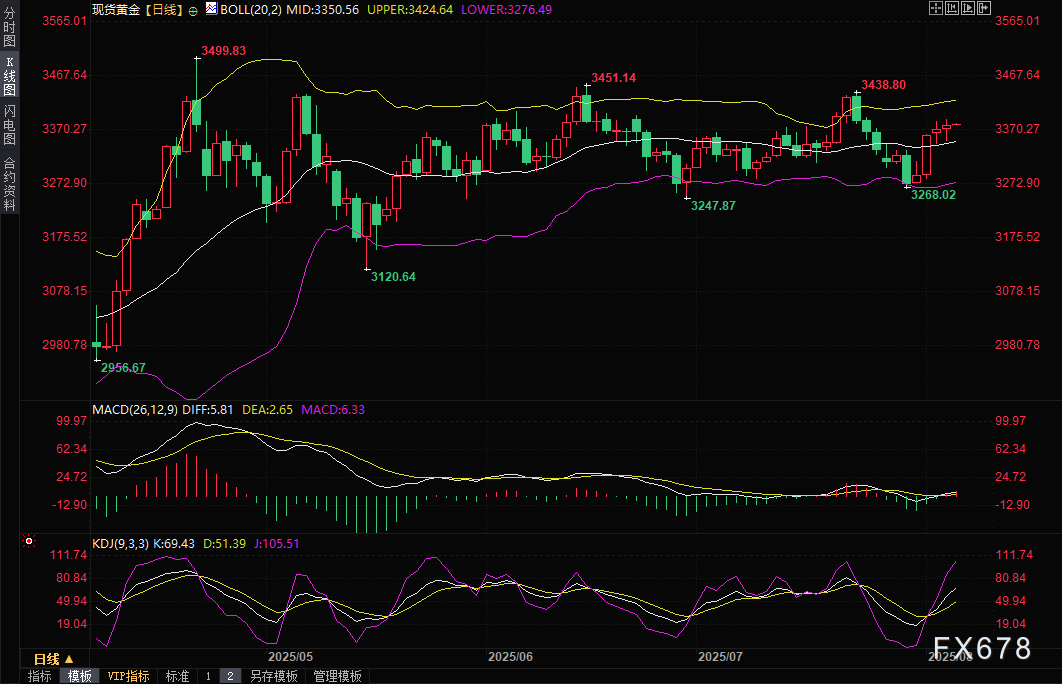
(Daily chart of spot gold, source: Internet)
Beijing time 07:45, spot gold is now quoted at $3382.47/ounce
Please indicate the source: https://www.daoctech.com/fxnews/2726.html
Disclaimer: The content of this article does not represent the views of the Institute of Foreign Exchange. The content is for reference only and does not constitute investment advice. Investors operate accordingly at their own risk.