
Gold trading reminder: US CPI hits this week, multiple positive or help gold prices overcome the 3600 mark?
In 2025, when the global economy is in flux, gold, as a traditional safe-haven asset, is ushering in an unprecedented feast. Driven by multiple factors such as weak US employment data, escalating geopolitical tensions and continued central bank holdings, spot gold prices have approached the historical mark of $3,600 per ounce, and have risen by as much as 37% so far this year. This round of strong gold prices not only reflects the strong market expectations for the Federal Reserve's monetary policy shift, but also highlights investors' risk-aversion under the heightened uncertainty. In early Asian trading on Monday (September 8), spot gold fluctuated at a narrow range at a high level, and is currently trading around $3,593.08 per ounce.
U.S. job weakness deepens, interest rate cut bets push gold prices higher
The August jobs report in the United States was undoubtedly the catalyst for this round of gold prices. The data showed that non-farm payrolls rose by only 22,000, well below the 75,000 economists had expected, while the unemployment rate rose to 4.3%, confirming the continued weakness in the labor market. Manufacturing jobs fell for four consecutive months, sounding the alarm.
Such data has sharply increased market expectations for the Federal Reserve to cut interest rates in September, with traders currently betting that the probability of a 25 basis point cut is as high as 90%, while the probability of a 50 basis point cut rises to 10%.
Tai Wong, an independent metals trader, pointed out that this trend will translate into multiple interest rate cuts, driving the bullish outlook for gold as a non-yielding asset at a time when labour market concerns are overwhelming inflationary pressures.
Meanwhile, this logic has been reinforced by the plunge in US Treasury yields. The two-year yield fell to 3.513 per cent and the 10-year yield to 4.088 per cent, the lowest in months. This not only reflects the market's pricing of Fed easing, but also causes the yield curve to steepen, with the two-year versus 10-year spread widening to nearly 60 basis points. The steep curve suggests investors expect short-term rate cuts to stimulate the economy, but if the Fed acts too aggressively, long-end yields could rebound on inflation fears.
Weakness in the dollar has also followed, with the dollar index closing 0.58% lower on Friday at a low of 97.71, directly lowering the opportunity cost of holding gold and further boosting the price of gold. Analysts believe this combination of monetary policy softening and economic uncertainty is the core driver of gold's 37% surge this year. After the 27% increase in 2024, gold's bull market is in full swing.
As geopolitical storms escalate, safe-haven demand becomes a new engine for gold
In addition to domestic economic factors in the United States, international geopolitical turmoil has also provided strong support for gold. US President Donald Trump said on Sunday that he was ready to launch a "second phase of sanctions" against Russia, which could involve pressure on oil trade and even the imposition of secondary tariffs on countries that buy Russian oil. The move is designed to push the Russian economy to the brink of collapse and force Putin back to the negotiating table. Although Trump had previously refrained from taking concrete action to promote peace talks, the tough statement added to the tensions in the conflict in Ukraine.
On the same day, Russia launched its largest airstrike since the start of the war, which devastated many parts of Ukraine, including the government building in central Kiev, killing at least four people, including an infant. President Zelensky condemned the move as a deliberate crime and called on allies to step up air defense assistance, while the U.S. envoy to Ukraine said it was not a signal of an end to the conflict.
The events amplified global uncertainty as investors sought refuge in gold, with Russian airstrikes not only damaging Ukraine's infrastructure but also stoking gloom among allies, with European countries vowing support but aid packages still hanging in the balance.
At the same time, the sudden resignation of Japanese Prime Minister Shigeru Ishiba has also added to the uncertainty. The departure of the 68-year-old leader could lead to policy paralysis in Japan, with the election of the LDP president looming, the new leadership may pursue looser fiscal policy, and further pressure on the yen and long-end Japanese government bonds.PepperstoneSenior analyst Michael Brown warned that this would pose significant downside risks and delay the Bank of Japan's tightening cycle. In this context, gold's safe-haven properties have been infinitely magnified, and the combination of geopolitical risks and economic uncertainties has made gold prices record highs and become the first choice for investors in troubled times.
The central bank increases its holdings of gold, and the fundamental support is unbreakable
Another pillar of gold's rise has come from continued central bank buying. The latest data from the People's Bank of China shows that gold reserves reached 74.02 million ounces at the end of August, an increase of 60,000 ounces from the end of July, which is the 10th consecutive month of increase. Such actions reflect not only emerging market countries' preference for gold, but also global central banks' protection against dollar hegemony and geopolitical risks. Combined with the independence of the US Federal Reserve - Trump's attempts to fire governors and pressure interest rate cuts - gold's value as a hedge has become increasingly apparent. Analyst Adrian Day pointed out that continued central bank buying, coupled with new buying from loose monetary policy, has pushed gold through key resistance levels.
From a broader perspective, gold's fundamentals are exceptionally strong. Non-yielding gold has stood out in an environment of low interest rates and high uncertainty. Spot gold closed at $3,587.30 on Friday, up 4% weekly, its biggest weekly gain in nearly four months. The previous refreshed all-time high of $3,599.91 is just a step away from the $3,600 mark. This rally is not a flash in the pan, but is based on a solid foundation of multiple factors, including the weakness of the dollar and expectations of a global economic slowdown.
Wall Street is collectively bullish, and ordinary investors' confidence is bursting
Wall Street's enthusiasm for gold is at its peak. According to Kitco News' weekly gold survey, 78% of 18 analysts expect gold prices to rise in the coming week, while only 17% are bearish.
Colin Cieszynski, chief market strategist at SIA Wealth Management, believes that the weak employment data will weigh on yields and the dollar, opening the door for gold to rise. James Stanley, senior strategist at Forex, stressed that it is pointless to question the trend at this stage, and the pullback is expected to be shallow. Even if a few bearish voices, such as Michael Brown of Pepperstone, point to the risk of a short-term pullback, most see it as a buying opportunity. Ordinary investors are equally optimistic, with 73% of Kitco's online poll bullish on gold, reflecting confidence that inflation is back in the spotlight.
The economic data in the coming week will be crucial. Wednesday's producer price index (PPI) is expected to fall, Thursday's European Central Bank meeting and the US consumer price index (CPI) will be the focus, the overall CPI is expected to rise 2.9% year-on-year. Friday's University of Michigan consumer < confidence survey will also focus on inflation. If core inflation is lower than expected, the probability of subsequent interest rate cuts by the Federal Reserve will increase. Marc Chandler of Bannockburn cautioned that the market's sentiment towards interest rate cuts has reached its limit. If CPI rises slightly, gold prices may be cautious for a while, but the overall bull market pattern remains unchanged.
To sum up, this round of gold's surge has benefited from the multiple forces of the weak US economy, geopolitical escalation and central bank support. Gold's approach to the $3,600 mark is not the end, but the beginning of a new chapter. Looking ahead, with the Federal Reserve's September meeting approaching and inflation data coming out, there is still plenty of room for gold's bull market, but it is necessary to be vigilant of short-term correction risks. Investors should pay close attention to policy trends and seize gold opportunities in the midst of uncertainty.
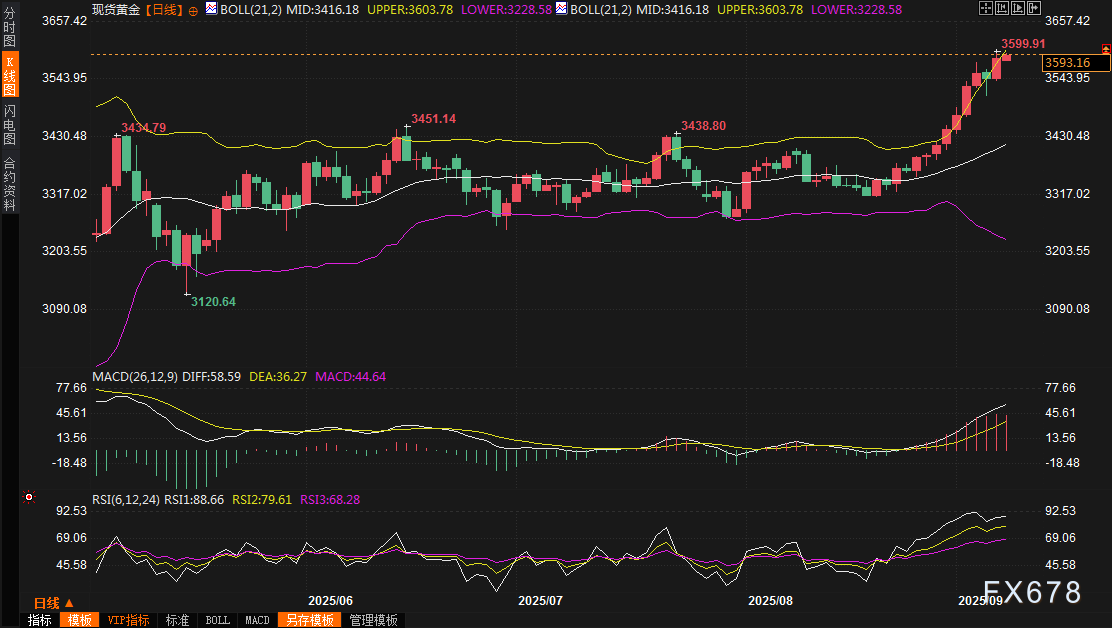
(Daily chart of spot gold, source: Internet)
At 07:52 Beijing time, spot gold was quoted at $3593.32 per ounce.
Please indicate the source: https://www.daoctech.com/fxoutrade/1750.html
Disclaimer: The content of this article does not represent the views of the Institute of Foreign Exchange. The content is for reference only and does not constitute investment advice. Investors operate accordingly at their own risk.