
Above the Track, Direction Undecided: Sterling Long and Powell's Ultimatum
On Tuesday (September 23), before the US market, the pound against the dollar was tested back and forth at 1.3500-1.3520, and the short-term volatility converged. The background is that the PMI of the United Kingdom in early September has weakened significantly and fiscal pressure has risen. After the Federal Reserve started the first 25 basis point interest rate cut of the year last week, the market is waiting for Powell's speech in North America and the initial S & P Global PMI of the United States in September to judge the relative strength of the follow-up path of the dollar and the pound.
Fundamentals: The "scissors gap" between the two ends widens - UK momentum slows, dollar pauses but does not surrender
In the UK, S & P Global data showed that the composite PMI fell to 51.0 in September, missing expectations of 52.7 and 53.5 in August. The manufacturing PMI fell to 46.2 (expected 47.0) and continued to be in contractionary territory. The services PMI fell to 51.9, below expectations of 53.5 and 54.2. Chris Williamson, chief economist at S & P Global, bluntly stated that the latest survey showed a combination of "weaker growth, lower overseas orders, lower confidence and increased job losses". The fundamental slowdown has coincided with the build-up of fiscal constraints: rising public debt and rising gilt yields have weakened growth prospects and opened up the possibility of tax increases in the November autumn budget. The latest data show that public sector net borrowing rose to £18 billion, a five-year high, a "fiscal-growth" mismatch that is structurally dragging on the pound.
At the monetary policy level, the Bank of England last week maintained its policy rate at 4% as expected, and re-emphasized the "gradual and cautious" pace of easing. For the market, this means that the Bank of England is "reluctant to bet on strong easing too early", but the weakening economy has heated up the game for further rate cuts, and the sterling spread advantage is difficult to build a certainty buffer.
On the other side of the Atlantic, the dollar has retreated in stages but it is difficult to say whether to turn. The dollar index (DXY) is currently cautiously hovering around Monday's low at around 97.30, after falling back quickly after three consecutive days of upside failed to hold above 97.85.
Last week, the Federal Reserve cut interest rates by 25bp for the first time in 2025, and pointed to "two more" rate cuts this year; several FOMC members characterized it as a "precautionary measure against the slowdown in employment", while cautioning that inflation remains above the 2% target and subsequent expansion needs to be cautious. In contrast, Governor Stephen Miran put forward a more aggressive view, arguing that the policy rate should be lowered by about "two percentage points", pointing to the appropriate range in the middle of 2%. Powell's speech in the early morning of Wednesday and the US September PMI forecast of 54.6 (released at 21:45 on Tuesday) will be the key watershed in determining whether the dollar is "repairing" or "continuing to decline". At the exchange rate level, if the dollar is only a technical retracement, the pound's rebound space will be limited; if the dollar restarts the downward band, the pound may gain a tailwind.
Technical aspects:
From the daily chart, the pound against the dollar is running close to the middle rail of the Bollinger Band (26,2). The middle rail of the Bollinger Band is about 1.3510, which almost coincides with the current price of 1.3516, and technically constitutes the "mean magnetic level". The upper and lower rail are basically level and the bandwidth is mild, suggesting that the market is consolidating in the near future, and the volatility is in a neutral contraction stage. The rebound started by the price from the low of 1.3140 did not form a sustained trend in early September. During this period, it was blocked near 1.3594. Then it rose to 1.3726 and then fell back. The previous high of 1.3788 was not rewritten, and the shape showed a slight downward wedge/upper edge of the box pressing characteristics of "high gradually moving down".
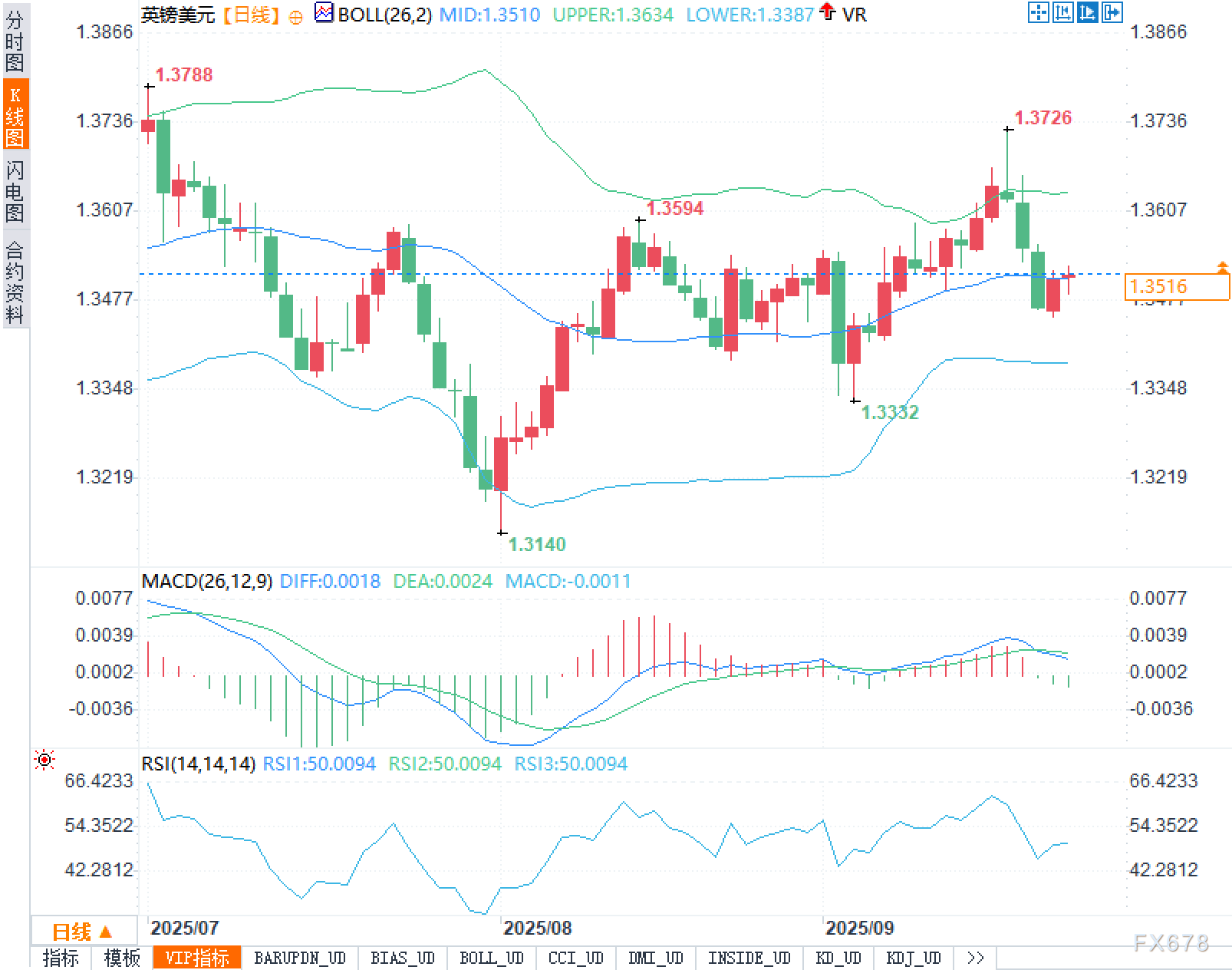
At the end of the indicator, in MACD (26, 12, 9), DIFF 0.0018, DEA 0.0024, and histogram -0.0011, that is, DIFF has slightly underpassed DEA and turned negative, showing that the short-term kinetic energy divergence and retracement pressure are still there; RSI (14) is about 50.0, located near the line of boom and bust, and the momentum is neutral but slightly weak. Comprehensive judgment: the middle rail 1.3510 becomes an immediate hub. If it stands above the middle rail, the exchange rate will challenge 1.3594 again and point to the upper resistance zone of 3726/1.3788; if it loses the gap between the middle rail and the lower Bollinger rail, pay attention to the support band of 1.3387 (near the lower Bollinger rail) and 1.3332, and further retracement still needs to guard against the key low of 1.3140. As far as the trend line and the K-line chart are concerned, the current stage is more like a game between mean reversion and box shock, unless there is an effective breakthrough in volume, it is difficult to be unilateral.
Market Sentiment Watch
The exchange rate is "caught" an inch above the Bollinger medium rail, which reflects not the consensus of direction, but the rebalancing of positions. On the one hand, the weakening of the UK PMI and fiscal constraints have cooled the "sterling bull market sentiment", and the risk premium requirements of macro funds for sterling have increased. On the other hand, although the Federal Reserve has cut interest rates, the official wording has not given a promise of "rapid easing", and the confidence margin of dollar bears is limited.
From a cross-market perspective, the rise in gilt yields means that the sterling interest rate spread has not formed a sufficient advantage, and the attractiveness of "carrying income" in the foreign exchange market is average. Powell's speech and the US PMI are the most important event risks in the near future, and the bulls and bears will respond quickly with a three-stage logic of "data-guidance-price": if the data is strong and the guidance is cautious, the market tends to "buy US dollars to cover"; if the data is weak and guides the doves, the pound may receive a "sentiment boost". Overall, the sentiment is in the shock zone of cautious optimism, rather than one-way excitement or panic.
Please indicate the source: https://www.daoctech.com/fxoutrade/1855.html
Disclaimer: The content of this article does not represent the views of the Institute of Foreign Exchange. The content is for reference only and does not constitute investment advice. Investors operate accordingly at their own risk.