
59.40 Life and death line! The oil market's multi-air dark war ushered in the ultimate judgment, and the three undercurrents behind it were about to explode
On Tuesday (November 11), during the Asia-Europe session, oil prices continued to adjust. At present, oil prices are back above the 5th line, falling by 0.52% and trading around 59.79.
Russia's Lukoil has sold off its core Iraqi asset West Qurna-2 oil field (which produces about 400,000 barrels a day) due to force majeure due to the latest restrictions imposed by the United States. The core pressure is from the United States. Concerns about Russia's shortage of supply in the market.
But at the same time, the rise of floating oil storage inventories to historical peaks has hedged the upside, and strong expectations of a global supply glut remain pervasive.
Policy and geopolitical dynamics are intertwined to influence trading sentiment
The US government shutdown has entered its 41st day, and the Senate reached a consensus on the short-term funding bill on Sunday night. If the subsequent House of Representatives passes and the president signs it into effect, domestic demand for goods and services such as energy will pick up, while improving risk appetite may drive capital back to oil and other commodities. The US government shutdown has broken the ice, and crude oil demand is expected to pick up.
Supply-side disturbances slightly support oil prices
After the United States imposed restrictions on Lukoil and Rosneft on October 22, Iraq has completely suspended cash and crude oil payments to Lukoil. The Russian energy giant holds a 75% stake in the West Qurna-2 field.
Geopolitical conflicts and restrictions on Russia continue to ferment
The ceasefire process in the Israeli-Palestinian conflict in the Middle East is advancing steadily, while the Russian-Ukrainian conflict in Europe has entered its 1355th day, and Russia is still storming the industrial town of Pokrovsk in Donetsk Oblast, Ukraine.
More importantly, the restrictions imposed by the United States and the United Kingdom on Russia's two major oil giants will come into effect on November 21. Major purchasers such as India and Turkey have turned to the United States and the Middle East for alternative supplies, causing disruption to Russian oil supplies.
OPEC + policy adjustment and oversupply warning form a game
On November 2, the OPEC + alliance announced plans to raise its December production target by 137,000 barrels per day, while deciding to suspend production increases in Quarter 1 in 2026, citing "seasonal factors."
The decision contrasts sharply with forecasts from the International Energy Agency, which warned that the global oil glut would average about 4 million barrels a day in 2026, the largest annual glut on record, and that stockpiles would weigh on prices even with supply disruptions.
Summary and follow-up attention
On November 12, OPEC will release its monthly oil market report for November 2025, the International Energy Agency will release the World Energy Outlook on the same day, and the Oil Market Report will be launched on November 13. The divergence in supply and demand forecasts between the two will guide the market direction.
The current crude oil market is in a complex pattern of "supply disturbance and excess expectations game, geopolitical risks and policy signals intertwined".
Traders need to focus on tracking the impact of restrictions, OPEC + production implementation, the pace of global demand recovery, and the Federal Reserve's policy movements. These core variables will together determine the direction of subsequent oil price shocks.
Technical analysis:
The December crude oil futures contract still shows that oil prices are running in the upper half of the box and above the 59.40 support, but since oil prices have not fallen below 59.40 for three consecutive days, the bulls should launch an attack here. If oil prices continue to approach 59.40, this support may be broken.
The current support level is still 59.40, 58.48, and the pressure level is 61.30. At the same time, after being affected by the shift of positions, the main focus is on the January futures contract of US crude oil.
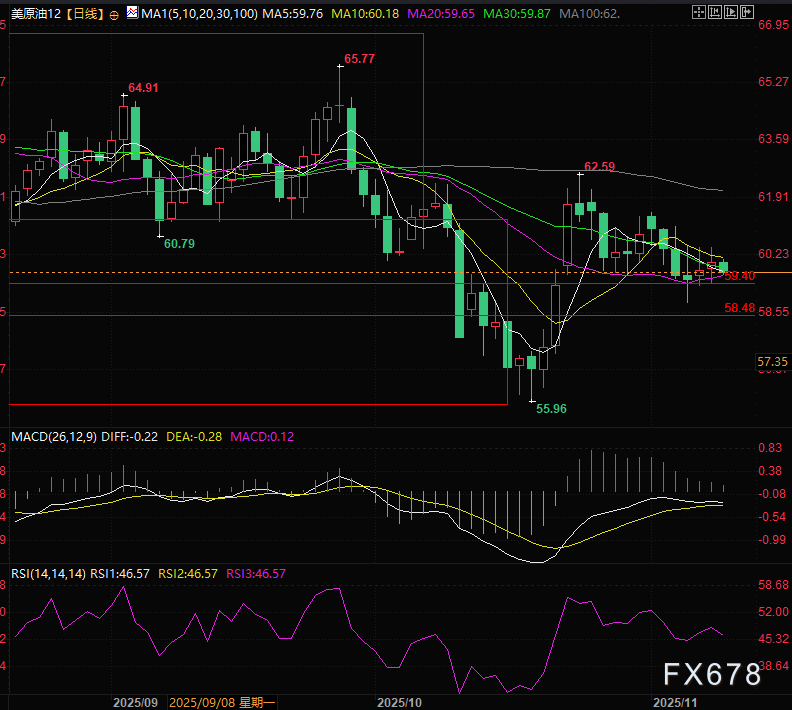
(Daily chart of U.S. crude oil futures contracts in December, source: Internet)
At 15:54 Beijing time, the US crude oil futures contract for December is now trading at $59.77 per barrel.
Please indicate the source: https://www.daoctech.com/fxoutrade/1890.html
Disclaimer: The content of this article does not represent the views of the Institute of Foreign Exchange. The content is for reference only and does not constitute investment advice. Investors operate accordingly at their own risk.