
Trade anxiety and a weaker dollar are driving up safe-haven demand, and gold prices are rising
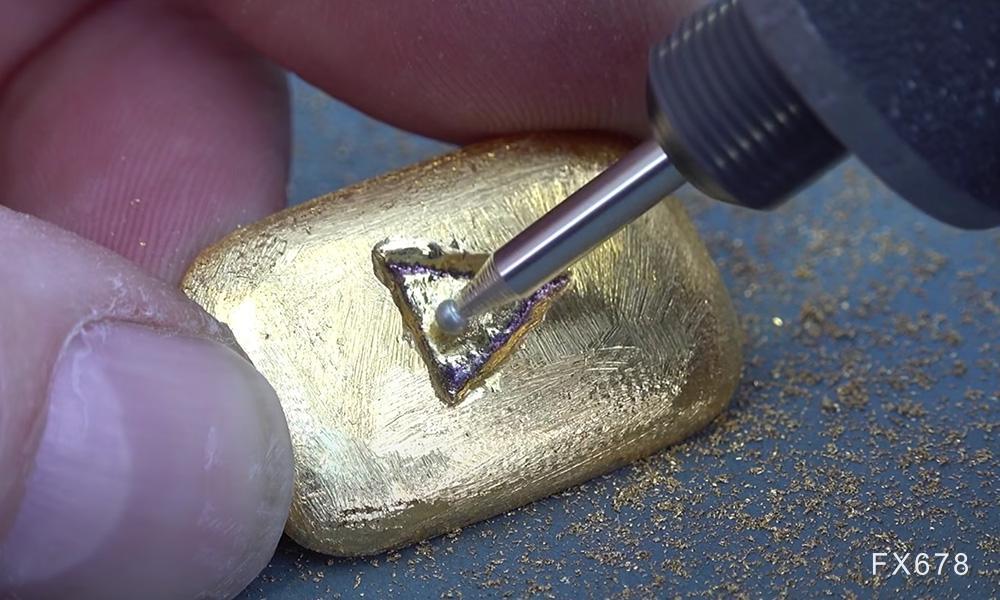
On Tuesday (July 22), fueled by trade tensions and concerns about the independence of the Federal Reserve, safe-haven demand heated up, and gold ushered in a new round of upward momentum. Gold climbed to a five-week high on Tuesday, extending Monday's rally, while benefiting from the dual boost of a weaker dollar and a decline in U.S. Treasury yields. Spot gold traded at $3,429.26 during the session, up 0.95%, with bullish momentum continuing to build up.
Trade talks and Federal Reserve independence come into focus, supporting gold's rise
Investors are wary as the chances of a deal between the European Union and the US before the August 1 deadline for a trade deal grow increasingly slim. This uncertainty, compounded by broader trade tensions between the US and its major trading partners, remains a central factor underpinning gold's safe-haven appeal. The average effective US tariff rate has surged to 22.5%, the highest level since 1909, which directly pushed the consumer price index (CPI) to 2.7% year-on-year in June, further exacerbating market concerns about inflationary pressures and the outlook for economic growth.
Another driver of market unease is the resurgence of questions about the independence of the Federal Reserve. In an interview on Monday, US Treasury Secretary Vincent Bescent said that "it may be time to look at the operation of the entire institution and its effectiveness", and proposed a review of the Fed's non-monetary policy functions, mentioning issues such as "mission creep" and cost overruns on building renovations. The current market focus is on the speech of Federal Reserve Chairperson Powell today, and investors are looking forward to his response to internal calls for interest rate cuts. Both Federal Reserve governors Waller and Bowman advocate immediate easing, believing that the inflation caused by tariffs is temporary, but the market expects a rate cut in July at only 4.7%, reflecting doubts about Powell's deviation from the current interest rate range of 4.25% to 4.50%.
When the Fed's independence from political interference, a central pillar of its credibility, is called into question, investors fear that monetary policy could be influenced by other factors rather than data, undermining confidence in the dollar.
Data showed that the dollar index (DXY) has fallen to 97.86, failing to hold the 50-day moving average of 98.60, recording a series of lower highs since April, indicating weak market sentiment. Meanwhile, the 10-year Treasury yield fell back to 4.37%, below the 50-day moving average and close to the 200-day moving average of 4.36%, indicating that investors' demand for US fixed income assets has weakened, attracting more buying for gold.
Multi-factor game, gold's upside is partially limited
While gold has traditionally benefited from economic uncertainty and risk aversion, recent developments have limited its upside. As regulatory transparency has increased, institutional interest in bitcoin has increased, and some safe-haven funds have flowed from gold to this alternative asset. At the same time, US stocks, especially technology stocks, remain attractive to investors expecting the Federal Reserve to cut interest rates. Even with high market uncertainty, the trend of these funds flowing into alternative assets still poses a resistance to gold. However, the persistence of geopolitical risks, combined with the continued purchase of gold as a reserve asset by central banks, still provides long-term support for the gold market.
Technical bullish momentum builds up, gold breaks through $3,400
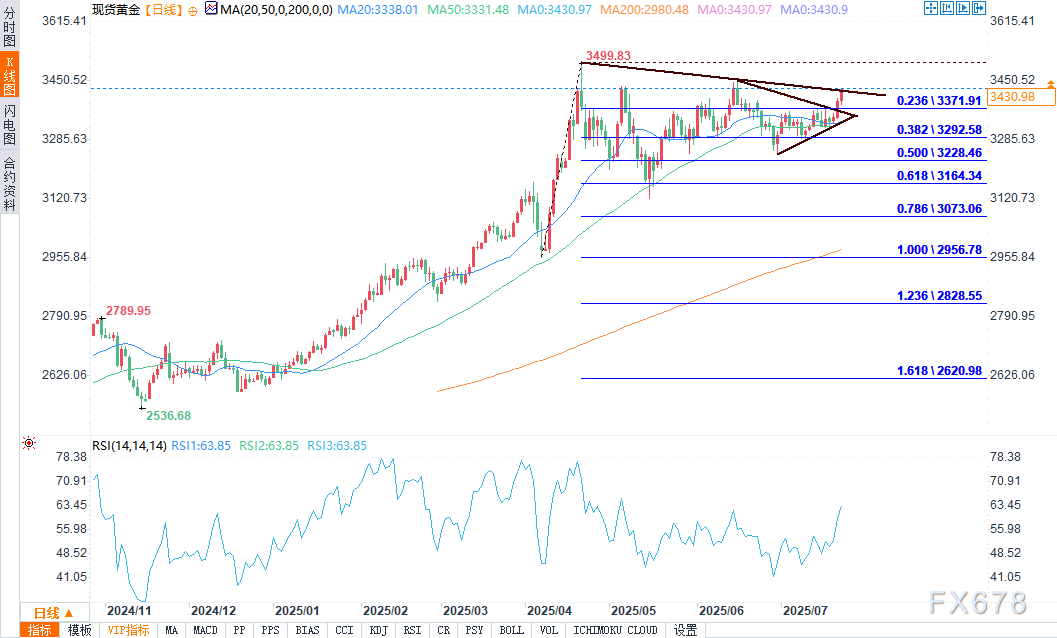
(Daily chart of spot gold, source: Yi Huitong)
From a technical perspective, gold has broken through the $3,400 resistance level, confirming a breakout of the symmetrical triangle pattern that has formed in recent weeks. Both price action and the Relative Strength Index (RSI) show bullish momentum to support this breakout - the RSI is currently near 63, indicating that there is still room for upside before entering the overbought range. Gold currently maintains a strong bullish structure, with key support levels between $3,331 and $3,310.
The price has firmly stood above the 23.6% Fibonacci retracement ($3,372) of the April low-to-high gain, with the next resistance at the June 16 high of $3,452, followed by the April record high of $3,500. A sustained break above $3,451.53 would point directly to the all-time high of $3,500.20, especially with Powell's dovish remarks; even if Powell remains neutral or cautious, divisions within the Federal Reserve could continue to weigh on the dollar, providing support for gold.
On the downside, spot support is located near the breakout level of $3,400, followed by the 50-day moving average of $3,331; if it falls below this level, the 38.2% Fibonacci retracement level of $3,292 could become the focus.
Overall, the breakout signals renewed bullish interest in gold, which needs to be confirmed with a daily closing price above $3,400. Ahead of the August 1 trade tariff deadline, rising risk premia is compounded by global economic and geopolitical uncertainty. Gold price forecasts remain bullish, with technical and fundamental support.
Please indicate the source: https://www.daoctech.com/fxoutrade/2016.html
Disclaimer: The content of this article does not represent the views of the Institute of Foreign Exchange. The content is for reference only and does not constitute investment advice. Investors operate accordingly at their own risk.