
Gold prices rose above $5,000, with a weaker dollar, safe-haven demand, and U.S. economic data in focus
On Monday (February 9), the international gold price rebounded strongly in the US market, regaining its footing and breaking through the key psychological barrier of $5,000. This round of gains was mainly driven by the weakness of the US dollar, continued safe-haven buying, and market expectations for the US's blockbuster economic data. This is both a continuation of last Friday's rally and highlights the strong resilience of gold in the global uncertainty environment.
In U.S. trading, spot gold rose 2.1% to $5,055.67/ounce, or 1.94%. It continued to rise on the basis of a 4% increase in the previous trading day. U.S. April gold futures rose 2.01% to $5,079.8/ounce, with an intraday high approaching $5,100. At the beginning of this month, gold prices briefly fell back to around $4,800, but then received strong support, which is also in line with the market's expectations of buying dips. At the same time, the U.S. dollar index fell 0.8%, hitting a new low in more than a week, making dollar-denominated gold more attractive to international buyers, further boosting the upward momentum of gold prices. Spot silver also rose 6.32% at $82.405/ounce.
Core driving factors: multiple positive resonances support gold prices
Analysts pointed out that the weakness of the dollar is closely related to the market's expectations of a slowdown in US economic data (especially the labor market), which may further strengthen the market's bet on the Federal Reserve to cut interest rates. There are multiple fundamental supports behind the current round of gold prices. Although there is no "super hot spot" in geopolitics, the underlying global tensions, including continued regional conflicts and unresolved trade uncertainties, may escalate at any time, which also keeps the demand for safe havens at a high level. Coupled with the recent rise in oil prices and the weakening of the dollar, the precious metals sector as a whole has been significantly boosted. The continued purchase of gold by central banks has also provided important support for gold prices. The People's Bank of China has increased its holdings of gold for the 15th consecutive month in January. This move also signals that institutional demand for gold remains strong amid concerns about currency depreciation. Analysts generally believe that the global debt problem and the loose monetary policies pursued by major central banks are the core long-term factors supporting the long-term strength of gold prices.
Market Focus: US Economic Data and Federal Reserve Policy Developments
The current market focus has turned to the US economic data released one after another this week. Affected by the partial shutdown of the government, these data have been slightly delayed. Among them, the January non-farm payrolls data released on Wednesday is expected to increase by only 70,000 people, the unemployment rate will remain at 4.4%, and the consumer price index (CPI) on Friday may show that inflation continues to cool. Core inflation is even expected to record the slowest year-on-year growth rate since the beginning of 2021. In addition, a number of important economic indicators such as the number of initial jobless claims and retail sales will also be released intensively. The current market has priced in advance that the Federal Reserve will implement at least two 25 basis point interest rate cuts in 2026, and the expected increase in interest rate cuts will undoubtedly reduce the opportunity cost of holding interest-free gold, further benefiting the price of gold.
U.S. Treasury Secretary Vincent Bescent attributed the recent volatility in gold prices to speculation in the Chinese market, saying that Chinese regulators are tightening margin requirements for "irrational transactions" in the local market to regulate market order. Data from the U.S. Commodity Futures Trading Commission (CFTC) also showed that hedge funds cut their net long positions in gold by 23% to 93,438 lots in the week ended February 3, the lowest level in 15 weeks. This change means that after the gold price broke through the all-time high of $5,600 in January, some funds have chosen to take profits and lock in profits. At the same time, Chinese regulators have also advised domestic Financial Institutions Groups to reduce their holdings of US Treasury bonds to reduce the risk of concentration in asset allocation, which also indirectly benefits gold and further enhances its attractiveness as a diversified asset.
Institutional Perspectives and Technical Perspectives
TD Securities' Bart Melek stressed that the trend of the US dollar is the main driver of the current round of gold prices, while geopolitical risks and China's continued gold purchases provide continued bullish support for gold prices; Mitsubishi UFG's Kim Xiuzhen pointed out that the current market focus has gradually shifted to US employment data, inflation data and Federal Reserve policy trends, which will directly affect the market sentiment in the precious metals market.
From a technical perspective, the price of gold has now firmly established itself at the key level of $5,000, and the short-term decline to the range around $4,800 is still regarded as a rare buying opportunity by the market. If it can successfully break through the pressure level of $5,100 in the future, the next target will be $5,400. In the medium and long term, the price of gold is even expected to challenge the historical high near $5,600 again.
However, analysts also cautioned that a sharp pullback of about $300 is still possible, and while this pullback will not change the overall upward trend, investors still need to be cautious and avoid overshooting. From a short-term trading perspective, the 5-minute gold chart shows that the current gold price support is in the range of $4,950 to $5,000, and the pressure level is in the range of $5,050 to $5,100.
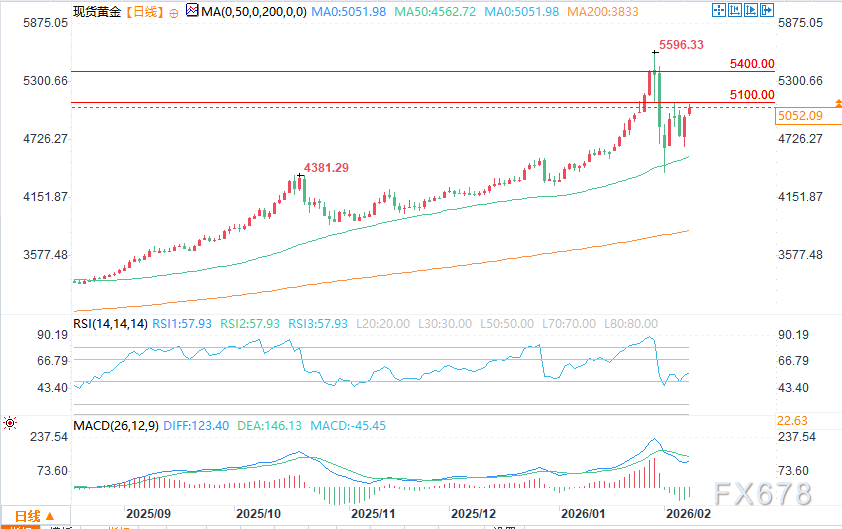
(Daily chart of spot gold, source: Internet)
The outlook for gold prices among major institutions is generally optimistic. Wells Fargo forecasts that the price of gold is expected to reach $6,100 to $6,300 by the end of the year, driven by institutional purchases and interest rate cuts. RoboForex believes that gold prices may enter the consolidation stage near $5,050 in the short term. InstaForex offers specific trading suggestions, suggesting that investors place multiple orders above $4,928, targeting $5,351.
Related precious metals performance and outlook
In addition to gold, other related precious metals also performed well, among which spot silver rose particularly prominent, following Friday's surge of nearly 10%, this Monday rose 6.32% again, at $82.405/ounce, which hit a record high of $121.64 on January 29; platinum and palladium also rose simultaneously, platinum rose 1.2%, reported 2120.62 dollars/ounce, palladium rose 1.7%, reported 1734.72 dollars/ounce.
Although the popularity of electric vehicles may depress demand for catalytic metals such as platinum and palladium in the long run, WisdomTree analysts pointed out that the current expectation of a slowdown in electric vehicle sales has not materialized, which may limit the growth of such metals in the short term. Heraeus analysts observed that the current gold and silver have entered a high volatility range, which is more similar to speculative assets than pure safe-haven assets, which also means that investors need to pay more attention to market volatility risks in the process of trading.
Overall, the upward trend of gold prices is still intact, supported by the central bank's continued gold purchases, geopolitical hedging demand, and loose policy expectations, and there is still room for further gains in the market outlook. However, it should be noted that the US economic data released this week may trigger short-term fluctuations in gold prices. If the employment and inflation data weaken, it may accelerate the rise in gold prices. If the data strengthen beyond expectations, it may trigger a short-term correction in gold prices. In the long run, the target of gold prices breaking through $6,000 reflects the structural bullish sentiment of the market, and $5,000 will become a key support for the follow-up trend of gold prices. For investors with layout needs, there is still a good opportunity for gold prices to recover.
Please indicate the source: https://www.daoctech.com/fxoutrade/2120.html
Disclaimer: The content of this article does not represent the views of the Institute of Foreign Exchange. The content is for reference only and does not constitute investment advice. Investors operate accordingly at their own risk.