
The US economy has survived the government shutdown, but it is not optimistic. How long can the Federal Reserve catch the "life straw"?
The United States faces a tough job market and persistent inflation. The National Gallery of Art in Washington put up signs to welcome visitors after the federal government reopened.
The US economy did not get any better during the longest government shutdown in history, but it may not have gotten any worse either. That is the prevailing view among Wall Street economists, who rely on the limited information available, most notably state statistics on weekly claims for unemployment benefits.

Initial jobless claims have remained low throughout the 43-day government shutdown. Economists estimate that initial jobless claims totaled 218,000 in the last week before the Oct. 1 shutdown, and the latest week's tally was only slightly higher at 228,000.
Oren Krachkin, economist at financial Marekt, the national insurer, said: "It is encouraging that we do not see significant volatility in the US economy since the government shutdown in early October."
Of course, the final conclusion will have to wait for economists to carefully comb through the various delayed reports on employment, retail sales, consumer spending and other issues that will be released in the coming month. The prolonged shutdown created a kind of data "black hole" between October and mid-November. During the government shutdown, economists had to rely on a large number of private reports to piece together the whole picture of the economy. The only official data came from state unemployment claims reports.
While weekly unemployment reports are compiled by the federal Bureau of Labor Statistics, they are also released simultaneously by state, allowing economists to make their own calculations. "The latest unemployment benefit data continue to show no sharp deterioration in the labor market," economists at Citibank said in a note to clients.
The job market is surging
Low job losses are critical to the five-year expansion of the US economy. Despite the recent recovery, unemployment remains well below historical norms - it was as low as 4.3 per cent before the shutdown.
However, hiring has come to a near standstill since the spring, making it significantly harder to find jobs. But as long as unemployment remains low, Americans should have enough confidence to keep spending and breathe life into the economy.
But that does not mean there are no warning signs. Large companies, most recently Verizon, have announced large-scale layoffs, although so far there have been no significant fluctuations in the unemployment claims data.
Jeffrey Schmid, president of the Kansas City Fed, noted: "The labour market has indeed cooled, but to some extent this cooling reflects important structural changes in the labour market rather than a cyclical downturn in the economy."
The slowdown in hiring is partly due to the continued retirement of baby boomers and a sharp drop in immigration, according to Schmid's analysis. "The shrinking size of the workforce has led to both fewer new jobs and fewer unemployed people seeking employment."
A weak labor market remains a concern, however, and will need to be watched more closely as the year draws to a close. Another big threat to the economy is persistent inflationary pressures.
Inflationary pressures remain high
Inflationary pressures had begun to subside by this spring, but President Donald Trump raised U.S. tariffs to their highest level in decades, and the current annualized inflation rate remains at 3%, which is not only significantly higher than the Federal Reserve's 2% policy target, but also nearly double the average annual inflation rate between 2010 and 2019.
Private sector reports show limited price volatility during the shutdown, but the data are far less comprehensive than official inflation measures, mainly consumer prices and personal consumption expenditures. Economists and business leaders point out that even if the private sector data are accurate, the full impact of tariffs on inflation may not yet be fully apparent.
Persistent inflation could prompt the Federal Reserve to leave interest rates on hold at its December meeting, with expectations that the Fed will hold off next month following the end of the government shutdown triggering a sharp sell-off in equities this week.
The twin pressures of a tightening job market and high inflation are having a real impact on the economy. Low- and middle-income groups are under heavier financial pressure, forced to cut spending, increase debt, or overdue credit card payments on car loans. But overall consumer spending, the economy's main engine, remains solid, thanks to rising wealth among high-income households in a sustained bull market.
Despite the "two-speed" divergence, the US economy continues to grow - but any prolonged weakness on Wall Street could endanger the current economic situation.
Analysis of the potential impact on the dollar
In the short term, the hawkish monetary policy expectations brought about by the stickiness of inflation will continue to support the dollar, but the pressure on the medium term is accumulating, and the trend of the dollar may depend on the game between the two forces of "inflation resilience" and "economic slowdown".
On Monday (November 17), the US dollar index continued its gains in the previous trading day, edging up 0.08% to around 99.35.
It is recommended to pay close attention to the delayed data on employment and retail sales that will be released in the coming month, which will fill the information gap during the government shutdown and provide clearer guidance for judging the direction of the dollar.
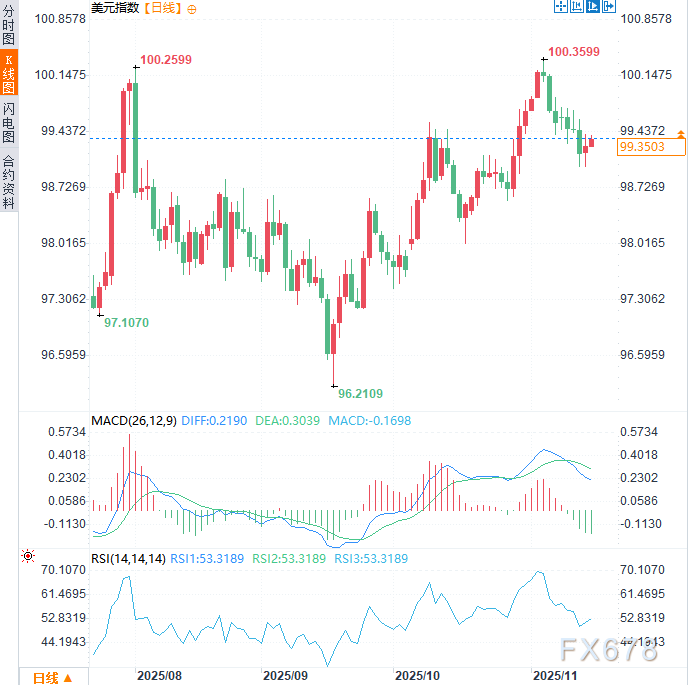
(Dollar index daily chart, source: Internet)
At 9:51 Beijing time, the dollar index was trading at 99.36.
Please indicate the source: https://www.daoctech.com/fxoutrade/2136.html
Disclaimer: The content of this article does not represent the views of the Institute of Foreign Exchange. The content is for reference only and does not constitute investment advice. Investors operate accordingly at their own risk.